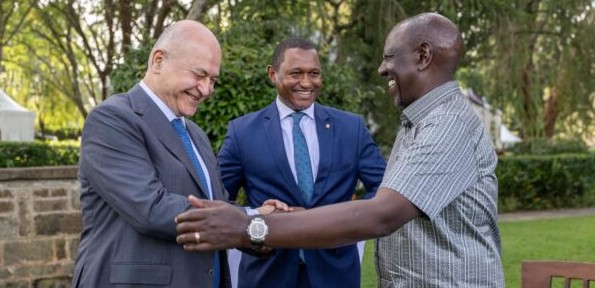
The United Nations (UN) has called on the international community to urgently increase financial and development support for Kenya as the country struggles to sustain one of the world’s largest refugee populations amid a worsening global funding crisis.
Speaking after visiting Kakuma refugee camp on Sunday, January 11, 2026, United Nations High Commissioner for Refugees (UNHCR) Barham Salih praised Kenya’s refugee policies and appealed to donors, development agencies and international partners to scale up their assistance.
He warned that shrinking global contributions are placing immense pressure on countries like Kenya that continue to shoulder major humanitarian responsibilities.
“I saw how refugees have access to healthcare, education, and play an active part in society, benefiting the whole community. This is how we move from aid dependency to self-reliance. Kenya is doing its part. It needs greater international support,” he wrote on X.
“This is something that we need to support and engage with. The international community, development agencies, the World Bank and others really need to engage in making sure that this notion of shared development is one way to include refugees in national life.”
The appeal comes at a difficult moment for the global humanitarian system. Major donors, including the United States, the United Kingdom and Germany, have sharply reduced funding, forcing UNHCR to cut nearly 30 per cent of its global staffing costs.
As a result, the agency has closed offices and laid off more than 3,500 permanent staff, alongside hundreds of temporary workers.
UNHCR says the cuts have had serious human consequences, affecting the health and well-being of 12.8 million displaced people worldwide, including 6.3 million children who rely on the agency for primary healthcare and related services.
In Kenya, more than 800,000 refugees have been impacted by the funding shortfall. The country has long been recognised as a welcoming and relatively stable refuge in a volatile region.
For more than four decades, Kenya has hosted people fleeing war, political unrest and humanitarian crises in neighbouring countries. Working closely with UNHCR, it has provided safety and protection to hundreds of thousands of displaced people.
As of January 2026, Kenya is hosting more than 800,000 refugees and asylum seekers. Kakuma refugee camp alone is home to over 300,000 people, while the Dadaab refugee complex hosts nearly 406,000.
Meeting the needs of these populations—ranging from education and healthcare to shelter and security—requires resources that far exceed Kenya’s national capacity.
President William Ruto has repeatedly defended Kenya’s refugee policy, saying it is grounded in humanity and shared responsibility. He has emphasised that Kenya has offered refugees comfort, a home away from home and a stable environment, even as it grapples with its own economic and social challenges.
“Kenya is renowned as a welcoming, secure nation that has played host to tens of thousands of refugees and immigrants over the decades. For the past 40 years, the Government of Kenya has worked closely with the United Nations High Commissioner for Refugees in supporting refugees from neighbouring countries fleeing war, conflict and instability. Kenya has given them comfort, a home away from home, and a stable environment,” he wrote on X.
Ruto has argued that refugees should not be seen as a burden, but as people with the potential to contribute meaningfully to society if given adequate support.
That vision is reflected in the Shirika Plan, launched in 2025, which aims to move refugees away from dependency-based camp systems and integrate them into host communities.
The plan promotes self-reliant settlements, access to livelihoods and broader socio-economic inclusion for both refugees and local populations.
“Last year, Kenya launched the Shirika Plan that aims at integrating refugees in local communities. The plan promotes self-reliant settlements and socio-economic inclusion for both refugees and host communities, moving refugees from dependency to self-reliance,” Ruto stated.
However, both the UN and the Kenyan government have cautioned that the success of the Shirika Plan hinges on sustained international support.
Without adequate funding and long-term development backing, they warn, the promise of refugee integration and shared prosperity could be severely undermined.