The next morning, we met our local driver and guide: Baluku. A walking encyclopedia on the country, its cultures, languages, evolving social norms and, importantly, the wildlife we would see along the way. I instantly knew we were in safe hands, but we could not have anticipated the value that Baluku would add to our experience through his storytelling and thoughtful answers to our endless questions about the scenes taking place around us.
Exploring Uganda. Photo / Beks Lockie
We jumped in the Land Cruiser that would transport us along bumpy unpaved roads and on game drives for the remainder of the trip; by mid-afternoon, we had made it to Kibale National Forest. While settling into our thatched jungle cottage, greeted almost instantly by families of curious colobus monkeys and baboons, we couldn’t help but acknowledge the dramatic contrast from the sensory overload of the capital.
Perhaps the most unique feature of a trip to Uganda is the opportunity to encounter primates in the wild. Uganda has the highest density and diversity of primates in Africa, after all. The Kibale National Forest has a population of habituated chimpanzees (being chimps living in their natural habitat that have become accustomed to humans through research and conservation efforts without significantly altering their natural behaviours). Chimpanzee tracking allows visitors to observe the troops at a safe distance, in an experience carefully managed by trackers and rangers for the safety of both humans and chimps.
Elephant sighting. Photo / Beks Lockie
We arrived at the park entrance and met the rangers for a briefing and important safety information: don’t mimic the chimpanzees because their vocalisations all have meanings and you don’t want to accidentally say the wrong thing. Then we started our trek towards where the trackers had found chimpanzee families that morning. No sighting is ever guaranteed, but after a gentle hike through the forest for 40 minutes, we came face-to-face with an energetic troop of chimpanzees: eating, playing, grooming and mating right in front of us in what must be one of the most invigorating wildlife experiences you can have.
Chimpanzee in the wild. Photo / Getty Images
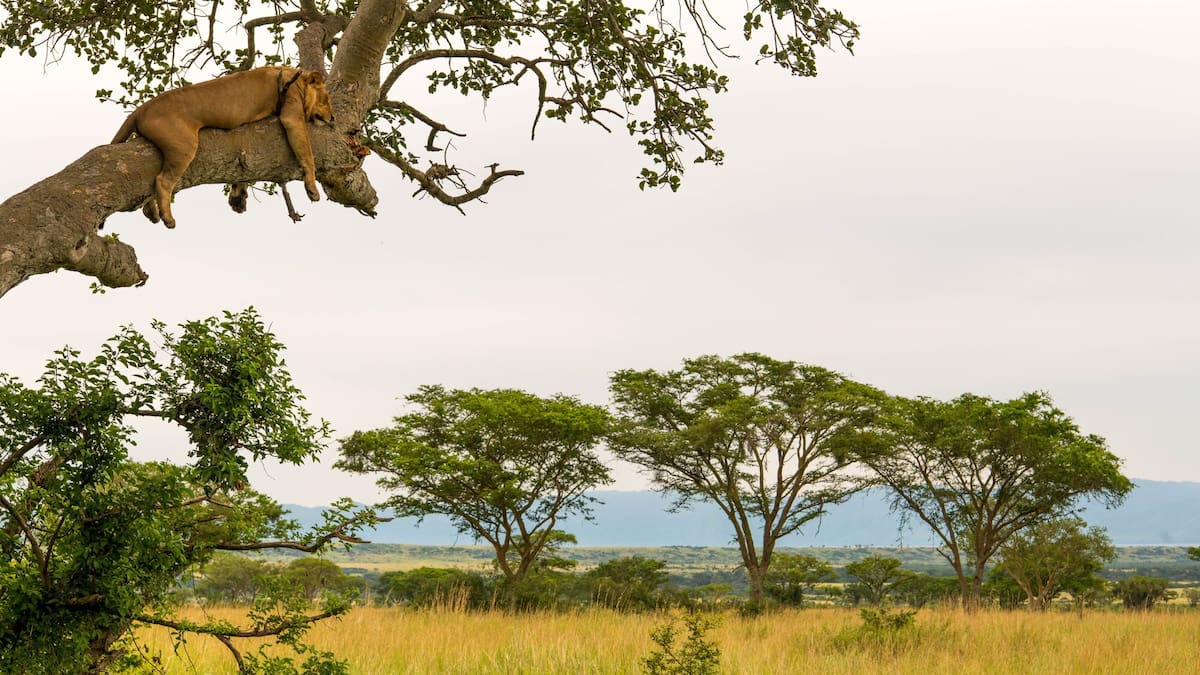
On the winding drive south, the jungle gives way to tea plantations and then nearly 2000km of African savannah as you enter Queen Elizabeth National Park. This park offers that quintessential African safari experience, with regular sightings of elephants, water buffalo and warthogs. Every journey is a game drive here. But you’ll also find two incredible sights that you won’t see elsewhere. First, the highest density of hippos anywhere in the world in the Kazinga Channel. We saw hippos in their thousands bathing next to elephants and, most surprisingly, living side-by-side with local fishing villages. A boat cruise on the channel is the best way to appreciate the extent of this hippo population. Second, tree-climbing lions draping across branches of fig trees to cool off or scout for prey in the park’s southern Ishasha sector. A rare phenomenon elsewhere in Africa, but we were fortunate to spot the majestic tree-climbing prides twice.
Bwindi Impenetrable Forest is home to mountain gorillas, offering one of the most sought-after wildlife encounters on Earth. Photo / Getty Images
The wildlife experience that put Uganda on the map for many tourists (including me) is the opportunity to hike to the mountain gorillas. The Bwindi Impenetrable Forest has a population of habituated mountain gorillas but, unlike the chimpanzees that are loud and energetic, the mountain gorillas are more likely to be calm and curious when visited by humans. The trackers start early to find known families of gorillas. Not a straightforward task as the gorillas sleep somewhere new each night and the bush is dense, steep and full of other wild animals that can interfere with their efforts.
Trekking. Photo / Beks Lockie
Once located, machete-wielding rangers cleared the path ahead of us as we set off, ready to hike whatever distance and on whatever terrain was required. We soon learned that the troop we were aiming for crossed paths with some jungle elephants, making their prints difficult to track. When the trackers found them again, they had engaged in a power struggle with some unhabituated gorillas and it would not be safe to visit – there are never any guarantees in nature. Fortunately, another family of 17 gorillas (including one imposing silverback and nine babies) were identified nearby, feeding, grooming and playing right on the trail as though they were waiting for us. A truly breathtaking scene to witness and a lesson in expecting the unexpected from the wilderness.
Uganda’s serene mountain views. Photo / Beks Lockie
After all that action, we headed to picture-perfect Lake Bunyonyi and perched on its edge at Birdnest Resort, the ideal viewpoint for a magnificent sunset flanked by volcano peaks. As a tranquil destination loved by honeymooners and domestic tourists in search of relaxation, I thought the wildlife portion of the trip had come to an end. However, the impeccably still waters dotted with islands are also home to abundant birdlife, including Uganda’s national bird, the crested crane, with its striking yellow crown. A remarkable sight even for the most hesitant birder.
Uganda is an incredibly underrated destination for a safari holiday. The most obvious drawcard is the unmatched access to wildlife. But the changing landscapes and everyday scenes that you’ll see along the journey really make the experience truly unforgettable.
The writer travelled at their own expense.