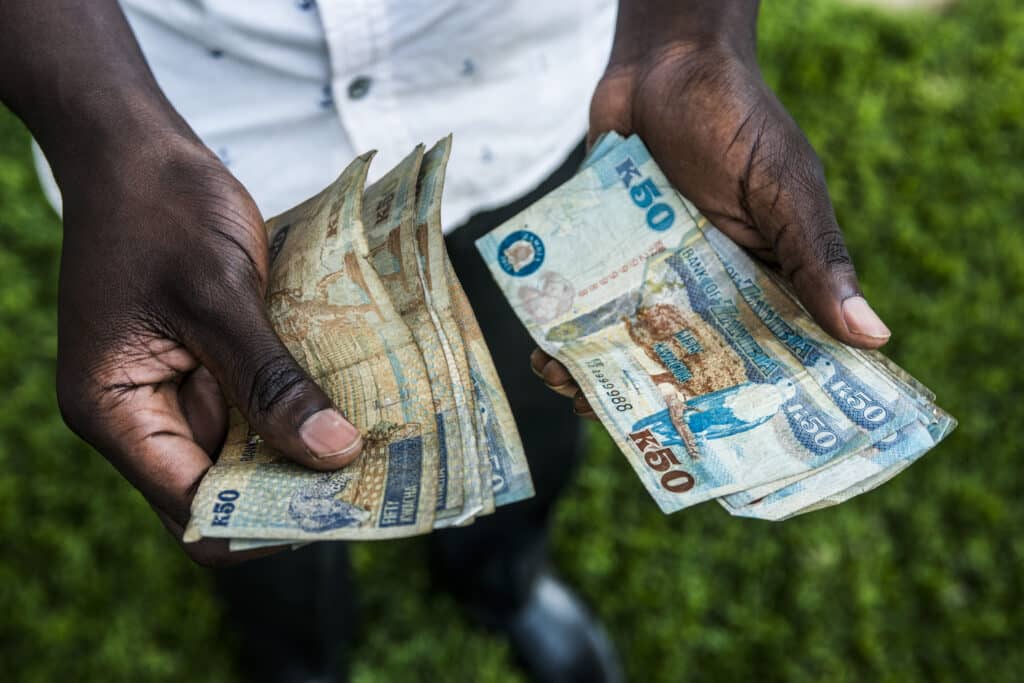
Zambia’s external debt rose to $16 billion (ZMW 311.26 billion) in the third quarter of 2025, up from $15.3 billion (about ZMW 297.64 billion) a year earlier, reflecting a 4.5% or $700 million ( ZMW 13.62 billion) increase as the southern African nation deepened its reliance on concessional financing.
Data from the Ministry of Finance and Budget Planning shows that multilateral credit grew from $4.8 billion (ZMW 93.38 billion) in Q3 2024 to $5.4 billion (around ZMW 105.05 billion) in 2025, accounting for the bulk of total obligations.
The uptick came as Zambia’s access to international financial markets remained constrained following its 2020 sovereign debt default.
Still, bilateral loans rose from $3.9 billion ( ZMW 75.87 billion) to $4.2 billion ( ZMW 81.71 billion), while plurilateral loans increased from $851 million (around ZMW 16.55 billion) to $888 million (ZMW 17.27 billion), as authorities stepped up debt negotiations with foreign creditors.
By contrast, commercial credit growth remained muted at $2.8 billion (about ZMW 54.47 billion) as Eurobond debt fell from $2.8 billion (ZMW 54.47 billion) to $2.5 billion (around ZMW 48.64 billion) during the period.
Zambia’s growing reliance on bailouts from multilateral lenders is further underpinned by revenue shortfalls, rising debt costs and widening spending gaps.
These concessional loans provide fiscal relief for struggling economies through lower interest rates and longer repayment periods.
IMF loans and debt restructuring
The International Monetary Fund remains one of Zambia’s largest multilateral partners, with total disbursements on record exceeding $3.5 billion (about ZMW 68.09 billion) as of July 2025.
The bulk of that support came in 2022, when Zambia secured a 38-month Extended Credit Facility worth about $1.3 billion (roughly ZMW 25.29 billion), the largest IMF programme in the country’s history. The financing, released in tranches, was aimed at stabilising the economy and backing fiscal and structural reforms after years of mounting debt distress.
Leverage how money moves in Africa
Get exclusive insights across banking, payments, and technology to gain a competitive advantage in Africa’s financial sector.
Those pressures culminated in a sovereign default in 2020, when the government missed a $42.5 million (around ZMW 826 million) Eurobond payment, becoming the first African country to default during the COVID-19 pandemic.
Under the IMF programme, Lusaka committed to restructuring its external debt under the G20 Common Framework, a key condition for continued disbursements. By November 2025, Zambia had reached restructuring agreements covering about 94% of its $13.3 billion (approximately ZMW 258.74 billion) external debt and unlocked more than $1.6 billion (around ZMW 31.13 billion) in IMF funding under its current ECF programme.
At the same time, Fitch and S&P upgraded the country’s long-term foreign-currency rating from “Restricted Default” and “Selected Default”, respectively, to “Stable”, marking the nation’s first upgrade since 2020.
Signs of stability
Zambia’s economy is showing early signs of stabilisation, amid rising multilateral inflows and a gradual return of investor confidence.
Inflation eased sharply in 2025, helped by a recovery in agricultural output after one of the worst droughts in a century hit the copper-producing nation the previous year. Consumer prices fell to 11.7% last month from a peak of 16.7% in December 2024, easing pressure on households and policymakers alike.
The Washington-based lender expects the disinflation trend to continue, projecting headline inflation to converge gradually toward the Bank of Zambia’s 6–8% target band by 2027.
External buffers have also strengthened. The kwacha gained about 19% against the US dollar between May and June 2025, reversing part of the roughly 50% depreciation recorded in 2020, as foreign currency inflows improved.
International reserves rose by $457.2 million (about ZMW 8.89 billion) to $5.2 billion (roughly ZMW 101.15 billion) at the end of September, equivalent to 5.2 months of import cover, up from 4.7 months in June. The build-up was supported by inflows from the IMF and World Bank, according to official data.
Domestic pressures persist
Despite these improvements, fiscal pressures remain as domestic revenue continues to fall short of government targets, constraining public spending and widening financing gaps.
An analysis of quarterly collections by Finance in Africa shows that government revenue totalled $131.8 billion (about ZMW 2.56 trillion) in the first nine months of 2025, missing its $136.7 billion (around ZMW 2.66 trillion) target by about $5 billion (roughly ZMW 97.3 billion).
The underperformance was driven largely by weaker-than-expected tax receipts, even as global copper prices surged. Copper is Zambia’s largest export and contributes roughly 40% of government revenue, highlighting the economy’s narrow revenue base. The gap also reflects weak tax efficiency outside the mining sector as the economy struggles with high poverty levels.
Shortfalls on the revenue side fed directly into spending cuts. According to the Ministry of Finance’s latest Debt Statistical Bulletin, government expenditure undershot targets throughout the year, with third-quarter spending at $55.6 billion (about ZMW 1.08 trillion) versus a prorated $62.9 billion (roughly ZMW 1.22 trillion), squeezing allocations to key sectors.
It is against this backdrop that Zambia is seeking a new IMF credit programme when the current facility expires later this month. Finance Minister Situmbeko Musokotwane said the aim is to pivot from stabilisation to growth.
“The policy priority is not to pursue a one-year extension of the current IMF-supported arrangement, but to deliberately transition towards a growth-focused agenda that accelerates investment, supports job creation and expands the productive capacity of the Zambian economy,” Musokotwane said in a statement last week.
The request comes as the IMF prepares to disburse $190 million (around ZMW 3.70 billion), subject to board approval.
Fiscal discipline remains key to recovery
With Zambia still assessed to be at high risk of debt distress, maintaining fiscal discipline and containing new debt will be critical to sustaining its recovery.
Analysts view continued access to cheaper multilateral financing as necessary in the near term, but caution that borrowing alone will not deliver durable growth. They argue that the government must use the breathing space created by concessional loans to broaden the revenue base, reduce reliance on copper, and limit exposure to global commodity price swings.
The IMF has echoed the importance of reform continuity. It says that if the government remains on its current policy path, economic growth could average about 5.6% between 2026 and 2031, supported by higher investment, improved electricity generation and stronger agricultural output.