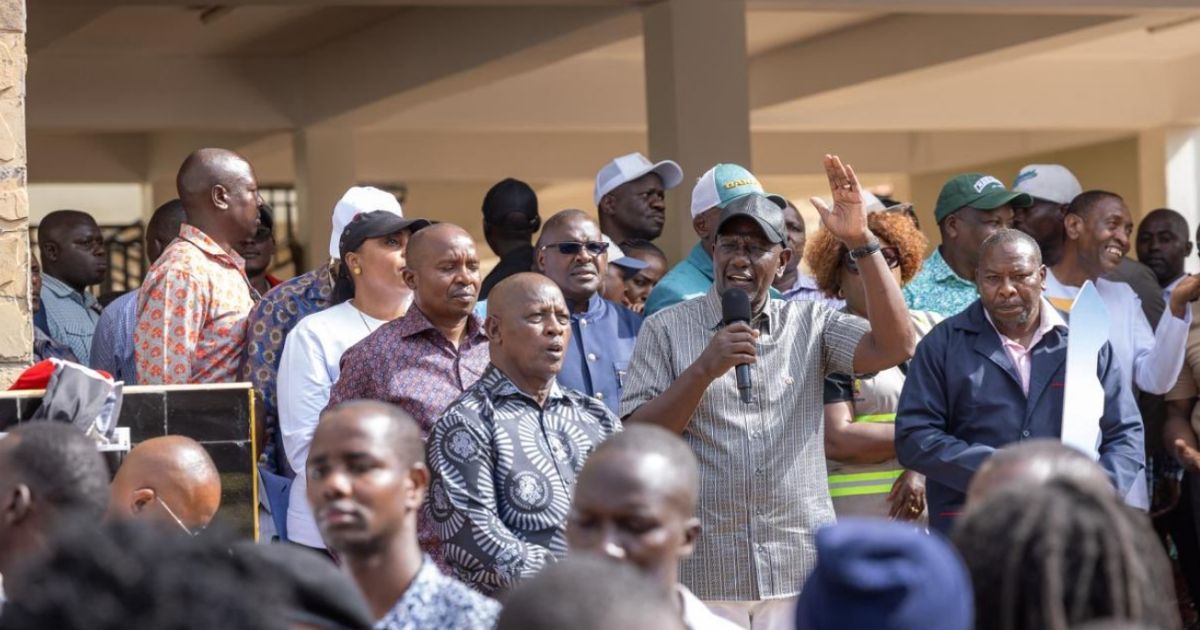
Kenya, January 12 2026 – President William Ruto on Monday took aim at his political critics, using the launch of a major youth empowerment programme in Nyeri to defend his administration’s record and challenge opponents to offer credible alternatives.
Speaking at the disbursement of Sh173.2 million to 6,982 young entrepreneurs under the National Youth Opportunities Towards Advancement (NYOTA) programme, the President accused some leaders of belittling government initiatives for political gain while doing little themselves to uplift the youth.
Those dismissing the Sh50,000 start-up capital as insignificant, he said, were out of touch with the realities facing ordinary Kenyans.
“If you think Sh50,000 is little money, it is little to you and your family because you are rich. With Sh50,000 you can begin a business,” President Ruto said, in remarks widely seen as directed at sections of the Opposition that have criticized the programme.
The President was speaking at the Kabiru-ini ASK Show Grounds in Nyeri Town, in the heart of the vote-rich Mount Kenya region, where his administration is seeking to shore up political support amid growing opposition agitation.
Flanked by Deputy President Kithure Kindiki, Governors Mutahi Kahiga (Nyeri) and Kiarie Badilisha (Nyandarua), and a host of Cabinet secretaries and MPs, Ruto used the occasion to draw a sharp political contrast between what he described as “talk and drama” and what he called “practical empowerment”.
He said the NYOTA programme, which targets 820,000 young people nationally, was proof that his government was focused on tangible results rather than rhetoric.
The programme covers four pillars — business financing, recognition of prior learning, training and mentorship, and savings.
“Those who are making noise have no better ideas and have not empowered the youth in all the years they have been in leadership,” he said, warning against turning development programmes into political footballs.
Beyond NYOTA, the President highlighted flagship projects such as affordable housing, digital jobs and labour export as part of what he termed a deliberate strategy to lock young people into the economy.