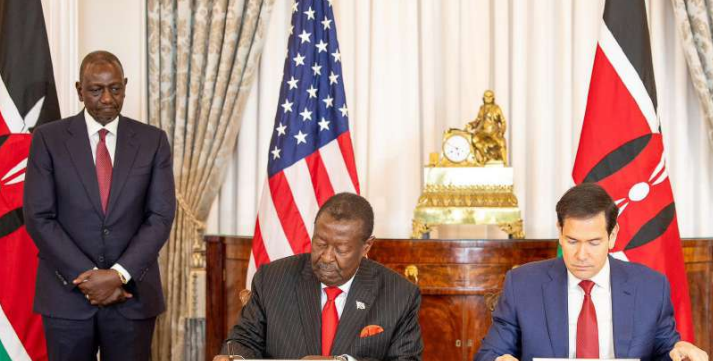
 President William Ruto watches as Foreign Affairs CS Musalia Mudavadi and Secretary of State Marco Rubio sign the Kenya–US Health Cooperation Framework on December 4, 2025, in Washington, US /PCS
Kenya will participate in renewed World Health Organization negotiations on global pathogen data sharing at the end of this month, even as it advances its new bilateral health agreement with the United States, which critics warn could weaken the WHO system.
The talks, set for 20–22 January in Geneva, are aimed at finalising the Pathogen Access and Benefit-Sharing (PABS) system, which is meant to govern how countries share dangerous pathogens and how they benefit from the vaccines, diagnostics and treatments developed from them.
Kenya’s participation places it at the centre of a growing global tension: whether countries should rely on a single, rules-based global framework or pursue bilateral deals that offer immediate funding but raise concerns about fairness, sovereignty and long-term equity.
In a statement issued after the latest round of negotiations, the WHO said member states had agreed to reconvene early because of the urgency involved.
“Member states requested the establishment of a PABS platform to operate as a global system to share pathogens and their genetic information, along with the benefits that arise from their use, in a timely, fair and transparent way,” the WHO said.
“This would pave the way for a more effective and equitable response to the next pandemic.”
The renewed WHO talks come a month after Kenya signed a five-year, $1.6 billion (Sh207 billion) health agreement with the United States, replacing funding that previously flowed through Usaid and Pepfar.
The deal commits Kenya to share pathogen data with the US within one day of any discovery.
This has raised concerns among health policy experts about how pathogen data and genetic sequence information could be shared outside the WHO framework.
President William Ruto said the agreement would strengthen Kenya’s health system and improve preparedness.
“This facility will also boost disease surveillance and emergency preparedness,” he said at the signing ceremony in December.
Amref Health Africa group CEO Githinji Gitahi warned that bilateral agreements risk undermining collective global efforts.
“Even without physical specimens, pathogen sequence data alone can enable the development of vaccines, diagnostics, or therapeutics,” Gitahi said.
“If American institutions use Kenyan pathogen data to develop high-value products, what benefits are guaranteed to flow back to Kenya? The agreement is silent.”
He noted that Kenya has strong domestic access and benefit-sharing laws but warned that these protections require active enforcement.
“The agreement leaves benefit-sharing to future negotiation with no timeline,” Gitahi wrote in an opinion.
“If Kenya ends up giving away its biological resources without fair compensation, it establishes a terrible template.”
These concerns mirror wider unease among African countries involved in the WHO talks. Many argue that without a strong global PABS system, poorer countries risk repeating the Covid-19 experience, when they shared data quickly but waited longest for vaccines.
The WHO has said informal dialogues with industry, laboratories and data platforms will continue ahead of the January session, with a fifth round of negotiations scheduled for 9–14 February.
Broadly, the Kenya–United States deal is about replacing the health funding previously channelled through the now-defunct Usaid system.
The deal, signed by US Secretary of State Anthony Blinken and Prime Cabinet Secretary Musalia Mudavadi, commits the United States to provide up to $1.6 billion (Sh207 billion) over five years, from April 2025.
In return, Kenya must raise about $850 million in domestic resources over the same period.
Kenya will receive a large portion of the Sh207 billion grant initially, but the amount will decrease each year until 2031, when the nation is expected to fully finance its HIV treatment, prevention and other health services.
This grant replaces all Pepfar (US President’s Emergency Plan for AIDS Relief) funding to Kenya and all the other health financing that came to Kenya each year through Usaid.
Ruto promised that “every shilling and every dollar will be spent efficiently, effectively and accountably”.
“The framework we sign today adds momentum to my administration’s universal health coverage that is focused on the supply of modern equipment to our hospitals, efficient and timely delivery of health commodities to our facilities, enhancement of our health workforce and health insurance for all, leaving no Kenyan behind. This facility will also boost disease surveillance and emergency preparedness,” he said during the signing ceremony.
The agreement is part of the America’s First Global Health Strategy (AFGHS) and Kenya was the first of 50 countries expected to sign by the end of December.
The US is slowly reducing its health funding through AFGHS and wants countries like Kenya to take over most of the costs. The US will still help, but with smaller and more targeted support.
Blinken said they will help countries build their own health systems over the next five years and stop being too reliant on donations.
“That money is not just going to be spent to provide medicine and care; it’s going to be spent to improve the domestic infrastructure, health care infrastructure, so that in five or six or seven or eight years countries will say we no longer need this much assistance,” he said.