There was a time in Kenya when the phrase “offshore investment” conjured images of hidden bank accounts and elite billionaires. For the average Kenyan, the idea of putting money into global stocks or foreign funds felt as distant and opaque as Wall Street itself. Investing abroad was often viewed with suspicion. Something only the ultra-rich or the unscrupulous engaged in. Not anymore. Today, technology has democratized global capital markets, tearing down barriers that once kept ordinary Kenyans out. In 2024 and beyond, a school teacher in Nairobi or a software developer in Mombasa can access the same international markets as a Wall Street banker. This seismic shift in accessibility is quietly revolutionizing how Kenyans think about growing their wealth.
Nairobi Securities Exchange (NSE)
From “Offshore” Fear to Borderless Opportunity.
Just a decade ago, sending money to an overseas brokerage account was a cumbersome affair. One might have had to fill out stacks of forms, endure long bank queues, and wait weeks for funds to clear – all while worrying if the money would safely reach its destination. It’s no wonder “offshore investing” sounded exotic and risky. But fintech innovation has transformed this landscape. Today, within a matter of days (or even hours), you can open, fund, and start trading in an international brokerage account right from your smartphone. Online platforms guide users through registration with user-friendly apps, often needing little more than a government ID and a few selfies for verification. Once approved, funding the account is instant – a far cry from the past. With a few taps on an online banking app, or increasingly via mobile money like M-Pesa, you can wire funds to your U.S. or European brokerage account within minutes. The Nairobi Securities Exchange itself is integrating with M-Pesa to let investors buy shares directly from their phones, underscoring how payment technology is merging with investment infrastructure.
The result? Global markets at your fingertips. A Kenyan retail investor sitting in Nakuru can now buy a stake in
Apple
or
Alibaba.com
as easily as they would buy Safaricom shares on the local exchange. In fact, Kenyan fintech startups have sprung up to bridge this gap. One notable example is Hisa , a Nairobi-based platform that partnered with a local investment bank to offer fractional ownership of stocks. Through Hisa’s mobile app, a Kenyan can purchase a sliver of high-priced U.S. shares – say $5 worth of Amazon or Tesla – and still receive proportional dividends. This fraction investing model pools many small investors together, overcoming the traditional requirement to buy whole shares in lots of 100. The effect is profound: it brings down cost barriers and invites first-timers to dip their toes into global equities without needing a fortune. As Hisa’s founders recount, the idea arose from their own frustration with the old process of opening a brokerage account – a process that used to take 2-4 weeks and tedious paperwork. Technology changed that narrative, allowing platforms to streamline onboarding and even operate 24/7, unhindered by time zones or physical borders.
Other African pioneers mirror this trend. In Nigeria, platforms like
Chaka.com
have branded themselves a digital “Investment Passport,” offering over 4,000 global assets from New York to Nairobi. “With booming growth in many nations around the world, investors can now own a stake in the growth of other economies,” notes Chaka’s CEO,
Tosin O.
Emphasizing the once-daunting task his platform made simple. The vision shared by these platforms is clear: to provide premium, borderless trading opportunities for African investors. And critically, they’re doing so in a regulated, secure way – partnering with licensed local brokers and global custodians to protect investors’ funds.
Investing Made Simple: Meet ETFs and Index Funds.
Breaking down borders isn’t just about access to accounts – it’s also about simplifying what to invest in. Global markets offer a dizzying array of stocks and financial instruments, which can overwhelm newcomers. Fortunately, retail investors today don’t need a degree in finance or hours of free time to make prudent investments. Index funds and ETFs (Exchange-Traded Funds) have emerged as the go-to choice for those seeking simplicity and diversification. Think of an ETF as a basket of stocks you can buy in one click, just like purchasing a single share. Some ETFs track famous stock indices – for example, a fund that mirrors the S&P 500 will automatically invest in 500 of the largest U.S. companies, from Microsoft to Coca-Cola. Others follow the Nasdaq-100, an index heavy on technology giants, or the Russell 2000, which captures smaller U.S. firms.
There are ETFs for almost every market niche or strategy:
Broad Market Index ETFs: These give you exposure to entire markets (e.g. the S&P 500 or Nasdaq-100 ETFs, which track hundreds of companies at once).
Sector ETFs: Focused on specific industries or themes – technology, healthcare, energy, commodities, you name it. If you believe renewable energy or biotechnology is the future, there’s likely an ETF for that sector.
International & Regional ETFs: These let you invest in foreign stock exchanges with ease. For instance, you can buy an ETF that tracks Chinese stocks, Indian stocks, or a basket of emerging markets. Through such funds, one can indirectly own slices of companies listed in Shanghai, Mumbai, Seoul or São Paulo – all without dealing with each country’s regulations individually.
For a Kenyan retail investor who doesn’t understand all these instruments yet, ETFs are a friendly introduction. Instead of picking one company to buy, you get a pre-packaged mix of many companies, reducing the risk that any single business’s troubles will tank your investment. It’s like buying a crate of assorted fruits instead of betting your whole appetite on one giant mango – if one fruit spoils, the rest can still give you a good meal. The costs are low and the approach is passive: you simply match the market’s performance. History shows that this approach often beats the returns of trying to actively pick “winner” stocks. In Kenya, platforms like
Ndovu
have made it even easier: with as little as KES 5,000 (around $35), an individual can start investing in a curated global ETF portfolio via a smartphone app. Ndovu and similar services guide users by offering portfolios for different goals – whether it’s a Tech-focused fund (for example, a fund that holds global tech giants like Apple and NVIDIA) or even a Sharia-compliant fund for those who want investments aligning with Islamic principles. The heavy lifting of selecting and balancing investments is handled by algorithms and experts behind the scenes, making investing as easy as “set and forget.”
The beauty of index investing is in its accessibility and reliability. It doesn’t take a genius to use it – in fact, it’s often the simplest approach that yields solid results. If you fear “stock picking” because you don’t have time to study balance sheets (and who does, really?), an index fund is a ready-made diversified portfolio. Legendary investor Warren Buffett has long recommended index funds for most people, and for good reason. You’re effectively betting on the overall economic trend rather than the fate of any single company. For Kenyan retail investors venturing offshore, this is like having training wheels: you gain global exposure without having to master the intricacies of each foreign stock.
The Allure of Global Returns.
Why go abroad at all? One simple word: returns. Global markets, particularly in the U.S., have historically delivered robust growth that can be hard to find in any single domestic asset. Take the example of the
Invesco
QQQ ETF, which tracks the Nasdaq-100 index (essentially the 100 largest tech-oriented companies in the U.S.). In 2023, despite bouts of market volatility, this tech-heavy fund returned about 21% in that single year. Its longer-term performance is even more striking. Over the five years up to 2023, QQQ doubled investors’ money with a cumulative return of roughly 102%, and over the last ten years it returned over 450%. According to Invesco (the company managing the fund), that means $10,000 invested 10 years ago would be worth around $55,000 today. In practical terms, a Kenyan who had put roughly KSh 1 million into such a fund a decade ago would have about KSh 5.5 million now – and that’s not even counting the boost from shilling depreciation (we’ll get to that shortly). These are eye-popping numbers: a +450% gain, fueled by the rise of companies like Apple, Amazon, Google, and other innovators that dominate the Nasdaq. Even the broader U.S. market, represented by the S&P 500, has yielded strong returns historically – roughly 10% per year on average – which means money doubles approximately every 7 years if those averages hold.
An investment of $1000 in Nvidia in 2014 would be worth over $297,600 in 2024
To be clear, no investment is a guaranteed one-way ticket up. Markets can and do swing down; for instance, QQQ itself saw a sharp drop in 2022, losing about 32% during a tough year for tech stocks. Volatility is the price investors pay for higher long-term rewards. However, the long-run trajectory has been kind to patient investors. A well-diversified global portfolio can smooth out some of the bumps. When U.S. stocks have a bad year, perhaps Asian or European markets do better, or vice versa. This is why financial advisors often preach diversification across geographies and asset classes – it’s about not keeping all your eggs in one basket, or all your money in one country.
For Kenyan investors, the global “tech boom” of the last decade offers a poignant illustration of missed opportunities. Many of the world’s most valuable companies – from
Microsoft
to
Tesla
– saw their valuations multiply several times over in the 2010s. Those who held a simple index fund like the S&P 500 or Nasdaq-100 reaped the rewards with minimal effort. Meanwhile, the
Nairobi Securities Exchange PLC
’s performance has been comparatively modest. Kenya’s stock market struggled through much of the last decade, with key indices often flat or declining amid local economic challenges. (A notable exception is
Safaricom PLC
, our telecom giant, which did deliver substantial gains to those who invested early – but one company’s success is not the same as a whole market rally.) By and large, an investment in a Kenyan stock index in 2013 would be worth around the same or even less in 2023, considering some indices like the NSE 20 are at lower levels now than a decade ago. And traditional safe havens like bank fixed deposits or Treasury bills have rarely kept pace with inflation in real terms, let alone matched the wealth-building potential of equities. In contrast, global equities not only grew in value but also shielded investors from local economic stagnation.
Rethinking the Kenyan Portfolio.
Despite these facts, many Kenyans – including well-educated professionals – remain far more comfortable investing in tangible local assets. The cultural affinity for real estate (“plots”), fixed-income SACCOs (co-operative savings societies), and familiar local stocks runs deep. Real estate, in particular, is often seen as the ultimate investment: “Land never loses value,” the saying goes. It’s true that property is a visible and satisfying asset – you can stand on your plot or touch the walls of your house, which gives a sense of security that abstract stocks might not. But we must ask some hard questions: Can a plot of land or a house really give you 500% return in ten years? And even if it miraculously did, could you easily sell a portion of that land to get cash in an emergency?
The answer, in most cases, is no. Land in Kenya does appreciate, but typically at a far slower pace (perhaps single-digit percentages per year in established areas, occasionally double-digits in a speculative boom). A study by a leading real estate firm showed Kenyan property prices rose about 425% between 2000 and 2023, roughly doubling every decade. That’s nothing to scoff at – but it pales next to the nearly +450% in just one decade that an index of U.S. tech stocks delivered. Moreover, real estate lacks liquidity. If you need cash, selling land or a house can take months if not years, and transaction costs (agent fees, taxes, legal paperwork) will eat into your returns. In comparison, selling your stake in a global ETF is as easy as a few clicks, and the cash can be in your account within days. SACCOs and fixed deposits, beloved for their stability, offer annual interest in the range of 5–10%. They are excellent for preserving capital and earning steady income, but they won’t turn KES 100,000 into 1 million in a decade. Even the NSE, while important for Kenya’s economy, has historically had limited listings and relatively low liquidity, which has translated to modest overall returns. In fact, the entire Kenyan stock market’s capitalization is smaller than the market value of some single global companies. This isn’t to say Kenyan investments are bad – rather, it’s a reminder that diversification is key. By all means, keep your SACCO membership and your plot in Ongata Rongai if they serve your goals, but consider balancing them with a slice of California’s Silicon Valley or China’s Shenzhen through offshore investments.
The mental shift can be significant. We Kenyans often take pride in visible investments like real estate – a new plot or house is something to show family and friends. In contrast, owning shares of a U.S. index fund might not sound as exciting in social circles. But the proof is in the pudding. The education needs to happen at a broad level: financial literacy efforts should highlight how compounding returns work, and how geographical diversification can protect and enhance wealth. Encouragingly, we’re seeing some change. The Capital Markets Authority (CMA) has begun to loosen regulations to make investing easier, and local institutions are creating products to give people global exposure. For instance, major Kenyan asset managers have launched USD-denominated funds that pool money to invest abroad. This is a way for even those uncomfortable with DIY stock picking to entrust professionals with an offshore strategy. And tellingly, many Kenyans have already shown an appetite for borderless investing through avenues like cryptocurrency. A United Nations report recently found that 8.5% of Kenyans (over 4 million people) own some form of crypto asset – the highest share of any African country. They turned to crypto partly because it was easily accessible on mobile phones, unlike the heavily gated stock market of the past. The lesson for policymakers is that if we don’t provide safe and convenient investment channels, people will flock to whatever alternative is available – even highly volatile or speculative ones. By opening up regulated paths to global markets, we can channel this enthusiasm into more stable, productive investments than, say, meme coins or sports betting.
A Hedge Against Local Risks – and a Boon for the Nation.
Investing beyond Kenya’s borders isn’t just about chasing high returns; it’s also about mitigating risks that are specific to our local economy. Kenya’s political and economic cycles can be turbulent. Elections come with uncertainty, fiscal deficits balloon, or a bad drought hits agricultural output – and suddenly many local assets (the shilling, stocks, even real estate) take a hit. When all your investments are in Kenya, your financial future is tied to these domestic factors. It’s like a farmer planting only one crop – a single pest or weather event can wipe out the entire harvest. Offshore investments offer a form of insurance against that. If the Kenyan shilling loses value or local interest rates spike, your U.S. stocks or European bonds remain unaffected by those domestic troubles. In fact, a declining shilling can boost the value of your foreign holdings in local terms. We have seen this clearly: over the past ten years, the Kenyan shilling has steadily depreciated at about 6% per year on average, falling from roughly KSh 87 per $1 in 2014 to around KSh 158 by early 2024. In simple terms, the shilling lost almost half its value against the dollar in a decade. Kenyans who held a good chunk of their savings in USD assets not only enjoyed the investment gains from those assets, but also preserved their purchasing power as the shilling weakened. It was a double benefit. Meanwhile, those who kept all their money in shillings (under the mattress or in a local bank account) saw their wealth quietly eroded by currency decline and inflation.
Another intriguing aspect of global investing is how it bends the constraints of time. The world’s markets operate across different time zones, effectively creating a 24-hour trading cycle. For the insomniac or the truly enthusiastic, it’s possible to structure your investment activities almost around the clock: European exchanges buzz in our afternoon, New York picks up in the evening (Kenya time), and as we sleep, Asian markets hit full swing. While it’s neither practical nor advisable for most people to trade constantly, the point is that you are no longer limited by Kenyan business hours. If something major happens at 8pm Nairobi time – say a big tech earnings report or a geopolitical event – you don’t have to wait for the NSE to open the next morning to react. You could log in to your brokerage app and make a trade on a U.S. or European market in real time. In a sense, the sun never sets on a globally diversified portfolio.
More importantly, the access to information has never been greater. Two decades ago, if you wanted data on an American mutual fund or the latest news on a Japanese company, you’d scour newspapers or pay for expensive financial terminals. Now, anyone with internet can get free, real-time information on virtually any stock or fund worldwide. Want to research how an ETF works? There are explainer videos and tutorials aplenty. Curious about a company’s financial health? Investor websites, Yahoo Finance, and countless blogs dissect them in plain language. There’s an entire ecosystem of financial education – much of it free – that simply didn’t exist before. Kenyan investors can tap into global communities (forums, social media, webinars) to share knowledge and tips. This democratization of information complements the democratization of access: not only can you invest, but you can also educate yourself to invest wisely.
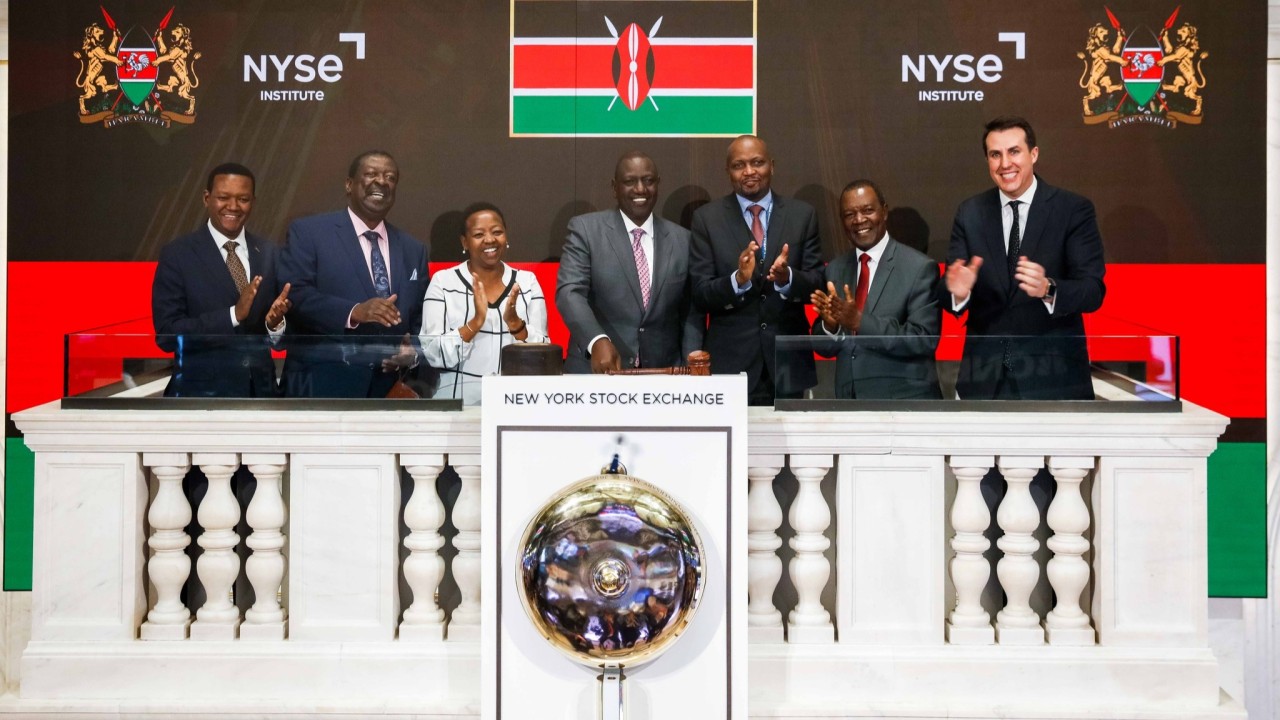
President William Ruto’s Visit to NYSE in 2022
From a national perspective, embracing global investment isn’t just a personal finance strategy – it could be part of our economic toolkit. Imagine if Kenya had established a sovereign investment fund 10 years ago dedicated to investing a portion of our reserves into global markets. For the sake of argument, say the government or pension funds had allocated $10 billion into a diversified global equity portfolio in 2013. Based on the kind of returns we discussed (e.g. U.S. markets roughly tripling or more in value over that period), that $10 billion might be worth in the ballpark of $50–60 billion today. That is real money – enough to comfortably clear Kenya’s external public debt with plenty left over. Of course, hindsight is 20/20, and managing such a fund comes with its own risks. But the point stands: there is enormous wealth-creation potential beyond our borders. Small economies like Singapore and Norway grew national wealth in part by wisely investing abroad; Kenya too can think creatively about leveraging global markets to complement domestic growth. At the very least, policies that encourage or facilitate responsible offshore investing could help the country in indirect ways. If more Kenyan individuals earn returns from abroad and eventually spend or repatriate some of those earnings, it brings in foreign exchange and strengthens our financial position. Additionally, reducing over-reliance on local opportunities might ease some pressures – for example, the speculative rush for land could cool, making housing more affordable, if people have other lucrative avenues to invest in.
From the standpoint of professionals and policymakers, there are a few considerations to keep in mind moving forward:
Strengthen Financial Literacy: As access widens, ensure that Kenyan investors truly grasp the risks and rewards. Regulators and financial educators should inform people about market volatility, the importance of a long-term horizon, and basic concepts like portfolio diversification. We want to avoid scenarios where uninformed investors jump in on a hot trend and panic at the first downturn. Education can be woven into app onboarding processes or national campaigns.
Enhance Regulation and Investor Protection: Cross-border investing via apps raises new questions. Are these platforms licensed and secure? Fortunately, some, like Ndovu, are already regulated by the CMA, and the CMA has shown willingness to integrate innovations like fractional shares. Continued vigilance is needed to protect against fraud and ensure fair, transparent operations. When things like fractional investing or crypto trading come into play, regulators must make sure companies aren’t taking advantage of consumers’ naivety. A level playing field of information – where retail investors have access to reliable data – is crucial.
Leverage Technology for Cost Reduction: One reason many Kenyans stayed away from stocks was the historically high cost of trading (brokerage fees of 2-4% per trade locally). In the U.S., many brokers charge zero commissions. Embracing digital platforms can drive costs down through efficiency and competition. If Kenyan intermediaries don’t adapt, investors might simply bypass them in favor of foreign online brokers. Thus, our financial industry must innovate or risk irrelevance.
The New Geography of Investing.
Technology is reshaping economic boundaries in much the same way it transformed communication. Capital is becoming as mobile and democratized as information. Nowhere is this more evident than in Kenya’s evolving investment scene. The playing field is leveling: a Nairobi engineer can invest side by side with a New York banker, and a Kisumu trader can wake up to check the performance of her portfolio of Asian equities with the same ease as if they were local. This is borderless investing in action – an encouraging story of inclusion and empowerment.
But much like any newfound freedom, this one comes with responsibilities. As individuals, Kenyans venturing into global markets should do so with eyes open. Start with simpler instruments (like index funds), learn as you go, and be mindful of the long-term nature of equity investing. As a nation, Kenya’s leaders and influencers would do well to embrace this trend rather than resist it. It’s an opportunity to integrate our relatively small economy with the vastness of global capital markets – to the benefit of our citizens. After all, money knows no borders, and neither should the savvy Kenyan investor.
In the end, investing beyond our borders is about expanding our horizons. It’s about not letting our geographical limits confine our financial dreams. Technology has handed us the keys to the wider world of investing; it’s up to us to open the door and walk through. The next time you consider where to put your hard-earned savings, remember that you’re not limited to a plot of land in your hometown or a fixed deposit at the local bank. You have a world of options, quite literally, in the palm of your hand. And that is a game-changer for every Kenyan with the courage to take that leap.
𝑾𝒆 𝒉𝒐𝒑𝒆 𝒚𝒐𝒖 𝒇𝒐𝒖𝒏𝒅 𝒗𝒂𝒍𝒖𝒆 😊 𝒊𝒏 𝒕𝒉𝒊𝒔 𝒘𝒆𝒆𝒌’𝒔 𝒏𝒆𝒘𝒔𝒍𝒆𝒕𝒕𝒆𝒓. 𝑰𝒇 𝒚𝒐𝒖 𝒅𝒊𝒅, 𝒘𝒉𝒚 𝒏𝒐𝒕 𝒔𝒉𝒂𝒓𝒆 𝒊𝒕 𝒘𝒊𝒕𝒉 𝒚𝒐𝒖𝒓 𝒏𝒆𝒕𝒘𝒐𝒓𝒌 📢? 𝒀𝒐𝒖𝒓 𝒔𝒖𝒑𝒑𝒐𝒓𝒕 🙏 𝒉𝒆𝒍𝒑𝒔 𝒖𝒔 𝒓𝒆𝒂𝒄𝒉 𝒎𝒐𝒓𝒆 𝒓𝒆𝒂𝒅𝒆𝒓𝒔. 𝑨𝒉𝒔𝒂𝒏𝒕𝒆 𝒇𝒐𝒓 𝒚𝒐𝒖𝒓 𝒄𝒐𝒏𝒕𝒊𝒏𝒖𝒆𝒅 𝒓𝒆𝒂𝒅𝒆𝒓𝒔𝒉𝒊𝒑 🙌. 𝑾𝒆 𝒍𝒐𝒐𝒌 𝒇𝒐𝒓𝒘𝒂𝒓𝒅 𝒕𝒐 𝒃𝒓𝒊𝒏𝒈𝒊𝒏𝒈 𝒚𝒐𝒖 𝒎𝒐𝒓𝒆 𝒊𝒏𝒔𝒊𝒈𝒉𝒕𝒔 🔍 𝒏𝒆𝒙𝒕 𝒘𝒆𝒆𝒌.
Do you have a fintech story or innovation to share?
Reach out to us at pr@fintechassociation.africa and get featured in our vibrant community.
We can’t wait to hear from you!
𝐏𝐮𝐛𝐥𝐢𝐬𝐡𝐞𝐝 𝐰𝐞𝐞𝐤𝐥𝐲 – 67,338++💙𝐬𝐮𝐛𝐬𝐜𝐫𝐢𝐛𝐞𝐫𝐬