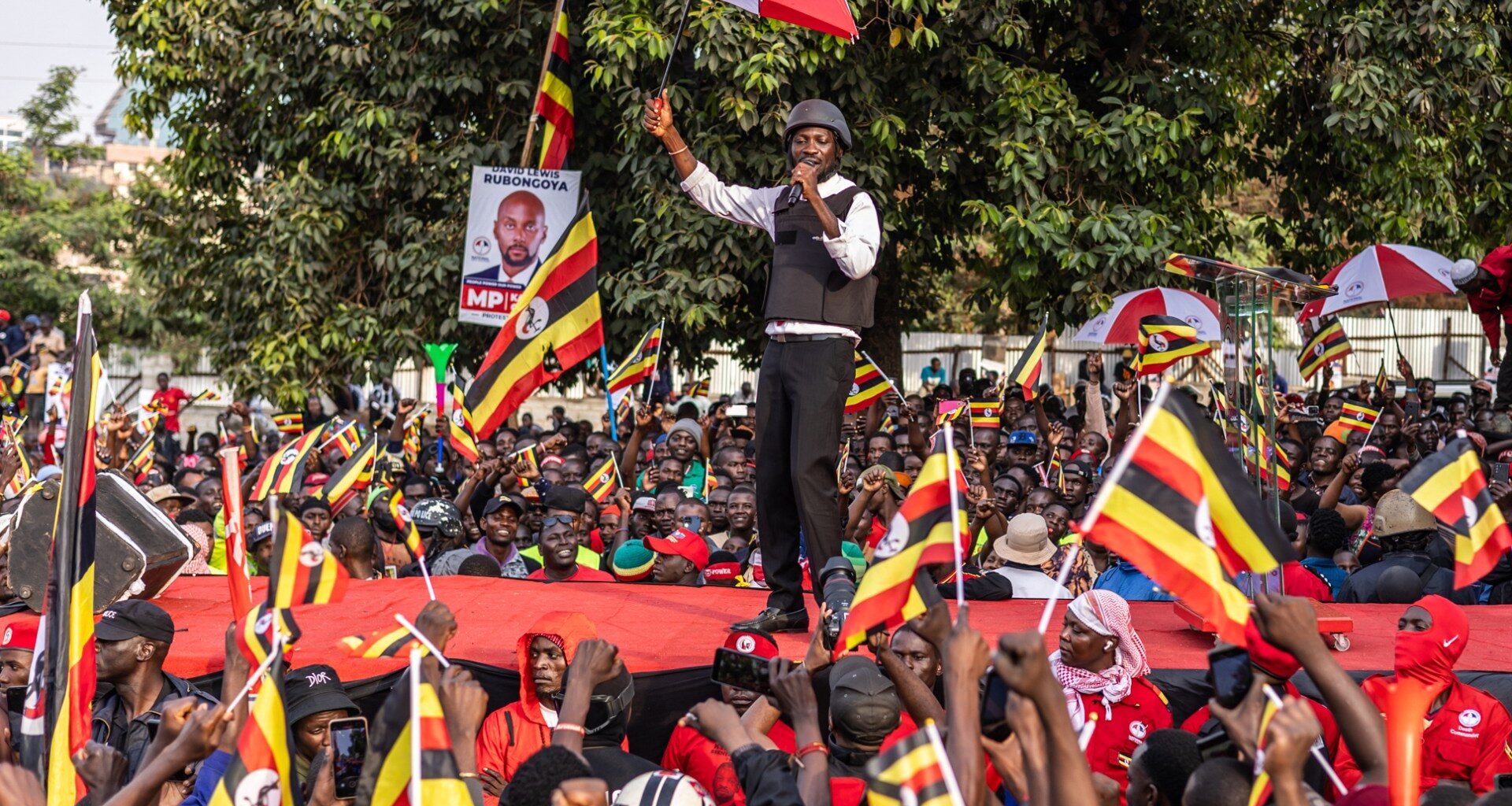
Kampala, Uganda – When Bobi Wine, a singer-turned-politician whose real name is Robert Kyagulanyi, launched his campaign to become Uganda’s next president in October, he appeared in tailored suits, greeting crowds with a familiar smile.
The mood, at least at first, felt cautiously hopeful.
Recommended Stories list of 3 itemsend of list
But by December, that image had disappeared.
As campaigning comes to an end on Tuesday, Bobi Wine, who is the main opposition candidate looking to unseat long-serving President Yoweri Museveni, now only appears in public wearing a bulletproof vest and helmet.
For many Ugandans, his change in attire – and the state violence that led to it – are symbols of a foregone political outcome: An incumbent victory likely to be rejected by his competitors.
Since he was cleared to run in the election in September, Bobi Wine’s campaign convoy has frequently been met with tear gas, roadblocks and arrests of supporters. Campaign events are regularly disrupted, with people abruptly dispersing and roads sealed off.
While the violence has not reached the deadly levels of the 2021 election, when more than 50 people were killed and hundreds of Bobi Wine supporters were detained following spontaneous protests in the capital, Kampala, the campaign environment has become increasingly militarised – defined by calculated repression, intimidation and a steadily shrinking space for Bobi Wine to sell his manifesto, analysts have observed.
Bobi Wine, 43, is contesting for a second time in Thursday’s election after he finished as the runner-up in the 2021 polls.
Museveni won that last disputed vote during which Bobi Wine alleged fraud and urged citizens to reject the result. The 81-year-old incumbent has ruled the country for nearly four decades after capturing power following a rebel war, and is seeking a seventh term in office.
Five other candidates are also in this year’s race, in which 21.6 million registered voters are expected to cast their votes.
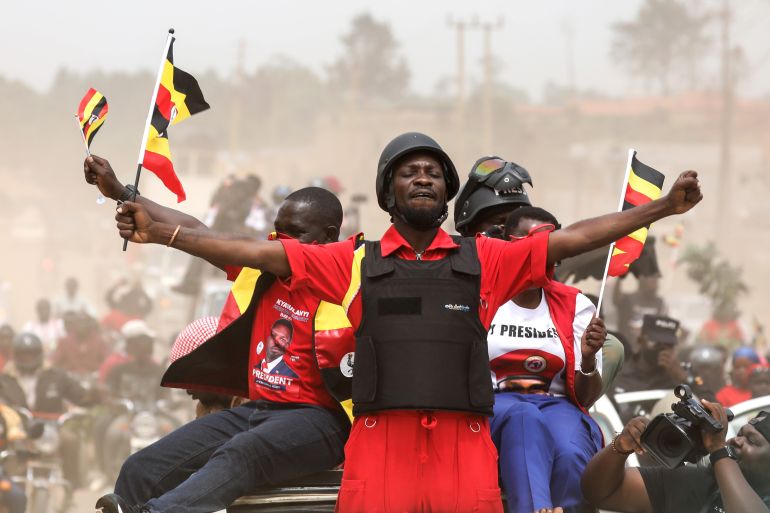 Bobi Wine waves to supporters at an election campaign rally in Mukono, Uganda [Hajarah Nalwadda/AP]A climate of fear
Even before campaigning officially began, Bobi Wine’s team expected violence.
Museveni’s son, Muhoozi Kainerugaba – who serves as Uganda’s army chief – had publicly threatened Bobi Wine in the months leading to the campaign season, including remarks about beheading him.
Kainerugaba also claimed responsibility for the abduction and torture of Bobi Wine’s bodyguard, Edward Ssebuufu, who remains in detention.
Opposition officials say that while the worst of Kainerugaba’s threats have not materialised, the state, fearing the big audience Bobi Wine was attracting, decided to unleash violence on him during the election campaign.
“In terms of violence, we saw that the first month [October] was a bit not so violent, but after that it became violent and chaotic,” David Lewis Rubonyoya, secretary-general of National Unity Platform (NUP), the party Bobi Wine leads, told Al Jazeera.
During a campaign stop in Gulu, northern Uganda, in December, Bobi Wine was attacked by security forces and plainclothes individuals armed with sticks. He and several of his aides were beaten, and campaign equipment was vandalised. One person later died following the incident. In a separate incident in Mbarara, western Uganda, in November, police arrested 43 Bobi Wine supporters after a confrontation over campaign routes. They remain in detention.
During the 2021 election period, the protests and deadly police crackdown were prompted by Bobi Wine’s arrest for allegedly flaunting COVID-19 guidelines. This year, although the violence has so far been muted, opposition figures and analysts insist the repression is no less severe – only more controlled.
Michael Mutyaba, a Ugandan political analyst and a doctoral researcher at SOAS University of London, says the difference lies in strategy.
“In 2021 and before, security agencies were in panic mode. There was state violence that was less calculated. The violence now looks more calculated and expanded,” he told Al Jazeera. He pointed to arrests of random people, like a Catholic priest charged with money laundering, as examples. The government also arrested Sarah Birete, a prominent human rights activist and critic, who will only be released after the election.
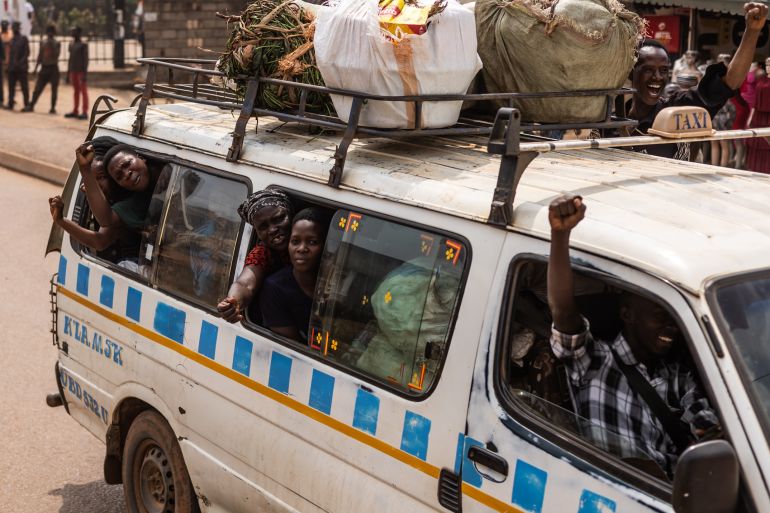 Opposition supporters gesture from a minivan at a campaign rally at Aga Khan Grounds in Kampala [Samson Otieno/AP]Voter and candidate ‘bribery’
Bobi Wine, too, has faced increased onslaught from the state, with candidates sponsored by his party to stand in parliamentary elections coming under particular strain. Many of the targeted candidates standing in the parliamentary polls, also being held on Thursday, have withdrawn their candidacies, publicly denounced Bobi Wine, and joined the governing party.
Most of these defections, managed by parliament’s deputy speaker, Thomas Tayebwa, have occurred daily but mainly outside the central region, which is considered Bobi Wine’s stronghold. Bobi Wine has claimed that these candidates were bribed, while the state maintains that they joined the governing party freely and without conditions.
Yusuf Serunkuma, a political analyst based at Kampala’s Makerere University, said he is not surprised by the “regime’s” tactics.
“This is part of transactional politics,” he told Al Jazeera. But he added that if the opposition had the capacity to buy candidates from the governing party, they too would be doing it daily.
Another method the state has used to eliminate candidates sponsored by Bobi Wine’s party has been through disqualification by the Electoral Commission, which has argued that some candidates failed to meet nomination requirements. Jude Byamukama, a Ugandan constitutional lawyer, says the cancellations have been “ridiculous”, as critics say they are tactics deployed to halt the opposition.
“They [Electoral Commission] were trying to create unopposed candidates in several constituencies without a lawful basis,” Byamukama told Al Jazeera. He added that after disqualification, the commission then made it difficult for candidates to appeal to the courts by failing to serve them the decisions on time.
Months before the election season, Museveni also launched a softer offensive, particularly targeting informal sector players in Bobi Wine’s strongholds in central Uganda. There, the president has distributed millions of dollars in cash to groups such as motorcycle riders, taxi drivers, salon operators and street vendors. Mwambutsya Ndebesa, a retired historian from Makerere University, describes this as “electoral corruption” meant to influence voters, while Serunkuma said “vote buying” is normal in Ugandan politics, but this time, it’s been more organised.
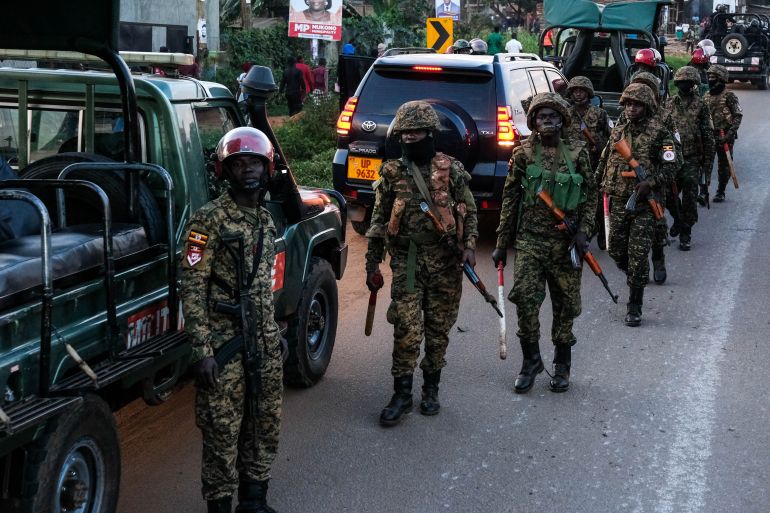 Ugandan security forces patrol a street during a campaign rally for opposition presidential candidate Bobi Wine, in Mukono, Uganda [Hajarah Nalwadda/AP]Fears the worst is yet to come
As election day approaches on Thursday, Bobi Wine has warned that the state plans to arrest him and abduct key organisers who would play a role in monitoring polling stations.
He has issued advice to supporters: Disable phone location services, avoid predictable routes, limit time spent in one place, and flee if followed by unfamiliar vehicles or motorcycles – like the Toyota Hiace commonly associated with state abductions.
“I am aware of a plot by the desperate regime to have me arrested before polling day,” he recently said on social media.
Another flashpoint looms over election day itself: Whether voters should remain near polling stations after voting to “protect the vote”, as Bobi Wine has urged.
Ugandan law allows voters to remain at least 20 metres (66ft) away from polling stations, but the Electoral Commission and security agencies have advised people to leave immediately after voting.
The Electoral Commission has framed the issue as one of discipline rather than legality, warning that crowds could provoke disorder.
Ugandans want peace
Despite the tense atmosphere among political players, Ugandans say they want peace – regardless of political affiliation.
Wanyama Isaac, a casual construction worker in Kampala and a Bobi Wine supporter, says elections should not descend into violence.
“Violence helps no one. It is the responsibility of both sides to remain calm,” he said.
Mashabe Alex, a boda boda rider who supports Museveni, agrees.
“Violence destroys businesses and lives, as we saw in 2021.”
He says the opposition should not threaten Museveni supporters like himself.
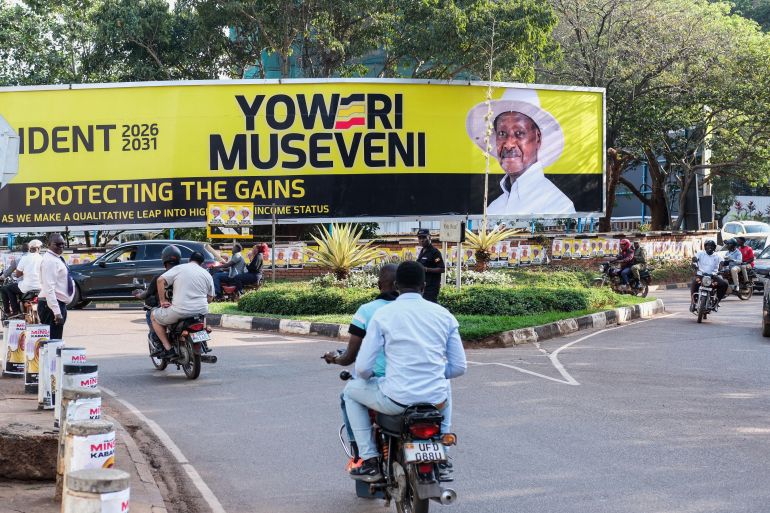 A campaign billboard for President Yoweri Museveni is displayed in Kampala, Uganda, Wednesday, January 7, 2026 [Hajarah Nalwadda/AP]An uncertain endgame
Bobi Wine’s camp has not disclosed its post-election strategy. But Museveni has been warning his competitor’s supporters not to dare confront security agencies.
“I have heard Bobi Wine say that soldiers and police are few while rioters are many. I advise you not to believe him. Every soldier and police officer has a gun with 120 bullets,” Museveni warned in December.
The military already has soldiers in infantry mobility vehicles in Kampala, an opposition stronghold.
Rubongoya of the NUP argues that the Electoral Commission cannot declare an opposition candidate a winner in Uganda without pressure from the public.
“If Ugandans vote in large numbers and peacefully demand their victory, the Electoral Commission will be pushed to announce the right candidate,” he said.
“Our ideology is people power. If people are determined, intimidation and money will not stop them,” he added.
However, Rubongoya acknowledged that memories of the 2020–2021 election violence still haunt many Ugandans. He warned that any attempt to protest could be met with lethal force.
Serunkuma argues that the opposition signed up for an electoral process that was rigged from the start, and that they know they can never win, suggesting that their target may not be unseating Museveni himself.
Rather, he says parties like that of Bobi Wine want to “consolidate themselves under Museveni” by, for instance, retaining positions they hold in parliament.
Mutyaba predicts that after the election results are announced, Bobi Wine will likely be placed under house arrest – a tactic the state has used repeatedly since 2011. His party will issue statements dismissing the election results, and that will likely be the end.
“It is impossible to organise protests under the current conditions,” Mutyaba said. “The dynamics are not in their favour. The only hope is that, at some point during Museveni’s next term, an incident could trigger an uprising. But that will not happen next week.”