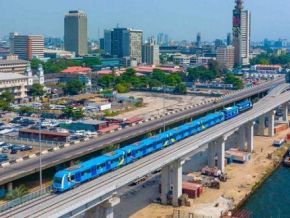
Nigeria included Lagos’s Green Line urban rail project among key investments in the 2026 federal budget.
Authorities proposed a 102.3 billion naira ($71.8 million) allocation to fund the first phase of the project.
The 68-kilometer line will add 17 stations to Lagos’s mass transit system.
Nigeria listed the construction of the third segment of the Lagos Rail Mass Transit system among the key investments in the 2026 budget.
According to reports from local media, authorities proposed a budget allocation of about 102.3 billion naira, or roughly $71.8 million, to finance the first phase of the project known as the Green Line.
The Green Line extends the Blue Line and the Red Line, which form the first two sections of a rail network designed to ease road congestion in Lagos.
The city hosts more than 20 million residents and faces severe traffic jams. Project technical details show that the Green Line will span 68 kilometers and include 17 stations.
The Red Line has operated since 2024 and can handle up to 500,000 passengers per day. The Blue Line entered service in September 2023 and can carry up to 250,000 passengers daily.
These capacities remain insufficient relative to demand, which private transport operators still meet largely. This imbalance highlights the urgency for the government to expand public transport supply.
Authorities said the Lagos urban rail system, which integrates with other public transport projects, also aims to address safety and comfort issues that users frequently criticize in private transport services.
The broader project also includes plans to develop four additional lines. These include the Yellow Line, the Purple Line, the Orange Line, and the Brown Line.
Authorities aim to connect Lagos’s districts and surrounding suburbs through this expanded rail network.
This article was initially published in French by Henoc Dossa
Adapted in English by Ange Jason Quenum