Donald Trump’s threat to slap a 25 per cent tariff on any country trading with Iran has placed Kenya, a prolific exporter of tea to Tehran and a strategic security partner of Washington, in an awkward bind.
“Effective immediately, any country doing business with the Islamic Republic of Iran will pay a tariff of 25 per cent on any business being done with the United States of America,” Trump declared on his Truth Social platform.
The message from Washington is blunt: Iran is to be commercially isolated, not merely sanctioned, at a moment when Tehran faces its largest wave of anti-government protests since 1979. Third countries are no longer expected to remain neutral observers. They are being asked to choose.
For Kenya, that choice is uncomfortable.
Nairobi has long balanced modest but lucrative trade with Tehran alongside far deeper political, security and diplomatic ties with Washington. Strategic ambiguity has served it well. But ambiguity is harder to sustain when alignment is demanded.
Iran is one of Kenya’s largest tea buyers, often absorbing lower-grade but high-volume tea that struggles to find other markets. In 2023, Kenya exported $48 million (Sh6.1 billion) worth of goods to Iran, of which tea accounted for $44.8 million (Sh5.8 billion). Exports to Tehran have grown at an annualised rate of 33 per cent over the past five years.
The trade balance favours Nairobi. Iran exported $28.4 million (Sh3.6 billion) worth of goods to Kenya in 2023, mainly asphalt mixtures, petroleum coke and pasta.
Yet tea diplomacy has not been smooth. In mid-2025, Tehran imposed a ban on Kenyan tea after a scandal involving a Kenyan firm, Cup of Joe, accused of exporting blended low-grade tea falsely marketed as premium Kenyan produce. The ban rattled exporters and bruised trust, though both governments moved quickly to establish a joint committee to resolve the dispute.
In August 2025, Kenya hosted the seventh Kenya–Iran Joint Commission for Cooperation in Nairobi. Musalia Mudavadi, Kenya’s prime cabinet secretary, urged the forum to “move beyond ceremonial diplomacy” and deliver tangible outcomes. The language was familiar and carefully calibrated.
What Trump’s tariff threat targets is not Kenyan tea per se. It threatens something far more valuable: Kenya’s access to American markets, investment, security cooperation and diplomatic cover.
The relationship with Washington is deeply asymmetrical. The US provides intelligence cooperation, counter-terrorism support, military training, equipment and political backing in multilateral forums.
In 2024, Kenya was designated a major non-NATO ally, and it became the first African country to sign a bilateral health agreement with the Trump administration following the collapse of the United States Agency for International Development (USAID).
Tehran offers none of this. Washington offers enforcement power.
Old diplomatic cables capture Nairobi’s thinking succinctly: Iran is commercially relevant but strategically sensitive. National Assembly Speaker Moses Wetang’ula once insisted that relations with Iran would not affect ties with the West.
“Our friendship with country A is not to the exclusion of country B,” he said when he served as Minister for Foreign Affairs, a phrase that has since become a staple of Kenyan diplomacy.
That posture has been tested before. Nairobi has hosted Iranian presidents and delegations with considerable fanfare, to the irritation of Western capitals.
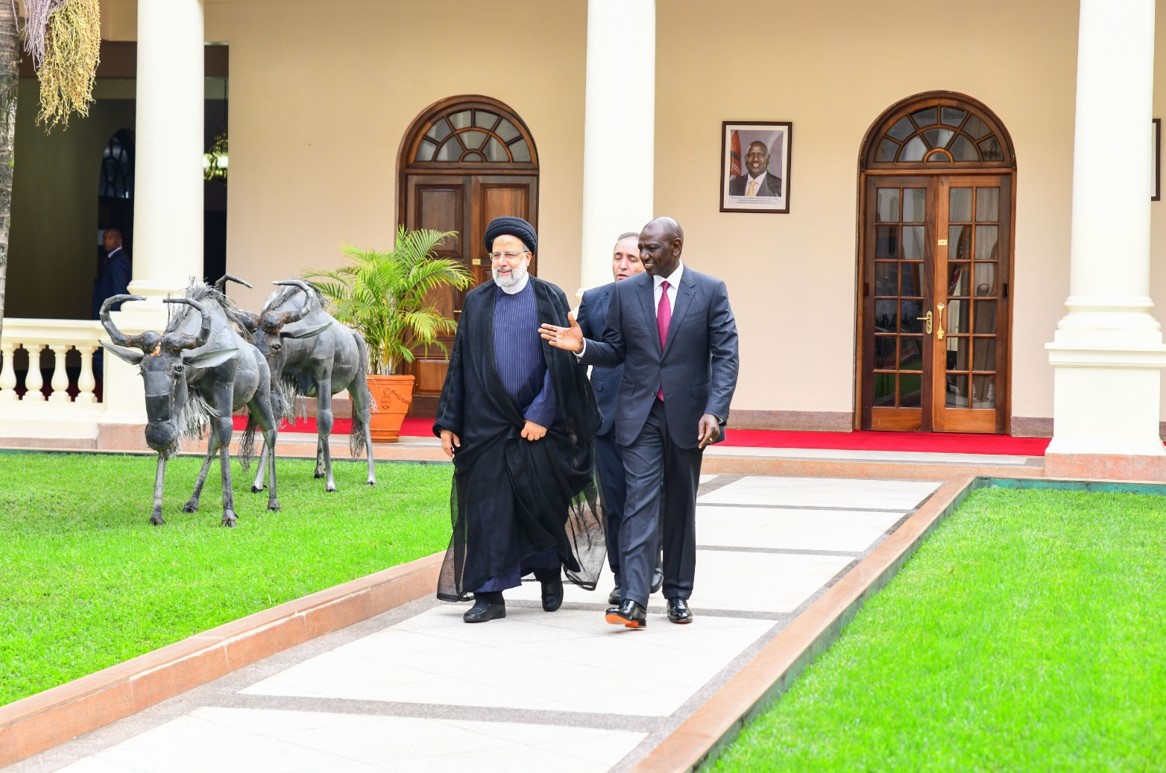
In July 2023, Iran’s president, Ebrahim Raisi, and his foreign minister, Hossein Amirabdollahian, both now deceased, were welcomed with a 21-gun salute, military honours and a state banquet. Five memorandums of understanding were signed, covering technology, fisheries, livestock and investment.
Western scrutiny was intense. Iran has a troubling security record in Kenya, with Iranian operatives arrested or convicted for terrorism-related offences in 2013, 2014, 2015 and 2021. During a US Senate hearing, Joshua Meservey of the Hudson Institute called the Kenya–Iran relationship “especially weird”, noting Tehran’s history of plotting attacks on Kenyan soil.
Iran, for its part, understands the limits of the relationship. It knows Kenya will never choose Tehran over Washington. The strategy has been to deepen ties without forcing a reckoning.
Trump’s threat may now force one.