Study setting, design, and period
Jimma Town is located in the Jimma Zone of the Oromia Regional State. Located 352 km from Addis Ababa city. The Central Statistical Agency’s 2024 population projections place Jimma Town’s population account 500,000. A municipality includes three sub-cities, thirteen town kebeles, and four rural kebeles. 128 health facilities in the municipality offer medical services. Jimma City contains one referral and one general governmental hospital, five private hospitals, four public health centers, 55 private clinics, 25 pharmacies, 36 drug stores, and 5 drug distributors39. Agaro, known in Oromo as Aggaaroo, is a prominent town that also functions as an independent woreda. It is 1,560 m above sea level and is situated in the Oromia Region’s Jimma Zone. 25,458 people were living in this woreda as of the 2007 national census, with 12,946 men and 12,512 women. The study was conducted in Jimma and Agaro Towns from April 15 to September 15, 2024. An institution-based cross-sectional study design was employed.
Study population, inclusion, and exclusion criteria
The source of the study population includes all female sex workers in Jimma and Agaro towns; however, the study population is active female street sex workers during the data collection period. To be included in the study, participants must be female street sex workers aged over 18 years and a conspirator on the road, working tirelessly during the data collection time.Excluded from the study are those who are ill and unable to respond to the questions, as well as individuals who have transitioned from street work to off-street venues. This approach ensures a clear focus on the target demographic while accounting for factors that could affect participation, including those who previously worked on the street but have since changed their working area to off-street locations.
Sampling technique, sampling procedures, and data collection procedure
A study screened 3,950 participants, including 400 street-based participants from Jimma and 100 from Agaro towns. Female street sex workers aged over 18 were selected for the study. After exclusion criteria, 219 participants were eligible, and a final sample of 203 was recruited from both towns as repicted in (Fig. 1).
Fig. 1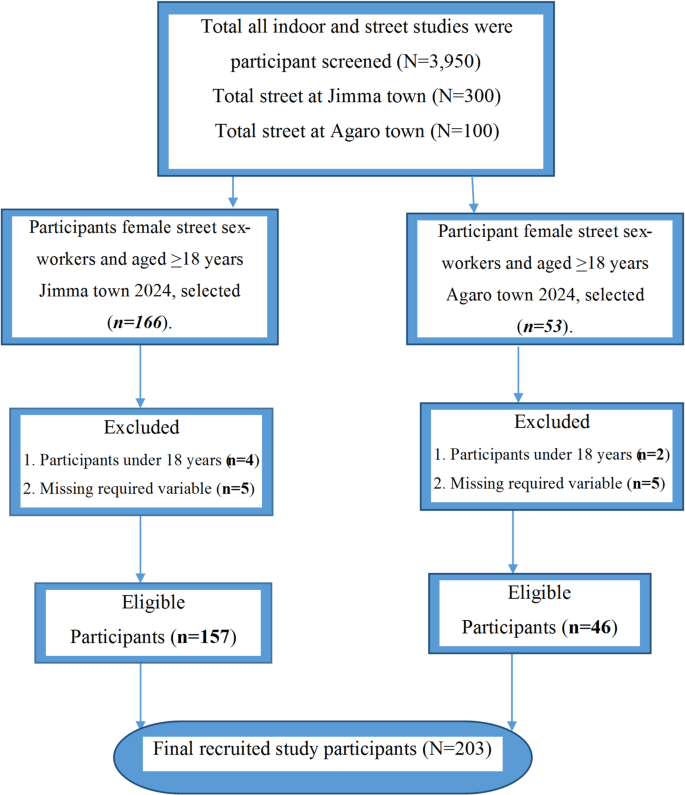
Participant screening, eligibility, and recruitment flow chart for female street sex workers in Jimma and Agaro towns.
The study used structured questionnaires in the English languageand translated them to Amharic and Afan-Oromo, then back to English. Pretest done on 20 street sex workers, 5% of the 400 in Jimma and Agaro towns, to ensure clarity and cultural suitability.The study used a convenience sampling technique toselect participants and interviewedface-to-face in two towns and five KPCs.Five female BSc nurses and two MSc nurses were data collectors and supervisors, with two days of training provided. Regular oversight, questionnaire completion, and confidentiality were maintained.
Study variables
The study variables include one dependent variable, which is the early initiation of street sex work. Several independent variables are categorized into three main areas. First, socio-demographic factors encompass age, marital status, educational status, parents’ education levels, history of having children, migration patterns (from rural to urban or city-to-city), and income. Second, behavioral risk factors involve substance use, such as chewing khat, tobacco smoking, and hashish, as well as exposure to pornographic materials and the use of heavy drugs, including inhalants, tranquilizers, marijuana, cannabis, and cocaine. Lastly, family and social factors include parental loss, parental divorce, history of rape, emotional abuse, childhood abuse, and peer influence. This comprehensive framework allows for an in-depth analysis of the various influences on the initiation of early sex work.
Operational definitions and terms
Sex work:
The exchangeof sex for money/materials.
Early initiation of sex work has been defined as those who participated in sex work before the age of 1840.
Parent education status:
The level of formal education and the highest degree attained by either mother or father.
Heavy drug use—use of any of these for non-medical purposes (cannabis, heroin, cocaine, and marijuana)alters mood or behavior.
Substance use:
When study subjects use alcohol, khat, or different types of tobacco.
Age at sexual initiation:
Age at first vaginal intercourse.
Early initiation of street sex work, also known as prostitution, involves a sex worker soliciting customers in public areas such as streets, parks, and bencheswho participated in this work before the age of 1841.
Data quality assurance, data management, and analysis
Based on the pre-test results, the questionnaire was adjusted contextually and terminologically, and data were coded before the data collectors filled it out. The principal investigator and supervisors did spot checks and reviewed the completed questionnaires daily to ensure the completeness and consistency of the information collected. Moreover, all complete responses were coded before entry. Finally, data entry was made into EPI Data version 4.6. Statistical software was used by the principal investigator to ensurethe accuracy of the data. Cronbach’s alpha coefficient was calculated, and the result was 0.73.
The data were entered into EpiData version 4.6 after being double-checked for accuracyand were exported to SPSS version 25 for analysis. At each stage, the variables were appropriately coded and recoded as needed. A binary logistic regression analysis was done to sort variables that are candidates for multiple logistic regressions. Finally, those variables with a P-value ≤ 0.25 were fitted to the multivariate logisticregression model.
A multivariate logistic regression analysis was conducted to identify factors strongly associatedwith the early initiation of sex work among street-based female sex workers. Finally, the association is declared with the p-value is less than 0.05 will be considered statically significant, and an adjusted odds ratio (AOR) at a 95% confidence interval measuresthe strength of the association. Hosmer and Lemeshow’s test was used to determine the model’s fitness.
Outcome measures and validation
The primary outcome of this study was “early initiation of street sex work,” which aimed to examine socio-demographic, behavioral, and social-related factors. The evaluation of “early initiation of street sex work” was conducted using a structured and validated tool designed to assess various factors. The evaluation included factors such as provider communication, perceived effectiveness of services, accessibility, and the responsiveness of those services. The tool underwent a cultural adaptation process and was pretested to ensure its content validity and relevance to the specific context.
Missing data handling
The study employed a rigorous data handling technique, including structured questionnaires and a thorough quality control procedure. This involved interviewer training, methodological completeness checks, and instrument pre-testing. Statistical analysis was performed using tools like SPSS, and data entry and cleaning were handled using specialized software. Missing data were filled using maximum likelihood estimation or multiple imputation.