Roughly one year ago, the Tanzanian government a multimillion-dollar tourism project funded by the World Bank, citing concerns over human rights violations. However, community members near the project in Ruaha National Park report that they continue to face violence by park guards. Civil society groups say the government threatens people with eviction.
Local residents and representatives with the Oakland Institute, a U.S.-based policy think tank, told Mongabay that rangers with the Tanzania National Parks Authority are still using excessive force against villagers and pastoralists. They also report that farmers are unable to access land they had used before the park boundaries were changed for the now-canceled tourism project. The World Bank Board approved a management action plan (MAP) in April 2025 to address such concerns; two people have since been killed.
“The situation is very dire on the ground,” Oakland Institute’s Anuradha Mittal told Mongabay via phone, adding that promises to train rangers and the establishment of a grievance mechanism are not being kept.
The MAP was supposed to address harms suffered by communities that filed complaints with the World Bank’s Inspection Panel, an independent watchdog. In September 2024, the panel concluded that the bank failed to follow key policies around resettlement and risk identification, finding that the project had not properly assessed or mitigated local impacts from the tourism project.
A spokesperson from the World Bank told Mongabay by email that implementation of the MAP is “well advanced” and that a grievance mechanism was established. The spokesperson said local people were informed about the tool via local radio stations, adding that a local NGO offers psychological support and legal aid information. “The government of Tanzania committed to implementing all actions agreed with the World Bank and has reaffirmed its position that it does not intend to resettle communities in the area in the foreseeable future.”
However, in September 2025, Tanzanian President Samia Suluhu Hassan stated in a speech that five villages inside the park would be relocated, several of which are among those the World Bank’s MAP had identified as beneficiaries of alternative livelihood support.
The World Bank spokesperson added that two programs are currently being implemented to create alternative livelihood opportunities for more than 10,000 villagers.
A Tanzanian civil society member who works with communities and requested anonymity in fear of retribution told Mongabay that “none of the victims … have been given an alternative source of livelihood so far, and none of them have been engaged by the processes that the World Bank and the government are purporting to be in place.”
He said pastoralists who graze livestock in traditional areas still risk getting shot or having livestock confiscated.
The World Bank suspended funding for the project in April 2024 and the Tanzanian government later canceled it.
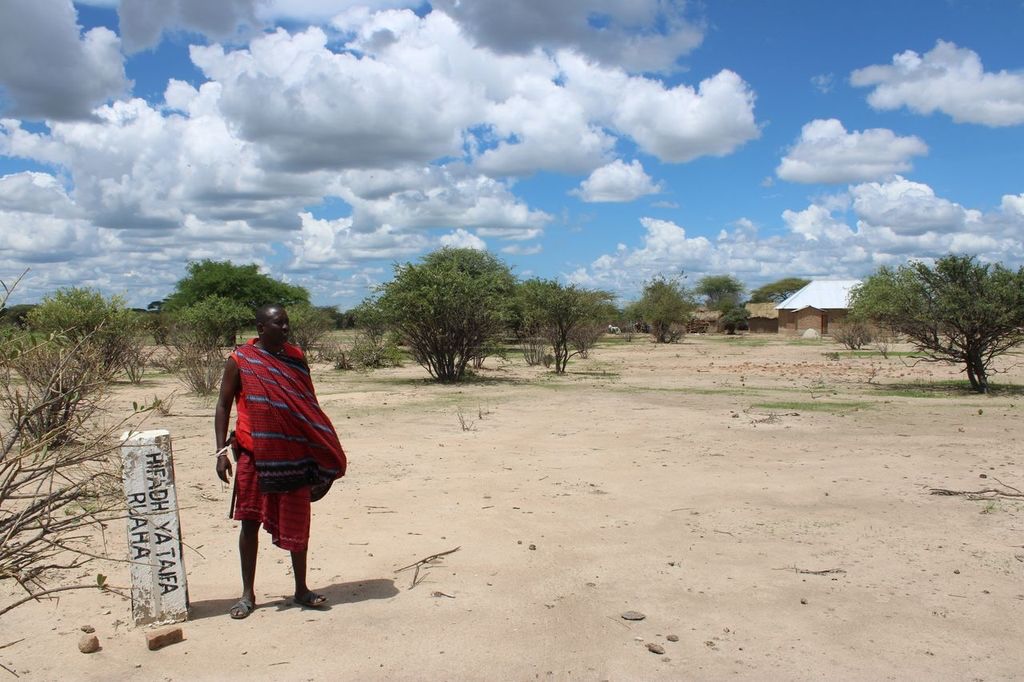
Banner image: A villager stands by a marker for the altered boundaries of Ruaha National Park. Photo courtesy of the Oakland Institute.
