Northern Tanzania’s Serengeti National Park makes for an incredible starter safari for first-time visitors to Africa. The experience there usually involves wide-open savannas and convoys of jeeps lined up to take in the wildebeest and zebras passing through in the millions during the Great Migration. It’s spectacular—but it’s also far from the only way to experience East Africa’s wildlife.
Located in the country’s center, Ruaha National Park offers a very different vision of safari. The park is roughly 37 percent larger than Serengeti National Park, yet it attracted just under four percent of its visitors in 2023—around 21,000 people in total. That imbalance is part of the appeal.
“Ruaha National Park offers something truly rare in today’s safari world—solitude,” Rose Hipwood, founder of The Luxury Safari Company, told Travel + Leisure. “While destinations like the Serengeti promise incredible wildlife, they can also come with crowds, especially during peak seasons. In contrast, Ruaha is a hidden gem where sometimes you can be the only vehicle at a sighting.”
Hipwood added that, while the wildlife-spotting is first-rate, “what truly sets Ruaha apart is its raw, dramatic beauty, from the ancient baobab trees to the rugged escarpments. It’s an untamed, authentic safari experience that feels like a well-kept secret.
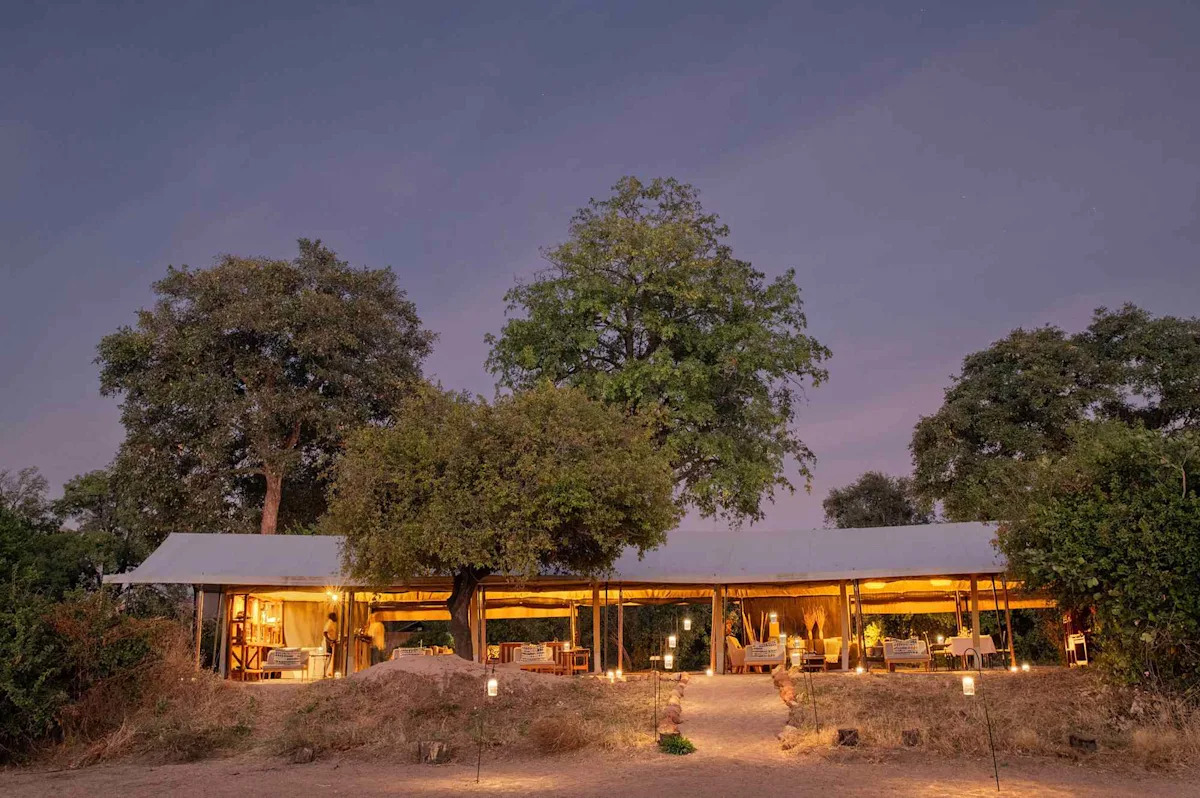
Befitting a setting this wild and remote, Asilia Kokoko opened in July 2024 with just three tents. And while that of course translates to a sense of exclusivity, it achieves so not with honeymooner-courting bells and whistles but instead a back-to-basics ethos that puts the wildlife at the forefront.
When I visited in October 2024, during the final weekend before the camp closed for the rainy season, I had the entire place to myself. Here’s what it was like.
The Terrain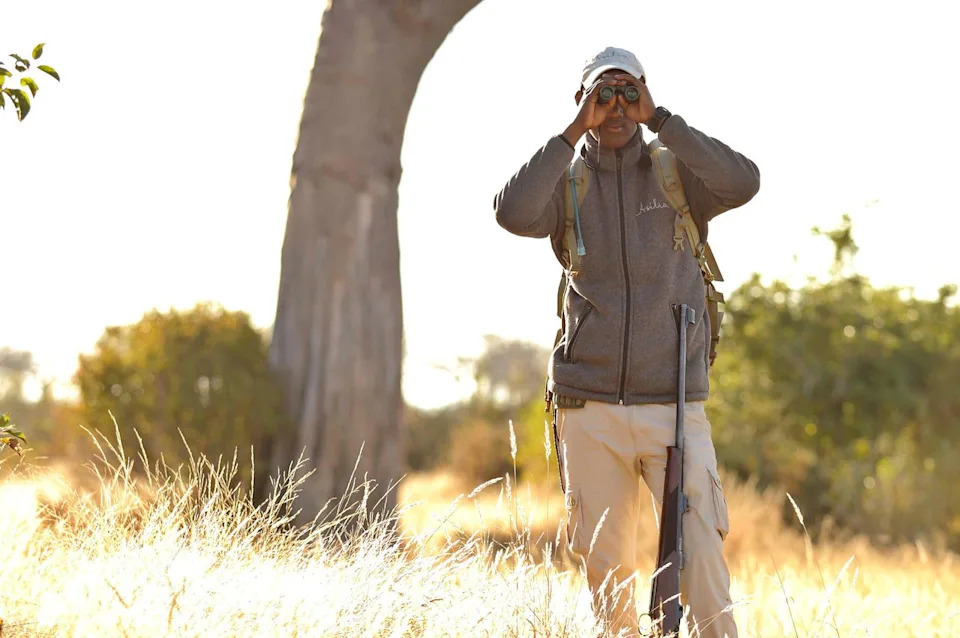
Asilia
An Asilia guide brining guests on a walking safari.
Ruaha National Park is vast. After annexing the Usangu Game Reserve in 2008, it now sprawls across 7,809 square miles—slightly smaller than Slovenia. That sheer size creates a surprising diversity of landscapes that set Ruaha apart from the Serengeti’s flatter savannas. Here, you’ll find Combretum–Terminalia woodlands, boulder-filled outcroppings known as kopjes, and surreal baobab forests, where elephants gather in the dry season to strip the bark and quench their thirst by harvesting the water-storing inner trunk. (Baobabs already look strange, but the elephant-tusk-induced scarring makes the image even more surreal, suggesting a tree chomped by enormous beavers.)
The defining feature of this region, however, is the Mwagusi Sand River, a seasonally dry riverbed that snakes through the park. Dense vegetation elsewhere can obscure wildlife and limit sightlines, but the sand river has the opposite effect. From its banks, you get a front-row seat to an amphitheater-like tableau where animals congregate out of necessity. During the dry months, elephants dig into the sand to expose small water pockets. Grazers—zebras, giraffes, impalas, warthogs, and more—soon follow, benefiting from the elephants’ labor.
The Camp
With just three tents accommodating a maximum of six guests, Asilia Kokoko represents safari intimacy at its purest. That exclusivity is reflected in the attentive yet unobtrusive service. You’ll quickly understand why the Swahili greeting karibu sana means “you’re more than welcome.”
Don’t expect traditional luxury trappings like infinity pools, hammocks, or spa treatments; those can be found at Asilia’s nearby Jabali Ridge. Kokoko is for travelers serious about wildlife viewing who want to spend as much time as possible out in the bush.
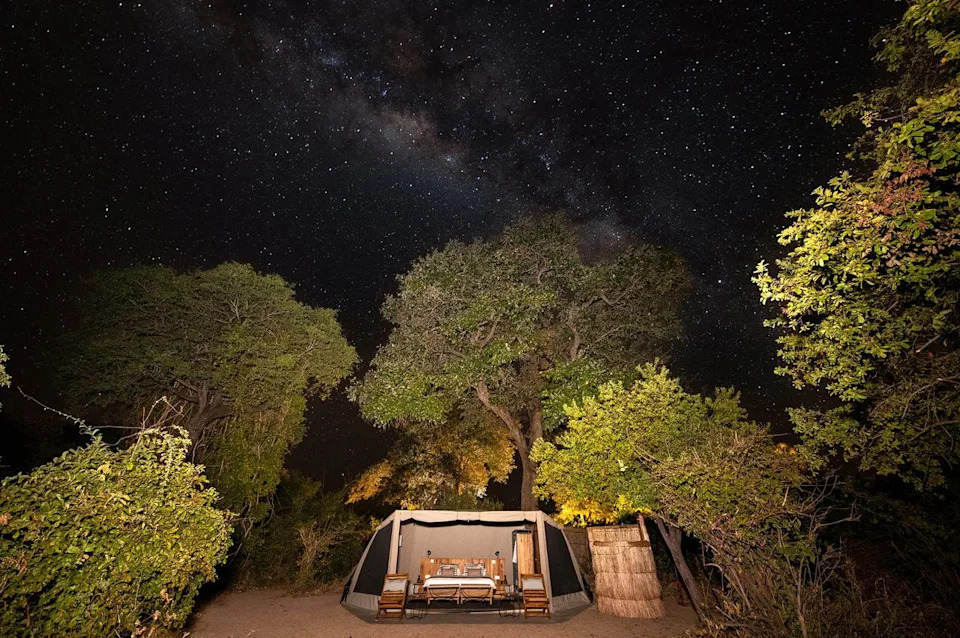
The tents are comfortable, stylish, and refreshingly unfussy. Mosquito netting forms the front wall of each expedition-style tent, framing views of the dry riverbed and distant ridgeline. Inside, there’s a plush bed, a cushioned chair, and an open wardrobe stocked with robes—essential for cooling down during the oppressive afternoon heat between game drives. On clear nights, the canvas roof can be rolled back like a convertible for stargazing from bed.
A wooden door leads to a compact bathroom with a basin and toilet, which then opens—via a zippered flap—onto an outdoor bucket shower. Staff fill it on request for morning, afternoon, or evening use. Organic toiletries come from Kenya-based Cinnabar Green and include ingredients like moringa oil. The tents sit at the edge of a forest of jackalberry, sausage, fig, and rain trees, and the shower is very open to the elements. I can now say with certainty that impalas, mongooses, vervet monkeys, and at least a dozen bird species have seen me naked.
The Experience
While planning my trip, the team at The Luxury Safari Company asked if I had specific wildlife goals. Was I desperate to see elephants? More interested in lions? “With fewer guests, the atmosphere feels more like a private retreat than a typical safari lodge,” Hipwood said. “This means you’re not just another visitor but an integral part of a carefully curated experience where your preferences and needs are generally catered to.”
My guide, Ramadan, tailored each outing accordingly. Because visitor numbers are so low, hours passed without seeing another vehicle. I mentioned early on that I’d already been on safari in Botswana and South Africa and had checked off the Big Five. While I’d happily see them again, I was far more interested in smaller, rarer, quirkier species.
One evening, just before sunset, we came upon a bat-eared fox—a house-cat-sized canid with satellite-dish ears and a fondness for termites—lounging in the road. With no pressure to rush off in search of lions, we lingered. Fifteen minutes passed. Then twenty. Then thirty. Eventually, the fox coaxed its tiny kits out of their den and led them on their first foray into the open. It’s the kind of moment that would be impossible with revving engines and competing vehicles.
Asilia
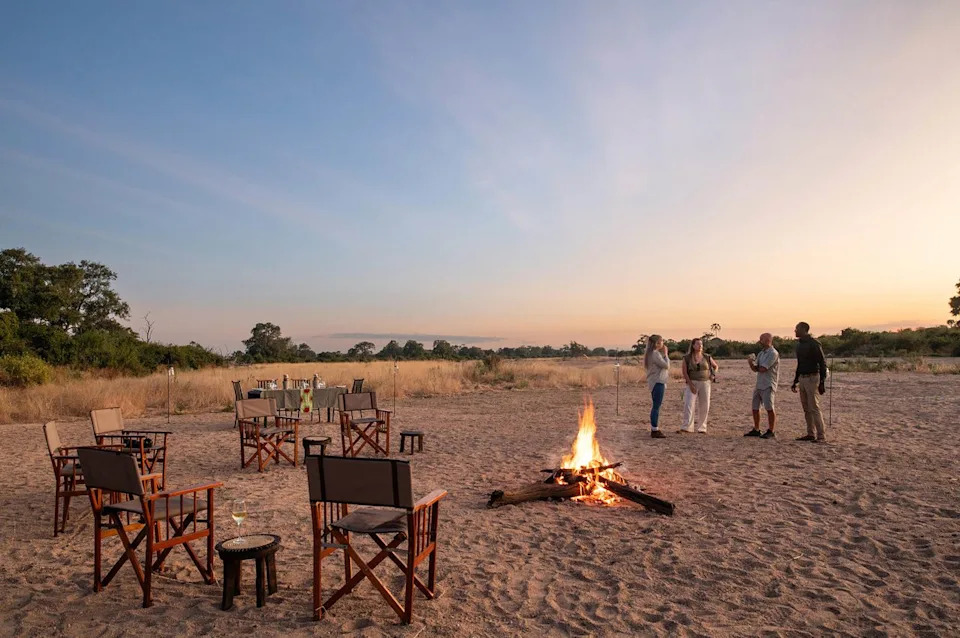
Guests enjoying a Kokoko Sundowner by the fire.
After dark, we headed back out for night drives, using powerful spotlights to find nocturnal creatures like genets and aardwolves—a lean, insect-eating hyena. When Ramadan learned that I’m an avid birder, he pointed out every species we encountered, from flamboyant lilac-breasted rollers to subtle brown warblers I might otherwise have missed.
Depending on the season, guides may also suggest walking safaris. Freed from the confines of your jeep, which puts you above the action, on-foot excursions allow you to really engage with every insect, leaf, or reptile. And yes, we still found the headliners. Ramadan followed lion tracks for miles, occasionally exchanging notes with a Swahili-speaking Italian documentarian filming nearby. The effort paid off when we found a pride of mothers and cubs lounging under a baobab, bellies full and spirits languid.
The Food
One of the great surprises at Asilia Kokoko was the cooking. Much of it is prepared over an open fire, and it’s hearty and homey. Before our 6 a.m. game drives, we warmed up with a simple oat porridge and strong black coffee beside a crackling fire set in the riverbed.
Lunch was served in the open-air lounge-bar-library-living room hybrid, while dinner unfolded under the stars in the sandy riverbed itself. The menu draws on international influences—pork schnitzel, Japanese noodle soup, chimichurri beef fillet—but my favorite dishes were rooted in place, including a simple local braised cabbage and a tangy sorbet made from baobab fruit.
The standout meal was a bush breakfast on my final morning. A long table draped with a patterned cloth sat beneath a baobab along the riverbank. The spread skewed “full English”—sausages, bacon, eggs, mushrooms—while kudus, giraffes, and impalas grazed nearby.
Bonus points for the excellent biltong (air-dried meat) served alongside my G&T at sundowners.
Asilia
A Kokoko tent under the bright stars.The Logistics
If there’s a downside to Ruaha, it’s that it takes a bit of a trek to get there—which is precisely why planning through The Luxury Safari Company proved invaluable. They handled internal flights, ground transfers, and logistics, and served as a single point of contact throughout.
My journey took me from New York to Nairobi, then on to Dar es Salaam. After an overnight at the Hyatt Regency, I boarded a tiny Auric Air prop plane that hopscotched around Tanzania, dropping off and picking up passengers in places like Zanzibar and Nyerere National Park. On the final leg, it was just me and the pilot—the closest I’ll ever come to flying private, and a testament to how undertouristed this region remains.
Given Kokoko’s size, I’d recommend pairing it with another Asilia property. I spent two nights at Usangu Expedition Camp, a six-tent operation set amid wetlands and miombo woodlands. There, the focus shifts toward citizen science: setting camera traps, logging species data, and exploring by boat through crocodile- and hippo-filled waters. You can even sleep in a transparent “star cube,” drifting off beneath the southern sky.
Read the original article on Travel & Leisure