TONNY ONYULO, in an article first published on Religion News Service, reports that with opposition crackdowns and allegations of rigging clouding the 15th January elections, religious leaders are telling voters to reject violence and trust faith amid uncertainty…
Kampala, Uganda
RNS
As church bells echoed across Uganda’s capital at dawn, Mary Lunyolo whispered a prayer before opening her grocery stall in Owino Market. She plans to vote in Uganda’s general elections Thursday, but she doubts whether her ballot will count amid allegations of rigging and a widening crackdown on opposition to the current president.
“I will vote because it is my right,” Lunyolo, a 33-year-old mother of three, said as she arranged tomatoes and onions on a wooden table. “But many people are afraid. We hear about arrests and blocked rallies. You wonder if the results are already decided.”
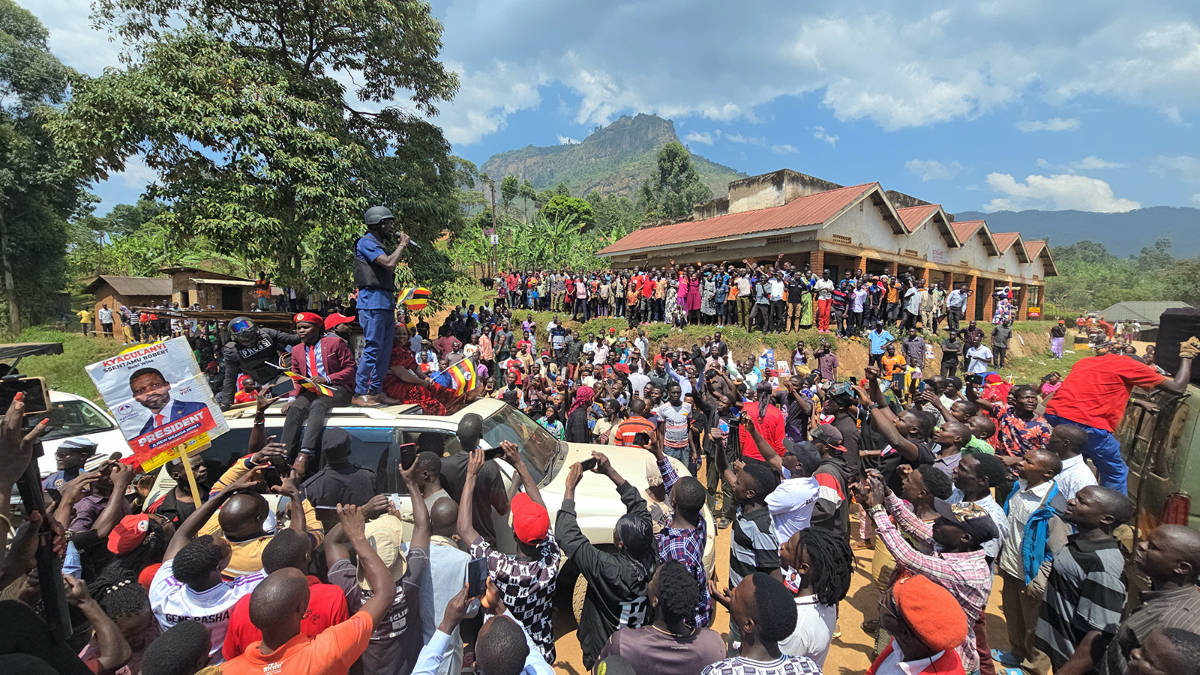
Uganda opposition presidential candidate Robert Kyagulanyi Ssentamu, known as Bobi Wine, stands atop a vehicle and addresses supporters during a political rally in Mbale City, eastern Uganda, on 2nd January, 2026. Thousands of supporters turned out, waving flags and recording the moment on their phones, despite government efforts to block the gathering. PICTURE: Gerald Matembu.
Her unease reflects a broader national mood as President Yoweri Museveni seeks a seventh term after nearly four decades in power. While Museveni is credited with restoring stability to the country after years of political turmoil, critics say his long rule has eroded democratic institutions, narrowed civic dialogue and entrenched a culture of fear.
“If violence comes, we suffer first.”
– Mary Lunyolo, who runs a grocery stall in Owino Market, Kampala
The election run-up has unfolded under heavy security, marked by arrests of opposition supporters, restrictions on rallies and repeated warnings from human rights groups about the use of force by police and the military. The government says it is maintaining law and order, but many Ugandans say the measures have deepened mistrust.
As political tensions rise, Uganda’s religious leaders have become increasingly vocal, positioning themselves as moral guardians rather than political actors. Across churches, mosques and Pentecostal halls, clergy are urging nonviolence, voter participation and respect for life.
Owino Market, the largest and busiest market in central Kampala, mirrors the tension gripping the country. Radios tuned to political talk shows crackled above porters and traders talking. Conversations about prices often turned to politics, usually in hushed voices.
For Lunyolo and thousands of other informal traders, potential election unrest is not an abstract concern – it could disrupt business and threaten already fragile livelihoods.
“Things are already hard,” she said. “If violence comes, we suffer first.”
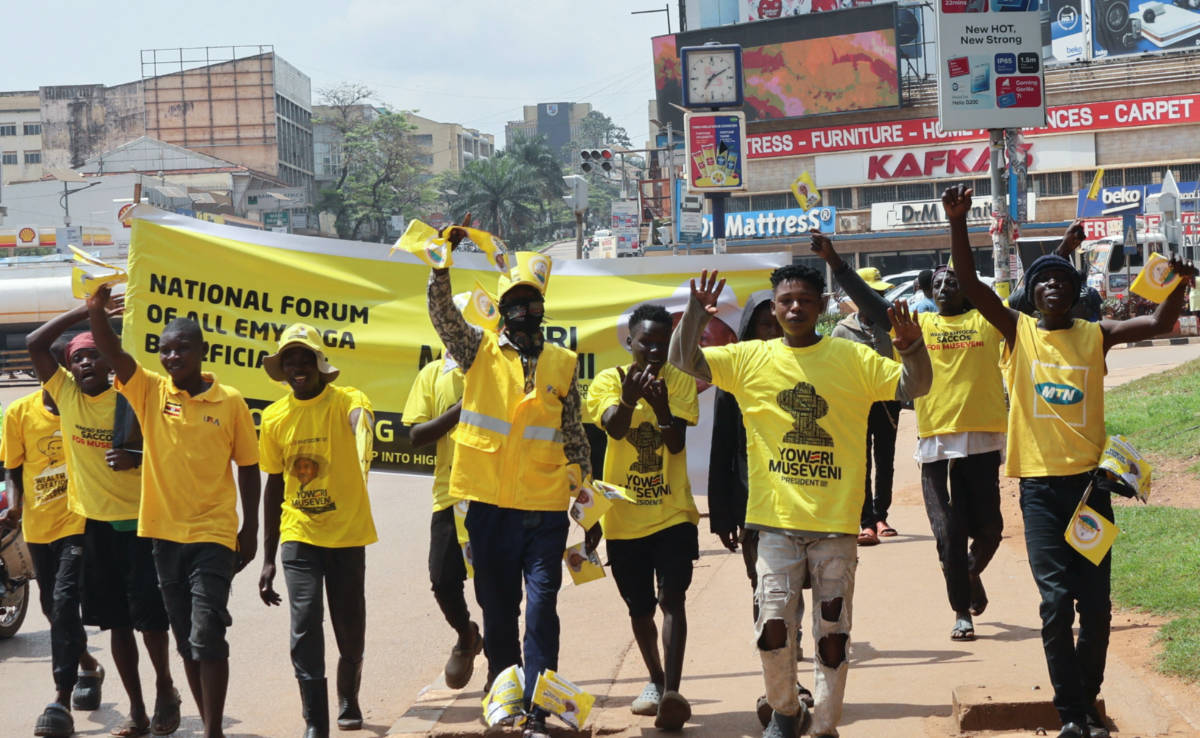
Supporters of Uganda’s President and the leader of ruling National Resistance Movement (NRM) party, Yoweri Museveni, march along the street before attending his campaign rally in Kampala, Uganda, on 13th January, 2026. PICTURE: Reuters/Michael Muhati
Uganda’s economy has struggled with inflation, unemployment and rising living costs. Young people, who make up the majority of the population, face limited opportunities. Those frustrations have fuelled support for the opposition movement against Museveni, particularly in urban areas.
That support has coalesced around Robert Kyagulanyi Ssentamu, widely known as Bobi Wine. A 43-year-old former pop star turned politician, Wine has mobilised large crowds wherever he is allowed to campaign. His rallies often draw tens of thousands of people, especially young voters and workers who see him as a symbol of change.
Those crowds have also seemingly made him a threat to Museveni’s presidency as six other candidates also run for president. Police have repeatedly blocked or dispersed Wine’s rallies, citing security and public order concerns. His National Unity Platform party says its supporters are routinely harassed, detained or surveilled.
“When Bobi Wine comes, people come in big numbers,” Lunyolo said. “That alone tells you something.”
Government officials deny targeting the opposition, insisting all political actors must follow the law. They say restrictions are necessary to prevent violence. But for many voters, the heavy security presence has reinforced fears that the playing field is uneven.
We rely on our readers to fund Sight’s work – become a financial supporter today!
Museveni’s human rights record has long drawn scrutiny from local and international groups. Past election cycles were marred by violent crackdowns on protests, leaving dozens dead. Rights organizations have documented cases of torture, enforced disappearances and the use of military courts to try civilians.
Meanwhile, the Inter-Religious Council of Uganda has convened consultations bringing together faith leaders and opposition representatives to discuss concerns about intimidation, violence and the credibility of the vote this election season. At one meeting in Kampala, opposition figures described harassment of supporters and journalists, as well as what they called discriminatory electoral laws that have sidelined some candidates. They also raised concerns about voter education and alleged irregularities in voter registration.
Stephen Kaziimba, the Archbishop of the Church of Uganda who chairs the council, acknowledged those grievances and pledged to engage state institutions. He announced a nationwide prayer initiative and urged citizens to reject violence.
“No political ambition is worth the blood of a Ugandan,” he said.
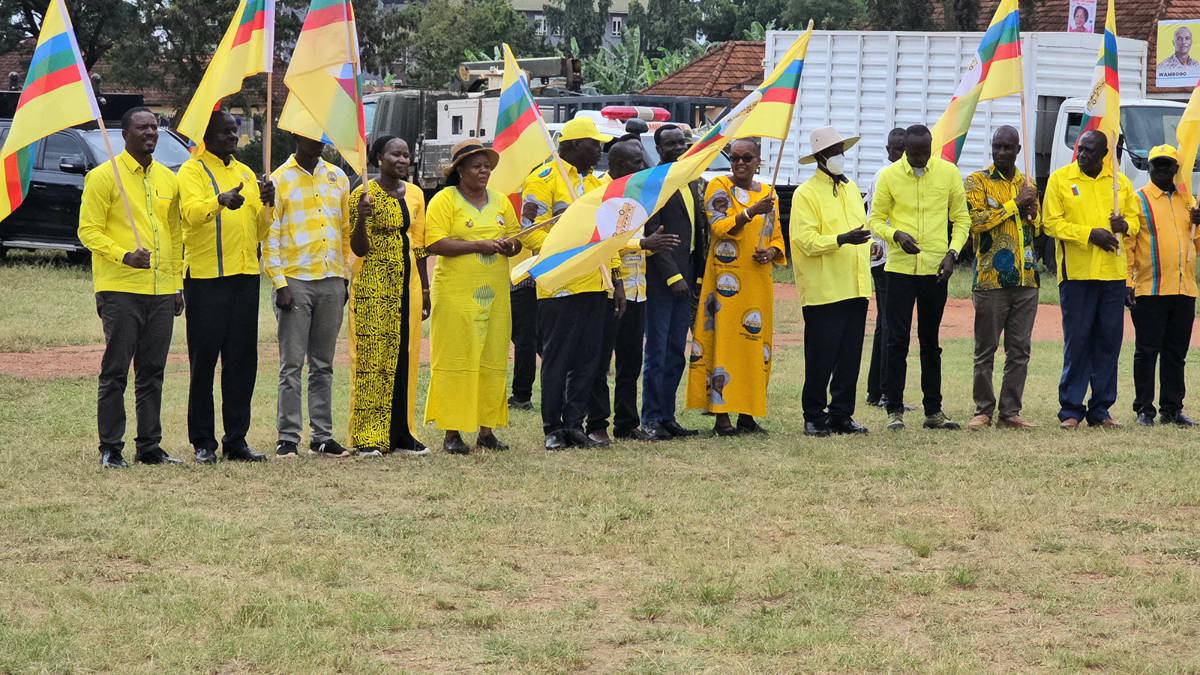
President and National Resistance Movement presidential candidate Yoweri Kaguta Museveni (wearing a face mask) stands with party officials and supporters during a campaign rally in Mbale City, eastern Uganda, on 10th November, 2025, as supporters wave party flags ahead of the elections. PICTURE: Gerald Matembu
In Mbale in eastern Uganda, evangelist Ruben Okumu said he preaches peace each week while privately questioning whether the election will be free.
“There is intimidation everywhere,” Okumu said. “Opposition supporters fear to gather. When key institutions are seen as captured, people lose confidence.”
Okumu said Wine’s popularity, especially among young people, has unsettled the government. He described rallies that swell beyond expectations, drawing supporters from neighboring districts. “The crowds are huge,” he said. “They show that people want change.”
At the same time, Okumu acknowledged Uganda has enjoyed relative peace compared with some neighboring countries and said it must be protected. “Peace is important,” he said. “But peace must go together with truth.”
From the pulpit, he called on the government to stop intimidating voters and urged citizens to vote according to conscience, not fear. He also appealed to security forces to exercise restraint.
Similar anxieties were evident across Kampala. Some Ugandans say they will vote regardless of the risks. Others say they may stay home, convinced the outcome is predetermined.
Journalists covering opposition events have reported harassment and restrictions, adding to the climate of fear and limiting access to information. Religious leaders say this is why their role matters now more than ever. In communities fractured by political loyalties, churches and mosques remain among the few spaces where people still gather across divides.
That message is captured in a national prayer circulated by the Uganda Episcopal Conference, now being read in Catholic parishes across the country. “Save us from violence, free our hearts from hatred and may our minds be for the common good,” the prayer reads. It asks for protection from “tribalism, greed, arrogance and sectarian tendencies”. Bishops also prayed for the Electoral Commission “to carry out its task with integrity, fairness and truth”, and urged candidates to remain humble and respectful as they solicit votes.
At a recent Mass in Nkokonjeru, Paul Ssemogerere, the Catholic Archbishop of Kampala, warned that divisive narratives were fueling fear and anxiety, and he urged Ugandans to pray for peaceful elections.
Some clergy have also offered practical steps. Rev Paul Sebitoogo, speaking at St Paul’s Catholic Parish in central Uganda, urged authorities to allow citizens to observe vote counting from a lawful distance.
“When people can see what is happening, suspicion reduces,” he said. “Transparency builds trust.”
He also cautioned politicians against attacking rivals, reminding worshippers that communities must live together after the vote. “After elections, we remain one people,” he said.
For Lunyolo, faith does not erase fear, but it gives her resolve. She said she remembers past elections marked by violence and contested results. She worries about what may follow if the outcome is rejected. Still, she plans to wake up early on Election Day and join the queue.
“If we stop voting because we are afraid, then we give up everything,” she said. “We pray, we vote and we wait. The rest we leave in God’s hands.”