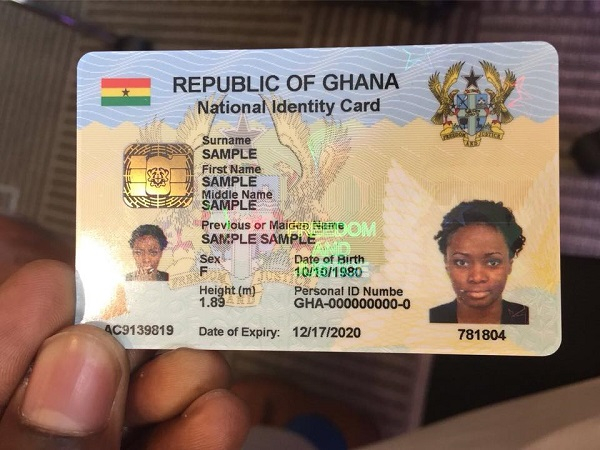
Former Vice President Dr Mahamudu Bawumia is widely credited with championing the operationalisation of the Ghana Card and its integration across multiple national identification and service platforms as Ghana’s primary source of identification.
From the financial sector to telecommunications and access to public services, the Ghana Card has become a mandatory and reliable means of identifying both Ghanaians and non-Ghanaian residents.
The card has also emerged as a critical tool in the fight against corruption, particularly for its ability to expose identity fraud, especially on the public payroll.
However, the man who spearheaded its implementation and integration as a unique national identification system did not have an easy path. Dr. Bawumia faced strong opposition and, at times, public ridicule from political opponents who questioned his focus on the Ghana Card.
He consistently argued that a credible national identification system was foundational to modern economic transformation, even once stating that the Ghana Card would deliver more long-term benefits than “1,000 interchanges” a comment that attracted widespread mockery.
Yet, one year after leaving office, many of those critics—now in government—have openly acknowledged the indispensable role of the Ghana Card in Ghana’s economic and digital transformation.
Below are six instances in which the current NDC government under President John Mahama has effectively vindicated Dr Bawumia’s position on the Ghana Card.
1. May 2025: Ghana Card a Model for Africa — President Mahama
Speaking at the 9th Ghana CEO Summit in Accra in May 2025, just five months into his presidency, President Mahama described the Ghana Card as far more than an identity document.
He stated that the card had become the backbone of a digitally sovereign and competitive economy, adding that Ghana’s model was attracting interest from other African countries.
“I recently received a request from the DR Congo asking for a reference on Moses and the Ghana Card system. They wanted to know if they had done a good job. I said yes, they did,” President Mahama disclosed.
2. May 2025: Ghana Card to Anchor New Road Tolls — Mahama
At the same event, President Mahama announced that the Ghana Card would anchor a new electronic road toll system, following its integration with vehicle registration data.
“Every vehicle is now linked to its owner’s Ghana Card. We no longer need old toll booths. A picture of your car is taken, the bill is sent to your mobile money or bank account, and payment is made,” the President explained.
3. September 2025: NIA Boss Admits Ghana Card Has E-Passport Features
In an interview with Joy News, the newly appointed Chief Executive Officer of the National Identification Authority (NIA), Yayra Koku, confirmed that the Ghana Card contains e-passport features.
This public admission followed years of scepticism from critics who had dismissed Dr Bawumia’s claims, despite Ghana’s participation in an ICAO event in Canada where the card’s international travel features were showcased.
The NIA CEO’s confirmation effectively vindicated the former Vice President.
4. December 2025: Ghana Card Made Mandatory for All Insurance Transactions
In December 2025, the government announced that the Ghana Card would become mandatory for all insurance transactions starting January 2026.
According to a notice issued by the National Insurance Commission (NIC), customers must present a valid Ghana Card for all insurance services, including policy purchases and renewals.
5. January 2026: No Ghana Card, No Forex Transaction
As part of efforts to curb money laundering and financial crimes, the Bank of Ghana and the Financial Intelligence Centre (FIC) introduced new rules requiring the Ghana Card for all forex bureau transactions.
Forex operators are now mandated to demand a valid Ghana Card from every customer before conducting transactions.
6. January 2026: Ghana Card Compulsory for All Bank Transactions
In a further move to strengthen financial sector integrity, the government and the Bank of Ghana issued a revised Supervisory Guidance Note, making the Ghana Card the mandatory identification document for all accountable institutions.
The directive, issued in the last quarter of 2025, was formally published on the Central Bank’s website on January 8, 2026, outlining stricter verification procedures for both new and existing customers.