Bishoftu International Airport Addis Ababa, Ethiopian building design, African transport hub architecture
14 January 2026
Design: Zaha Hadid Architects and Pascall+Watson Architects
Location: Abusera, Addis Ababa, Ethiopia
Images by X Universe
Bishoftu International Airport, Ethiopia
Ethiopian Airlines Group, the leading carrier in Africa, has begun construction of the continent’s largest airport, approximately 40 km south of the Ethiopian capital Addis Ababa in Bishoftu.

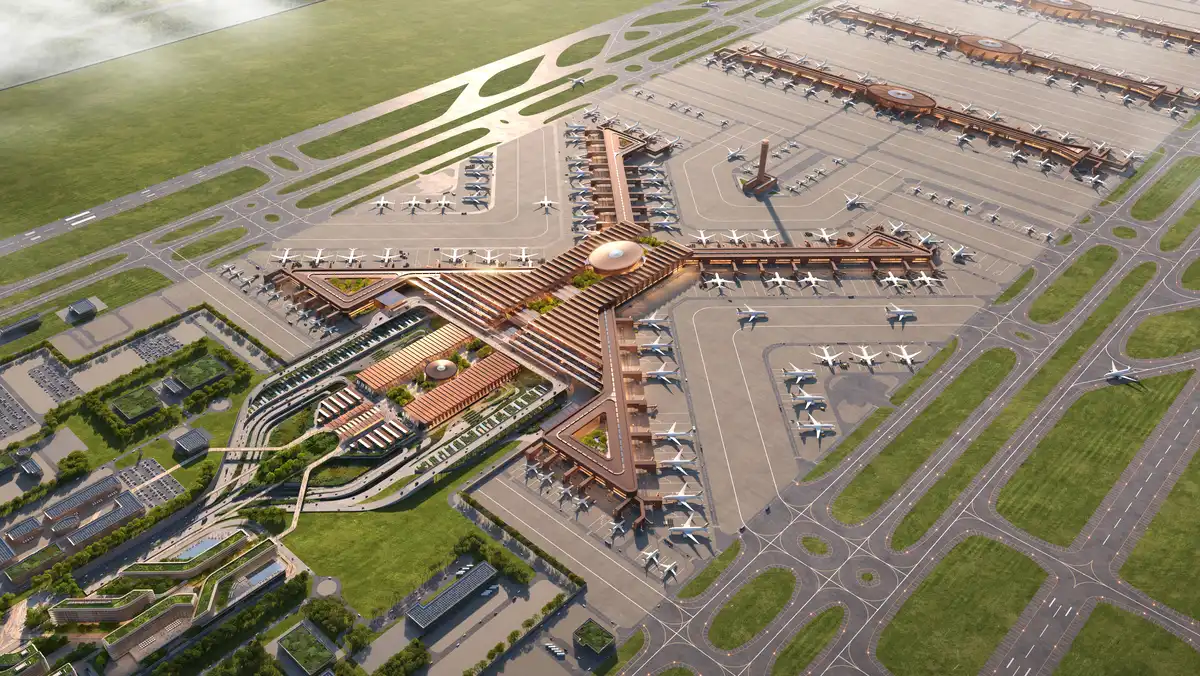
Phase One of the new Bishoftu International Airport (BIA) will serve 60 million passengers a year. Further phases will serve up to 110 million passengers annually with four runways and parking for 270 aircraft.
Meeting IATA regional growth forecasts for passenger demand, the US$12.5 billion investment in BIA will optimise Ethiopia’s position at the crossroads of Africa, Asia and the Middle East with a global transportation hub for the 21st century.

Construction has begun on the new Bishoftu International Airport (BIA) approximately 40 km south of the Ethiopian capital Addis Ababa. Ethiopia’s Prime Minister Abiy Ahmed Ali laid the cornerstone at the airport’s groundbreaking ceremony on Saturday 10th January 2026.
“Bishoftu International Airport will be the largest aviation infrastructure project in Africa’s history, more than four times the capacity of Ethiopia’s current main airport which will reach its limits on existing traffic in the next two to three years,” said the Prime Minister.

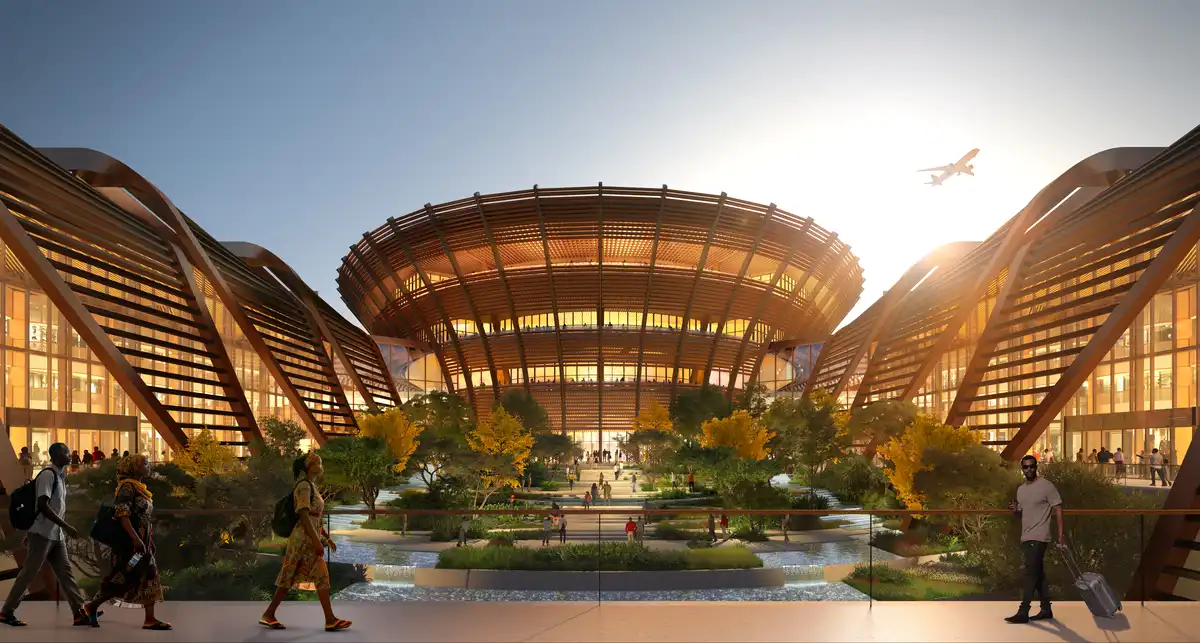
BIA will serve Ethiopian Airlines, Africa’s largest carrier. Designed by Zaha Hadid Architects to meet the airline’s future passenger demand and operational needs, BIA will become Africa’s global aviation hub, providing facilities of the highest standard with a strong focus on transferring passengers.
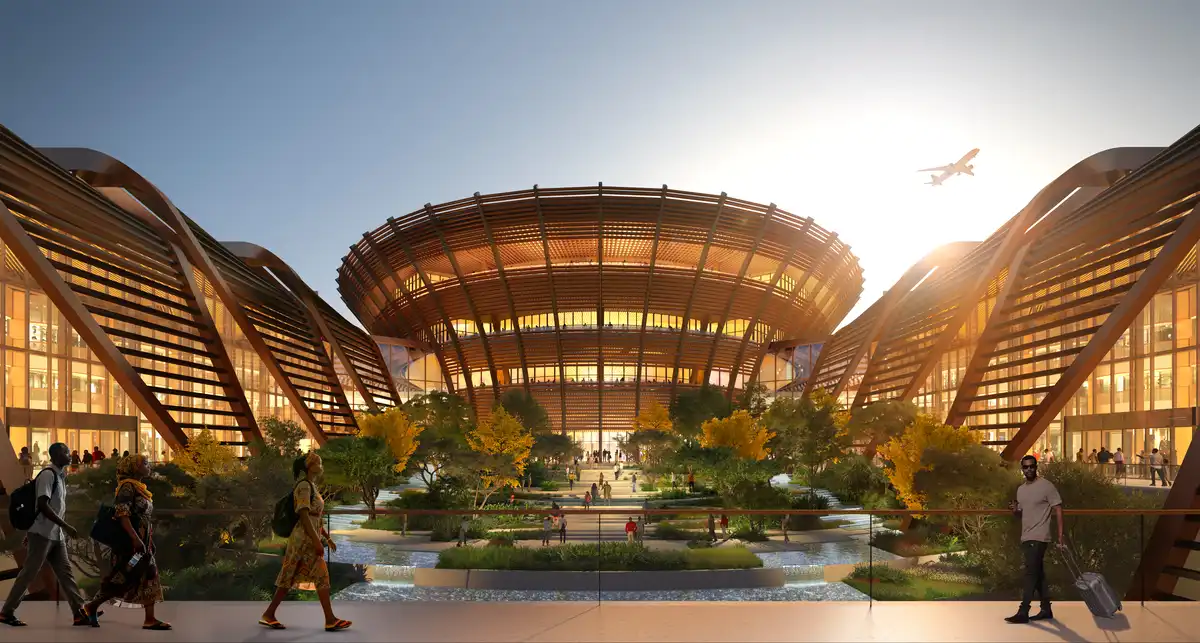
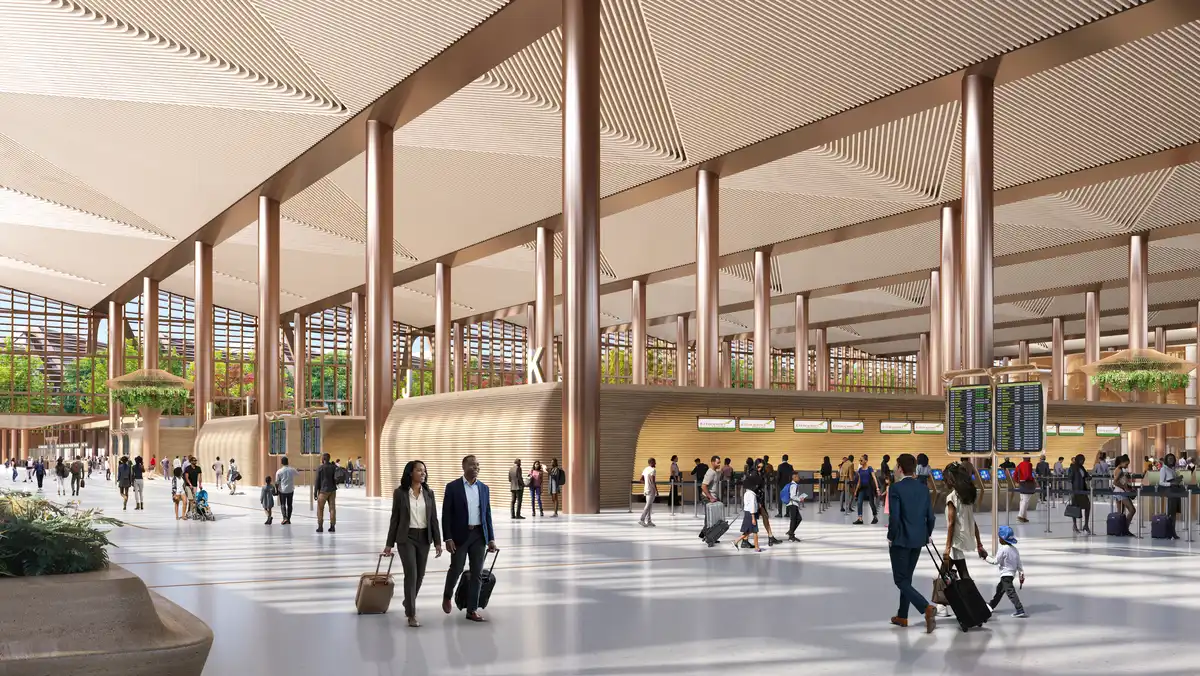
With up to 80% of passengers transiting between destinations without leaving the airport, BIA has been designed to accommodate these requirements—incorporating extensive amenities for transiting passengers including airside hotel with 350 guestrooms, a wide variety of dining and entertainment facilities, as well as outdoor gardens and courtyards for relaxation.
Each of the terminal’s piers incorporates a unique interior materiality and colour palette to reflect the diverse regions of Ethiopia. Inspired by the Great Rift Valley that passes near Bishoftu as it crosses through the country, a single central spine connects the terminal’s facilities and aircraft piers—minimising transfer distances and ensuring connecting passengers can easily navigate to their next departure gate.
BIA’s elevation at almost 400m lower than Addis Ababa’s existing Bole Airport—in addition to BIA’s longer runways—will enhance aircraft performance, enabling Ethiopian Airlines to optimise the maximum take-off weight (MTOW) of their modern fleet of aircraft—using less fuel to carry more passengers and cargo on longer-range, non-stop flights to further global destinations.
Targeting an initial opening in 2030, BIA will be constructed in multiple stages. The first phase will include two Code 4E independent-operating parallel runways and 660,000m² terminal serving 60 million passengers annually (60MAP). Further phases will enable BIA to accommodate up to 110 million passengers every year with four runways and parking for 270 aircraft.
Cristiano Ceccato de Sabata, Zaha Hadid Architects’ Director of Aviation, said: “Bishoftu International Airport is a visionary project for Ethiopia and Africa as a whole. Airports bring people together and bridge national divides. ZHA is honoured to be part its development—connecting every region of the continent as Africa’s global gateway”
Situated within the temperate subtropical highland climate of Ethiopia’s Oromia region, BIA’s passenger terminal is designed to achieve LEED Gold certification. The terminal will be naturally ventilated with effective solar shading and will include semi-enclosed spaces and outdoor areas for transferring passengers to enjoy the region’s warm summers and mild winters.
Constructed using modular fabrication and assembly to ensure flexibility and cost-effective efficiency, BIA’s procurement will incorporate concrete, aggregates and steel that have been produced or recycled locally in Bishoftu.
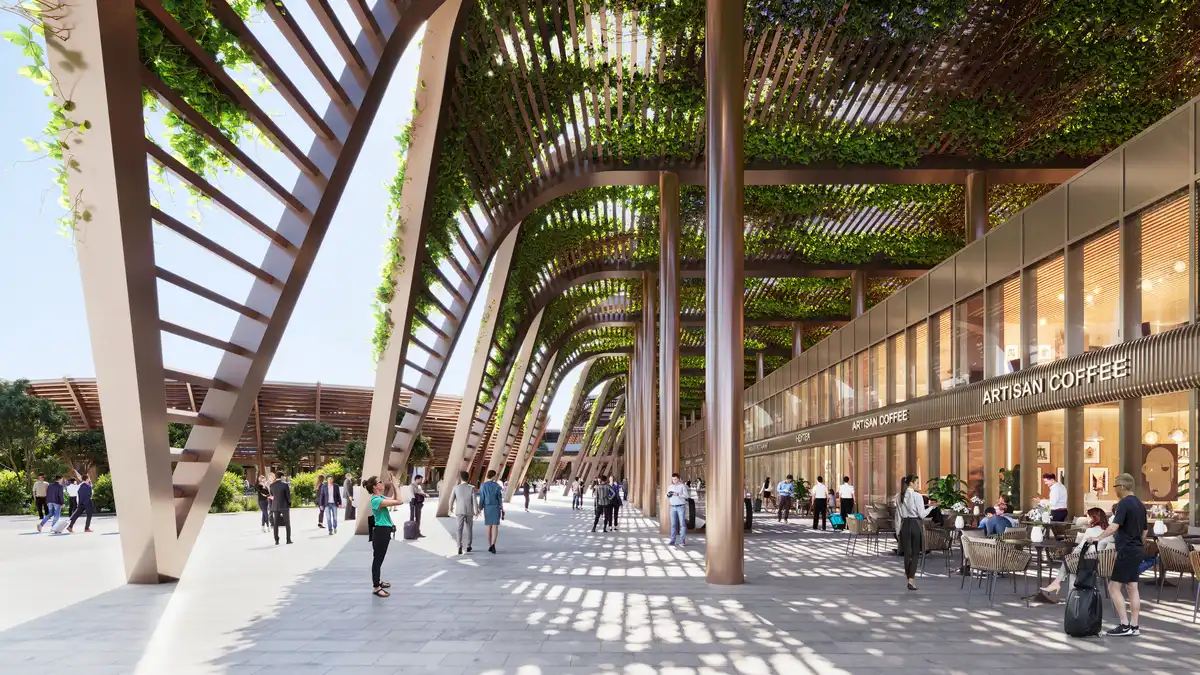
Stormwater from the airport’s runways, taxiways and aprons—as well as the roofs of the passenger terminal and cargo buildings—will be channelled into new wetlands and bioswales for storage and reuse while also enhancing the airport’s local biodiversity. Photovoltaic arrays installed throughout BIA will enable on-site energy production.
Landscaped with native drought-resistant planting including resettled trees, BIA’s design integrates landside public parks for local residents and airside gardens for passengers.
BIA will be connected to the centre of Addis Ababa and the existing Bole Airport via a high-speed rail link, serving as the cornerstone of a new regional transport network. Specifically located for 24-hour operations without the need for a curfew, BIA and its integrated Airport City of mixed-use buildings will create new jobs supporting a local population of 80,000 and enable Ethiopian Airlines to continue its rapid growth and meet future passenger demand. These new developments support the airline’s ‘Vision 2035’ strategy, becoming a leading global aviation group offering passenger, cargo, and MRO (Maintenance, Repair, and Overhaul) services with a focus on technology and efficiency.

Ethiopian Airlines Group
The continent’s leading carrier connecting Africa with the world, Ethiopian Airlines Group was founded in 1945 and is the oldest airline in Africa. The group includes the airline’s Aviation University which will be joined by Boeing’s new African centre of excellence.
Achieving more than threefold growth in the past ten years and targeting similar expansion over coming decades, Ethiopian has become Africa’s largest airline—and one of the fastest-growing airlines worldwide, operating to more than 150 domestic and international destinations across five continents. A key member of the Star Alliance—the world’s largest association of airlines—Ethiopian is implementing its 15-year strategic plan to become one of the leading and most competitive aviation groups in the world.
Meeting International Air Transport Association (IATA) forecasts for East Africa of more than 200% growth over the next decade, the US$12.5 billion investment in BIA will optimise Ethiopia’s position at the crossroads of Africa, Asia and the Middle East (the world’s fastest growing markets for air travel) with a global transportation hub for the 21st century.

In 2024, Ethiopian Airlines Group launched the tender for a strategic design team that would include airfield design, airport masterplan, terminal design and airport city planning. The project was awarded to the team comprising lead consultant, DAR (Dar Al-Handasah) with ZHA as design architects responsible for the new terminal’s technical and functional planning, architecture and interior design.
Bishoftu International Airport in Addis Ababa, Ethiopia – Building Information
Project Team
Client: Ethiopian Airlines (Federal Government of Ethiopia)
Lead Consultant and Airport Planner: DAR (Dar Al Handasah)
Terminal Planner and Design Architect: Zaha Hadid Architects (ZHA)
ZHA Project Director: Cristiano Ceccato de Sabata
ZHA Project Manager: Paul Brislin
ZHA Project Leader: Clara Martins
ZHA Board Oversight: Charles Walker, Mouzhan Majidi
ZHA Project Architects: Leo Alves (Planning), Sai Prateik Bhasgi (Design), Electra Mikelides (Airport City)
ZHA Project Team: Abhilash Menon, Abhishek Jain, Adam Twigger, Aditya Ambare, Afsoon Eshaghi, Akis Polykandriotis, Aleksander Mastalski, Amin Divshali, Arnon van Embden Spanjaard, Aurora Santana, Bahaa Alnassrallah, Bechara Malkoun, Canon Lee, Carlos Bausa Martinez, Charles Walker, Chiara D’Anna, Christoph Geiger, Clara Martins, Cristiano Ceccato de Sabata, Cristina Barrios Cabrera, Dahyun Kim, Danae Mavridi, David Fogliano, Disha Shetty, Electra Mikelides, Elizabeth Konstantinidou, Evgeniya Yatsyuk, Fara Tengku Nasrudin, Genci Sulo, Ghanem Younes, Haohao Chen, Haoyue Zhang, Hyun Jin Kim, Jasmine Abu Hamdan, Jing Xu, Juan Fernandez Castanada, Julian Lin, Jung Yeon Kwak, Karmung Sze, Ken Bostock, Khaled Omara, Laetitia Khachwajian, Lars Elseth, Lenie Mets, Leo Alves, Liam Rogers, Marcella Fedele, Marco Cosmi, Maria Bystrova, Maria-Christina Manousaki, Mariagrazia Lanza, Matt Walker, Meenakshi Sharma, Michael O’Reilly, Michael Rogers, Michelle Sin, Mouzhan Majidi, Murathan Alp Ozok, Nassim Eshaghi, Nicolas Tornero, Ninad Katdare, Ningxin Zheng, Paul Brislin, Pavlos Symianakis, Peter Safranka, Ruzena Maskova, Sai Prateik Bhasgi, Shajay Bhooshan, Shao-wei Huang, Shibani Choudhury, Simona Viviani, Tul Srisompun, Ulrich Blum, Vasiliki Sargkani, Vegard Elseth, Vishu Bhooshan, Wo Lin, Yara Manla, Yaseen Bhatt
Consultants
Contractors: Beijing Urban Construction Group (Enabling Works), China Communications Construction Company (Infrastructure)
Lead Consultant and Executive Architect: DAR Dar Al Handasah
Executive Interiors Architect: Pascall + Watson
Structural Engineers: DAR
Geotechnical Engineers: DAR
Cost Management: DAR
Environmental Sustainability: DAR
Façade Engineering: Maffeis
MEP Engineering: DAR
VHT Engineering: DAR
Transport Consultant: DAR
Fire Engineer: DAR
Landscape Consultant: DAR UK
Architectural Lighting Design: Spectrum
Acoustic Consultant: DAR
Baggage Handling System: BNP Associates Inc.
ICT & Low Voltage: DAR
Security Planning: DAR
Wayfinding: DAR
Retail Planning & Analytics: Portland Design
Airfield and Apron Planning: Landrum & Brown
Airfield City Planner: SPADA Ltd.
Airport Master Planner: DAR + ZHA

Renders by X Universe
Bishoftu International Airport, Addis Ababa, Ethiopia images / information received 140126 from ZHA
Architects: Zaha Hadid Architects – https://www.zaha-hadid.com/
Location: Addis Ababa, Ethiopia, Northeast Africa
Ethiopia Architecture
Ethiopian Architectural Designs – selection:
Berhan Bank Headquarter Addis Ababa, Ethiopia, northeast Africa
Design: Söhne & Partners
image courtesy of architects office
Melaku Center Building, Tigray, Ethiopia
Architect: Xavier Vilalta
image from architect
The British Council
The British Council is the UK’s international organisation for educational opportunities and cultural relations. We work in over 100 countries worldwide to build engagement and trust for the UK through the exchange of knowledge and ideas between people.
We work in the arts, education, English, science, sport and governance and last year we engaged face to face with 13.2 million people and reached 221 million. We are a non-political organisation which operates at arm’s length from government. Our total turnover in 2008/9 was £645 million, of which our grant-in-aid from the British government was £209 million. For every £1 of government grant we receive, we earn £2.21 from other sources. Ref. www.britishcouncil.org
African Architectural Designs
Contemporary Africa Architectural Designs – recent selection from e-architect:
CEM Kamanar Secondary School Senegal, Senegal, West Africa
Niamey 2000, Niamey, Republic of the Niger, West Africa
University of The Gambia – New Campus
Snøhetta
Comments / photos for the Bishoftu International Airport, Addis Ababa, Ethiopia Africa Architecture design by Zaha Hadid Architects and Pascall+Watson Architects page welcome.