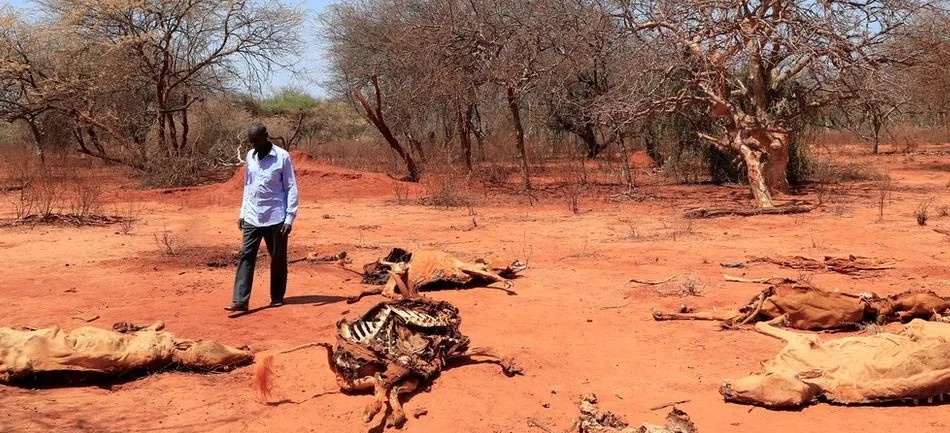
Millions in eastern Africa face an increased risk of food insecurity and water stress as persistent drought affects eastern Kenya, Somalia, Uganda, and Tanzania, a new climate advisory warns.
According to the Intergovernmental Authority on Development’s (IGAD) Climate Prediction and Applications Centre (ICPAC), rainfall deficits over the past three months have led to soil moisture shortages and widespread vegetation stress, raising alert levels across the region.
The advisory, issued Wednesday, January 14, and valid until February 13, identifies several drought hotspots, including eastern Kenya, large parts of Somalia, central Uganda, and some central and northern areas of Tanzania.
“Analysis of October–December rainfall using the Standardised Precipitation Index (SPI) reveals that significant rainfall deficits across most of these areas have persisted in the last three months. Corresponding crop and pasture warning levels indicate that these deficits have translated into soil moisture shortages, vegetation stress, or a combination of both,” reads the advisory.
“Collectively, these conditions have elevated alert levels in the affected areas, signalling heightened vulnerability to agricultural and pastoral impacts.”
The advisory also notes that global climate patterns are influencing the current dry conditions in eastern Africa. According to the report, sea surface temperatures and atmospheric circulation suggest that La Niña is likely to persist in the tropical Pacific but is expected to weaken and probably end by February 2026.
“The current Sea Surface Temperatures (SSTs) and atmospheric circulation anomalies indicate that La Niña is likely to continue in the tropical Pacific, while the Indian Ocean Dipole (IOD) has moved from negative phase to neutral. The neutral IOD conditions are expected to continue through the advisory period, while La Niña is expected to weaken and most likely end during February 2026,” reads the report.
“Although the influences of IOD and La Niña are now diminished or weakening, much of the affected area is now in dry season, between the long- and short-rains seasons, with little prospect of sufficient rainfall to alleviate rainfall deficits and vegetation stress.”
Forecasts for January to March 2026 suggest that drier-than-normal conditions will persist in areas not currently in the dry season, including Kenya, Tanzania, Uganda, Rwanda, and Burundi.
ICPAC warned that this could worsen existing conditions, significantly impacting socio-economic sectors such as agriculture and food security, water resources, livestock, and health.
Maps from the East Africa Agriculture Watch highlight regions in Somalia, Kenya, and parts of Tanzania experiencing both water and biomass stress. Observed SPI for October to December 2025 confirms the persistent rainfall deficit, while seasonal rainfall forecasts predict continued dryness.
The advisory explains that a Climate Watch is issued for areas where drought indicators or crop and rangeland conditions show water and vegetation shortages. It applies to regions covering parts of at least two countries with more than 5 million people at risk.
ICPAC drew on multiple sources, including the East Africa Drought Watch, East Africa Agriculture Watch, and observed sea surface temperature data.
The Centre said the advisory will be updated on or before February 13, 2026.