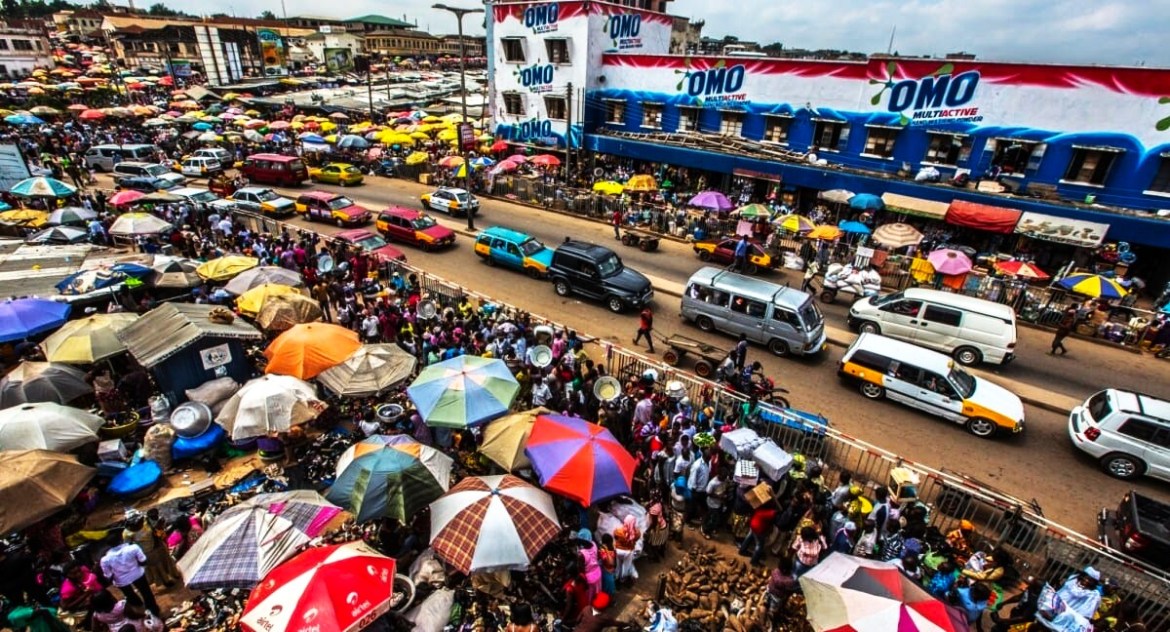
In many parts of Africa, dysfunction is the norm.
That sounds controversial, but it’s not news to anyone on the ground.
Think about it:
About 70 percent of Africans self-medicate without seeing a doctor.
Eight out of ten South Africans still use cash for everyday transactions, despite having many digital options.
And over 600 million Africans still have no access to electricity.
What’s interesting is that over the last ten years, innovation has been rising steadily on the continent.
Startups have built solutions to many problems, from healthcare to fintech and power.
Yet, the dysfunction persists.
To see why, let’s take a walk through one of Africa’s most important “products” that nobody ever designed.
The market that wasn’t “built”
There’s a market in Nigeria that’s the size of a small town.
It’s called Onitsha Market.
The Onitsha Market, the largest market in West Africa.
Here, hundreds of thousands of traders set up shop selling all kinds of things: textiles, shoes, food items, car spare parts, and even electronics.
And every year, about USD 5 billion worth of goods are sold here.
There’s just one problem: it’s chaos.
Onitsha Market wasn’t planned.
It emerged from an organic sprawl of stalls, shacks and improvised structures piled on top of each other.
Walking through it feels like crossing an environmental minefield:
It’s overcrowded.
On busy days, traffic hits 100,000 people.
Drains are blocked, with refuse dumps right next to food stalls.
It’s so dense that multiple studies have flagged it as a serious fire and health risk.
And Onitsha is not a one‑off.
Across the continent, open markets are where trade, transactions and dysfunction collide:
Gikomba Market, a major market in Nairobi, has seen more than 15 major fires between 2015 and 2022
In Nigeria, Ariaria Market saw 70 percent of its stalls using illegal electrical wiring, increasing the risks of fires.
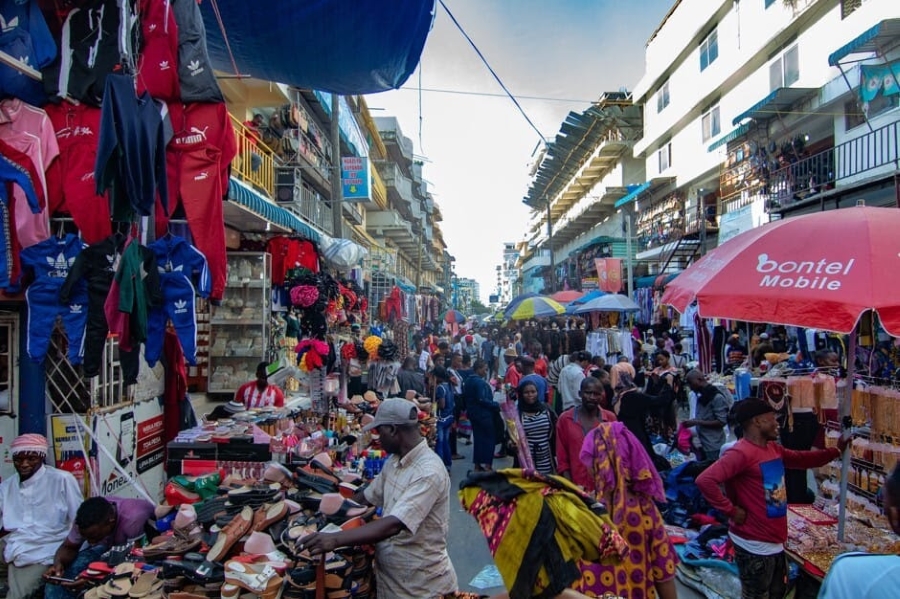 Kariakoo Street Market in Dar-es-salaam
And in Dar es Salaam, Tanzania’s capital, 40 percent of cars can’t move around during peak hours at the Kariakoo market, due to overcrowding.
Fires are also common at Kariakoo, the 24/7 busy center.
Anyway, all these markets are hazardous, congested, and wildly inefficient.
They’re also indispensable.
They’re how goods actually move.
So, 16 years ago, a group of founders tried to put this mess online.
When infrastructure isn’t enough
You know this story.
In 2009, Jumia launched with a clear promise: to help everyday Africans buy goods via the internet.
And on paper, it made perfect sense.
No more unsafe, overcrowded markets.
No more hours lost in traffic.
And access to more products than any physical stall could hold.
If you could buy from your phone instead of fighting your way through a crowded market, why wouldn’t you?
But more than a decade later, the numbers tell a different story.
In most of Africa, e-commerce makes up less than 3 percent of all commerce.
In Nigeria, Jumia’s biggest market, e‑commerce makes up just about 6 percent of retail-level sales. Jumia’s cut is only a slice of that.
What’s more revealing is how much Jumia had to build just to get here:
A continent‑wide logistics network because public postal systems were under‑capacity.
JumiaPay, its own payments layer because existing rails weren’t good enough.
A huge marketing machine to convince customers to trust buying what they couldn’t touch.
Jumia is not unique.
In Africa, startups are often forced to build not just a product, but the surrounding infrastructure: logistics, payment rails, education, and even regulation‑adjacent processes.
Sometimes they succeed.
But often, after all that work, the old, “broken” way of doing things still wins.
Policy has the same problem.
Nigeria’s cashless policy was first rolled out in 2007.
Yet, it took nearly a decade before financial inclusion started meaningfully rising. Even today, cash is still everywhere.
So, if:
Building the solution isn’t enough,
Building the infrastructure isn’t enough,
And raising capital doesn’t automatically shift behavior…
What actually moves the needle?
Underneath the chaos, there’s a quieter force calling the shots.
The real infrastructure: trust
In 2023, Africa’s online payments market generated about $15 billion from 47 billion transactions.
Big number. Until you realise that’s still only around 5% of all payment activity.
Cash still dominates.
Why?
Because cash has a superpower: finality.
Once you hand over notes, the transaction is done.
No failed transfers. No network downtime. No reversed debits with no explanation.
No “pending” status that never clears.
In a world of unreliable systems, cash is the simplest form of trust.
In South Africa, cash still accounts for more than half of all payments.
This is in a country with world‑class banking and plenty of digital options.
Scratch the surface, and it gets clearer: Africa is a low‑trust environment.
In one survey, only about 14 percent of Nigerians said, “most people can be trusted”.
A study by Klasha and TechCabal found a major trust gap between African consumers and businesses.
Customers fear hidden fees, poor quality, and impossible refunds
Businesses fear chargebacks, fraud, and regulatory uncertainty
When systems fail, people don’t switch to “the future.”
They switch back to what works, even if it’s dangerous, inefficient, or technically worse.
And that’s why:
Onitsha Market remains a massive economic engine despite its chaos.
And so is the Kariakoo in dar-es-Salaam where traders from as far as Zimbabwe, Zambia, Malawi and DR Congo flock on daily basis
Two‑thirds of banked customers still say they trust traditional banks over fintechs.
Millions of people on a continent with low health literacy still self‑medicate, despite the risks.
In this context, dysfunction isn’t just a bug.
It’s a service.
It’s a rough, informal operating system that people know how to navigate, because they’ve had to, for decades.
And for a new product to win, it’s not enough to be more modern.
It has to be more trusted than the existing dysfunction.
The good news? Some players have already shown what that looks like.
Trust me, bro
Some African products have managed to cross the trust barrier.
Like M-PESA.
When Safaricom launched M‑Pesa in Kenya in 2007, it didn’t ask people to believe in an entirely new system.
Instead, it tapped into something they already trusted: cooperative savings groups and community lending circles.
M‑Pesa slotted into that familiar mental model:
Agents were often local shopkeepers whom people already knew.
The interface used USSD, which was familiar to mobile phone users.
The logic (send, receive, store value) felt like a convenient upgrade to the status quo, not a replacement.
M‑Pesa borrowed trust from Safaricom’s brand, local agents, and the social capital of savings groups.
Within a few years, it became the default way to send money, pay bills, and run small businesses.
Then there’s Paystack.
In Nigeria, Paystack didn’t set out to transform African payments in one go.
It focused on one painful problem: online card payments that just didn’t work.
The company built a plug‑and‑play payment gateway that made “card transaction successful” feel normal:
Easy integration for merchants.
Clear, human support for businesses.
Reliable dashboards, invoices, and transaction records.
By helping merchants understand and trust every inflow, Paystack reduced the anxiety around money “disappearing” into the system.
Today, more than 400,000 businesses use Paystack because it makes digital payments feel less risky than the old way, not more.
In Nigeria, Fez Delivery goes beyond just picking up and dropping off parcels.
It adds specific trust‑building features:
Safe lockers for customers who won’t be home.
Live parcel tracking so customers can see exactly where their delivery is.
Clear communication when something goes wrong.
Each feature is aimed at a particular trust‑breaker: failed deliveries, stolen packages, opaque processes.
To the average customer, Fez isn’t just “faster logistics tech.” It’s “my stuff is less likely to disappear.”
These companies have one thing in common: they treat trust as a part of the infrastructure.
And after a while, customer behaviour tips over.
Innovation becomes safer than the old way.
And dysfunction becomes unattractive.
Beating dysfunction at its game
If you zoom all the way out, the biggest competitor for most African startups is not another startup.
It’s dysfunction:
The open market that’s a fire hazard, but always has what you need.
The risky cash economy that always settles instantly.
And the local chemist shop that’s cheap and always available.
Call it Dysfunction as a Service: a network of improvised, informal systems that deliver just enough value to beat fragile new ones.
To win against DaaS, your product doesn’t just have to be better; it has to be trusted and predictable.
And all of Africa’s most successful products have trust as a feature.