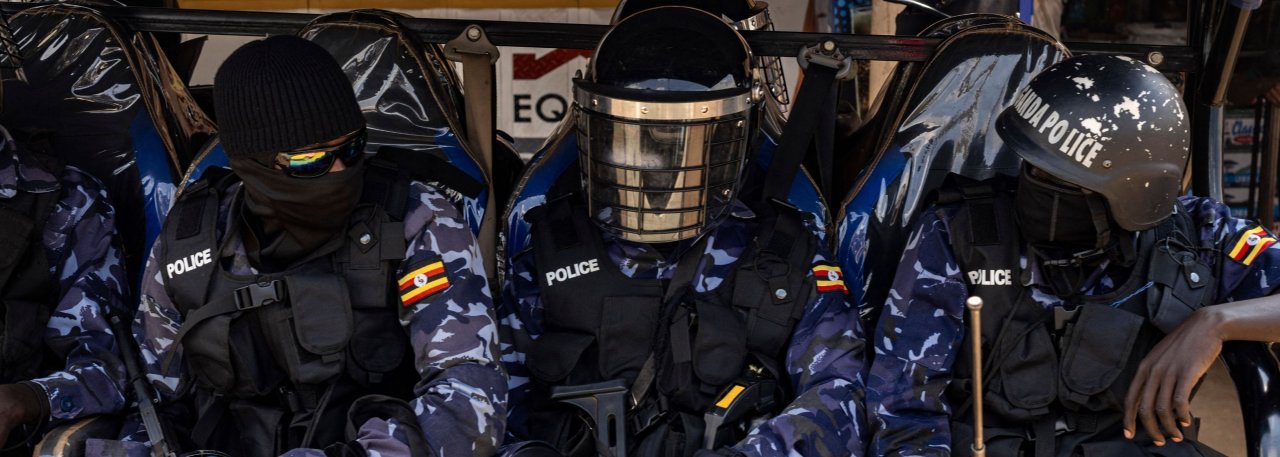
As Ugandans prepare to vote in the 15 January 2026 general elections, systematic repression and restrictions on fundamental freedoms threaten the credibility of the process. The International Federation for Human Rights (FIDH) urges authorities to take immediate steps to ensure transparency, safety, and openness essential for genuine democratic legitimacy.
Paris, Johannesburg, 14 January 2026. With just one day until polling day, the electoral environment is marked by severe restrictions on opposition activity and civic participation. President Yoweri Museveni, seeking a seventh consecutive term, faces a main opposition challenger in presidential candidate Bobi Wine, but the campaign has been conducted under conditions that raise serious concerns about fair political competition. Opposition supporters face arrest and intimidation, leading opposition figures have been detained, journalists covering opposition activities have been assaulted, and restrictions on digital communications threaten to limit voters’ access to diverse information sources. These conditions create a risk that electoral outcomes may not reflect genuine voter choice.
Detention of opposition leaders and electoral participation
Opposition leader Dr Kizza Besigye was abducted from Kenya on 16 November 2024 and remains in detention on treason charges, preventing his participation in the 15 January elections. His detention raises questions about whether all major opposition figures have had equal opportunity to contest the presidency.
Human rights lawyer Sarah Bireete, who has documented human rights violations, and has been a leading voice on electoral management monitoring, was arrested on 30 December 2025—just 16 days before the election—on charges related to accessing the national voters’ register. Her arrest raises concerns about the treatment of those seeking to monitor electoral processes.
On 9 January 2026, the National Bureau for Non-Governmental Organisations suspended the operating permits of five prominent CSOs – Chapter Four Uganda, the Alliance for Election Finance Monitoring (ACFIM), the Human Rights Network for Journalists-Uganda (HRNJ-U), the National NGO Forum, and the National Coalition of Human Rights Defenders. The Bureau cited alleged prejudice ‘to the security and the laws of Uganda’ under Section 42(d) of the NGO Act, Cap. 109 (as amended), and ordered the freezing of their accounts. These organisations play an essential role in defending civic freedoms, moniroting elections, and supporting human rights. Their suspension just days before the polls further narrows the civic space and undermines independent oversight of the electoral process.
Opposition mobilisation and campaign violence
The National Unity Platform (NUP), the main opposition force led by presidential candidate Bobi Wine, has faced significant obstacles to campaigning. Over 400 NUP supporters have been arrested on politically motivated charges in recent months. During the Kawempe north by-election in March 2025, security forces killed NUP supporter Miseach Okello during opposition campaign activities.
NUP rallies have been disrupted by security forces, limiting candidates’ ability to campaign and citizens’ opportunity to hear political messages. These restrictions on opposition campaign activity undermine the ability of voters to make informed choices between competing candidates.
Media freedom and access to information
With election day approaching, journalists and media practitioners face considerable pressure, as stated by the African Commission on Human and Peoples’ Rights. At least 32 journalists were assaulted by security operatives during the March 2025 by-election, with equipment confiscated or damaged. In October 2025, The Observer media office was ransacked with twelve computers stolen, and accreditations for journalists from NTV Uganda and The Daily Monitor were revoked in what appears to be retaliation for critical reporting.
The government’s directive to Starlink to disable satellite internet as of 1 January 2026 raises concerns about a potential internet shutdown during the election period, similar to the four-day blackout during the 2021 elections. The African Commission on Human and Peoples’ Rights has expressed concern about such measures, noting that Internet shutdowns and restrictions on digital communications violate Article 9 of the African Charter on Human and Peoples’ Rights. Restrictions on internet access and media freedom limit voters’ ability to access diverse sources of information and make fully informed electoral choices.
Electoral credibility and democratic standards
For elections to have genuine credibility and reflect the will of voters, they must take place in an environment where opposition candidates can campaign freely, opposition supporters can participate without fear of persecution, journalists can report without harassment, and voters can access diverse information sources. The current conditions in Uganda—with leading opposition figures detained, supporters arrested, journalists assaulted, and digital communications restricted—fall short of these standards and create a serious risk that election results will not accurately reflect voter preferences.
FIDH calls on Ugandan authorities to:
1. immediately release opposition leaders and candidates detained in ways that prevent their electoral participation, including Kizza Besigye;
2. ensure the safety of opposition candidates and supporters, enabling free campaign activities;
3. end harassment, arrest, and intimidation of journalists and media practitioners covering elections;
4. guarantee full internet access throughout the election period and refrain from shutting down digital communications;
5. ensure transparent vote counting and results verification with meaningful observation by independent monitors.
FIDH calls on regional and international bodies, the African Union and East African Community to;
1. ensure that election observation missions have full access to monitor conditions and results;
2. impose targeted sanctions on officials responsible for human rights violations and the suppression of electoral competition;
3. demand that Uganda comply with international human rights obligations and the African Charter on Democracy, Elections and Governance;
4. support Ugandan civil society and journalists through protection mechanisms and international advocacy;
5. withhold endorsement of electoral results unless election conditions meet international standards for free and fair elections.
The 15 January 2026 elections can only have genuine democratic legitimacy if the severe restrictions currently limiting opposition mobilisation, media freedom, and civic participation are immediately lifted. The regional and international community must support credible, transparent electoral processes that enable Ugandans to freely choose their leaders. FIDH urges all actors to ensure that Uganda’s elections reflect the will of the Ugandan people, not the interests of those in power.