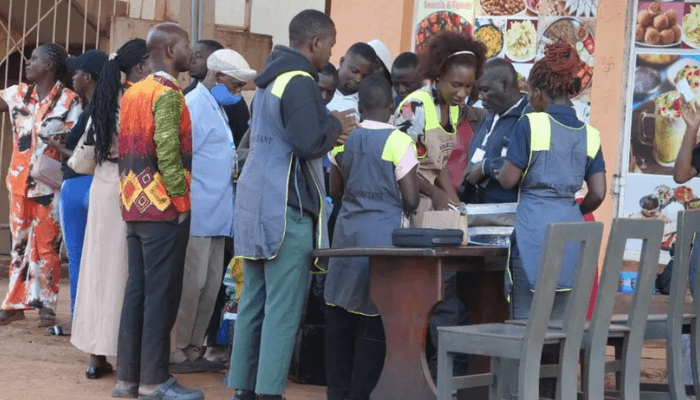
Polls have opened in Uganda’s presidential and parliamentary elections, but voting has been disrupted by logistical delays, tight security, and a nationwide internet shutdown that has drawn criticism from rights groups.
By mid-morning in the capital Kampala, voting had yet to begin at several polling stations an hour after the official opening time. Journalists observed delays blamed on failures of biometric voter identification kits, a problem election officials and observers say may be linked to the internet outage imposed days before the vote.
Read also: Museveni set to extend 40 years in power as Uganda votes under cloud of violence
Ugandans are voting in a tense atmosphere, with President Yoweri Museveni widely expected to extend his nearly forty years rule amid a heavy police crackdown on the opposition and fears of election day violence.
The internet shutdown, ordered by the Uganda Communications Commission and enforced by mobile network operators from Tuesday evening, has cut off public access to online platforms nationwide.
Authorities say the move is meant to prevent misinformation and unrest. The United Nations Human Rights Office has condemned the blackout, calling it “deeply worrying”.
Read also: Uganda opposition says more than 300 supporters detained as election campaign heats up
“Open access to communication and information is key to free and genuine elections,” the UN said in a statement. “All Ugandans must be able to take part in shaping their future and the future of their country.”
Heavy police and army patrols have been deployed across major cities and towns. AFP journalists reported a strong security presence in Jinja, while in Kampala armoured vehicles were stationed at key junctions and officers marched through neighbourhoods in formation. Some residents said they had left the city to vote in rural areas, fearing unrest.
“Ugandan elections are often violent, so I decided to re register my polling centre in my home village,” one voter told the BBC, speaking anonymously. “The security presence in the city is intimidating.”
Read also: Uganda’s 81-year-old president confirms bid for seventh term in office
At the centre of the presidential race is an expected showdown between Yoweri Museveni, 81, who is seeking a seventh successive term, and Bobi Wine, 43, the pop star turned opposition leader whose real name is Robert Kyagulanyi. Six other candidates are also on the ballot.
Museveni, who has ruled since 1986, presents himself as the guarantor of stability and development. Wine has campaigned on promises to fight corruption and deliver sweeping political and economic reforms, especially for young people.
Uganda has more than 21.6 million registered voters, and about 70 percent of the population is under 35. Unemployment, rising living costs and lack of opportunity dominate concerns for first time voters, alongside poor infrastructure and unequal access to education and healthcare.
The campaign period has been marked by repeated clashes between security forces and opposition supporters. Amnesty International has accused authorities of running “a brutal campaign of repression”, citing the use of tear gas, pepper spray, beatings and mass arrests at opposition rallies.
Police spokesperson Kituuma Rusoke has rejected the accusations, blaming supporters of Wine’s National Unity Platform party for provoking disorder.
Wine lost to Museveni in the 2021 election, officially securing 35 percent of the vote against the president’s 59 percent. He rejected the result, alleging widespread fraud.
Tensions have also surrounded the vote counting process. Simon Byabakama, chair of the electoral commission, told the BBC he had received threats linked to the outcome.
“Some people say if you do not declare so and so as president, you will see,” he said. “I tell them I am not in the business of donating votes. Only voters will decide.”
Polling is due to close at 16:00 local time, with anyone already in the queue allowed to vote. Partial results are expected later on Thursday, while the final presidential result is due to be announced by Saturday.
Uganda’s past elections have often been violent. During protests after the 2012 polls, dozens of people were killed, with security forces implicated in several deaths, according to a BBC investigation. As voting continues, many Ugandans remain hopeful but cautious, casting their ballots under the watchful eye of the state.
Faith Omoboye is a foreign affairs correspondent with background in History and International relations. Her work focuses on African politics, diplomacy, and global governance.