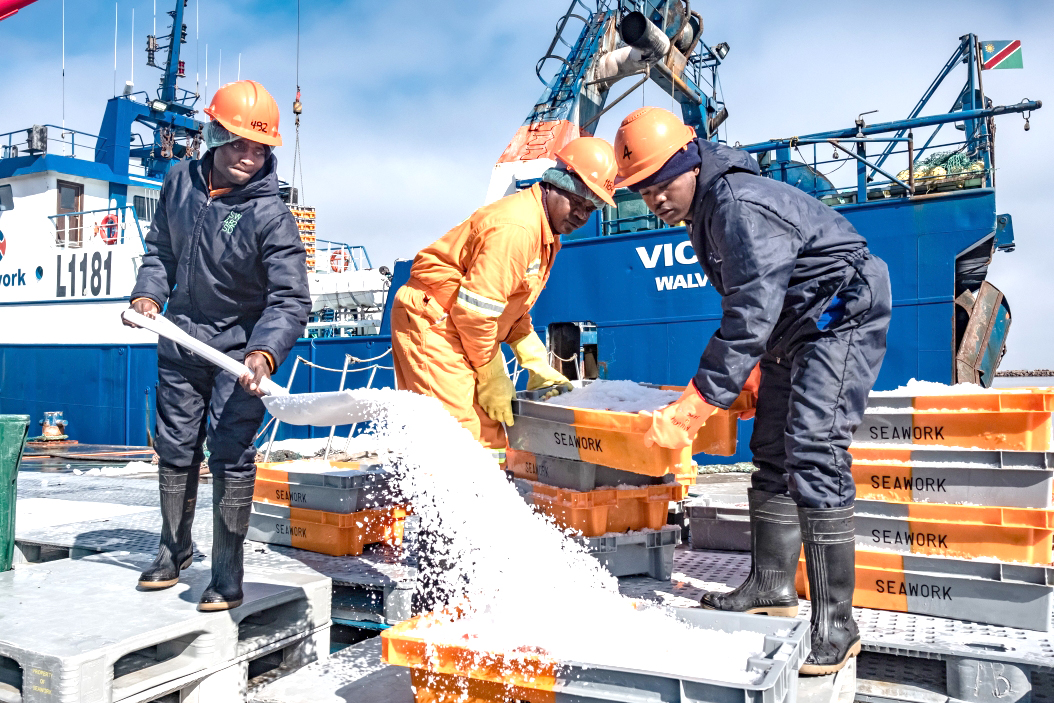

Namibia’s hake fishery has secured its second Marine Stewardship Council (MSC) certification, reinforcing the industry’s commitment to sustainable fishing practices. The hake industry contributes significantly to Namibia’s economy, accounting for approximately 7% of GDP and providing around 16 000 direct jobs.
MSC certification has enhanced market access, allowing Namibian hake to meet global demand for sustainable seafood and expand into new markets. MSC is an international non-profit organisation that sets globally recognised standards for sustainable fishing and the seafood supply chain.
Fisheries representing 20% of the world’s wild marine catch are engaged in its certification program, including six African fisheries. The MSC works with fisheries around the world to combat overfishing, including the six MSC certified African fisheries supplying the global seafood supply chain with sustainable hake and tuna.
Namibia’s hake fishery has implemented a harvest strategy aligned with scientific advice, high observer coverage, and monitoring programmes to protect sensitive habitats and mitigate interactions with wildlife. Matti Amukwa, chair of the Namibian Hake Association, noted that, “Since [the country’s] Independence, the government, scientists, and industry have worked hand-in-hand to rebuild the hake resource and create a profitable fishing industry that gives back to people and the environment. Achieving MSC certification, first in 2020 and now, has been a team effort and provides assurance to the world that we are committed to the sustainability of Namibian hake.”
In 2020, Namibian hake trawl and longline fishery targeting two species of hake became the first fishery in the country, and the second in Africa, to meet the globally recognised, science-based standard for sustainable fishing set by the MSC.
Yesterday, 14 January 2026, the fishery achieved its second MSC certification after a rigorous, independent assessment led by Control Union (UK) Limited, which examined hake stocks, the fishery’s management processes, and ecosystem impacts.
As part of the stock rebuilding plan, the fishery has implemented a clear harvest strategy, with catch targets aligned with scientific advice. The MSC certified Namibian and South African hake trawl counterparts, targeting the same M. paradoxus stock, are required to collaborate and share information on their stock assessments.
In addition to high rates of observer coverage at sea and effective on-land monitoring and surveillance, the fishery has also implemented a program to evaluate risks to sensitive habitats.
Namibian hake fishers continue to assess and manage their impacts on Cape fur seals and seabirds, ensuring fleet-wide deployment of bird-scaring lines and trialling an acoustic deterrent to mitigate interactions with seals. Supported by the MSC’s Ocean Stewardship Fund, the fishery is working with international bio-acoustic expert, Dr Thomas Götz, and sound technology manufacturers, GenusWave, to test and deploy targeted acoustic startle technology (TAST) to safely deter seals from hake fishing boats.
MSC’s programme director for Africa, the Middle East and South Asia, Michael Marriott, congratulated the fishery on its recertification. “We applaud the Namibian Hake Association, the ministry, and their partners for securing their second MSC certificate. What has been very positive in Namibia is not only stakeholder collaboration within the country but also cooperation with external experts and other stakeholders operating on the same resource. There is a drive to improve, to explore new technological innovations, and a commitment to safeguard the hake resource for the future,” he said.
Kirsten Manasterny of Merlus Group added that, “What I love about Namibia is the vast space and natural biodiversity. I also love the commitment by everyone to keep it that way, and I see MSC as a great role partner on this journey.
Hake, the Cape fur seal, and seabirds all have a place in our biodiversity.”
MSC certification has given Namibia hake a competitive edge, helping to meet the demand in existing markets as well as expand into new markets where retailers and brands preferentially stock MSC certified whitefish in line with consumer expectations.
“Our hake has gained very much in popularity over the last few years, and I think one of the main reasons is that the resource is certified as sustainable and we can show this with the MSC’s ecolabel on our products. Since the first certification, we have gained access to several new, high-value markets and are known in Europe and elsewhere for our quality hake and good environmental and ethical practices,” said Tristan Przybylski of Seawork Fish Processors.
Miguel Angel Tordesillas of Novanam & Nueva Pescanova explained that, “The fishing industry is very important to our country. Not only does it contribute roughly 7% to Namibian GDP, but it also employs approximately 16 000 people in direct jobs and, indirectly, a coefficient of three. Of this, the hake industry is the biggest constituency of the Namibian fishing industry.”
Tordesillas, who also serves on the MSC’s global Stakeholder Advisory Council, added that, “I’m most proud of two things. First, we were recertified, which means we are still meeting the high standards set by the MSC. Secondly, the way in which the hake industry has put aside our natural competitiveness, which allowed us to work together in ensuring continued good practice, transparency, and building trust in the way we look after the ocean.”
-ebrandt@nepc.coom.na