Ayọ̀ Akínwándé examines restitution, spiritual provenance, and the unresolved tensions between royal authority, state power, and museum-making in Benin City.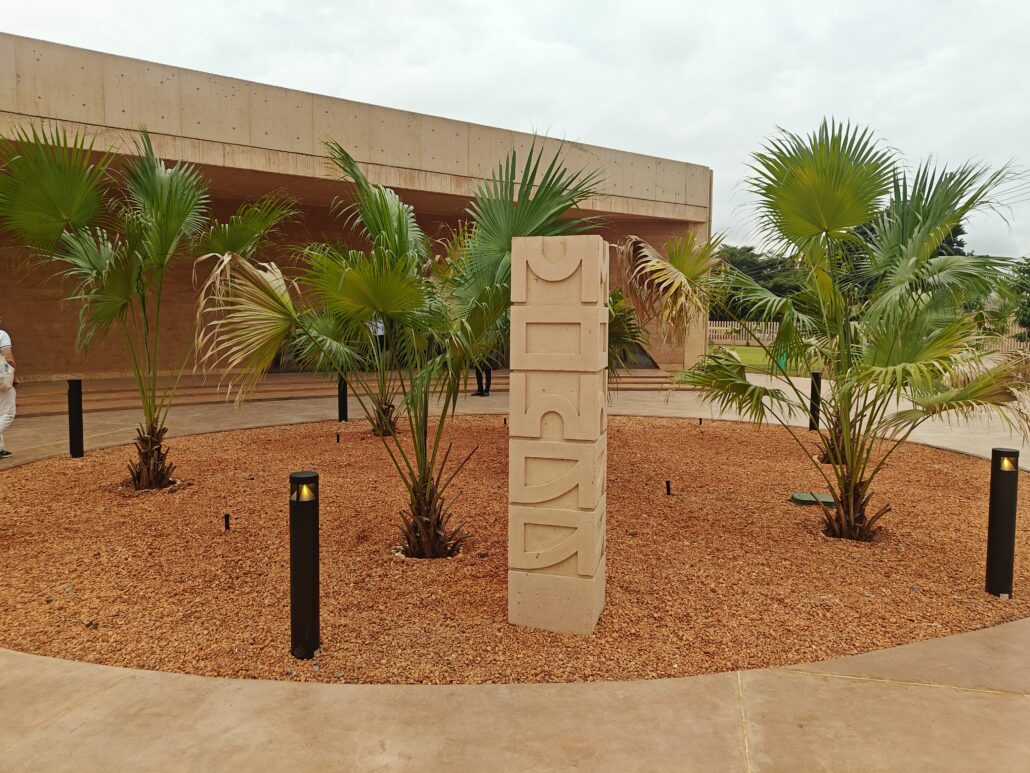 Interior and gallery views of the Museum of West African Art (MOWAA), Benin City, 2025. Photo: Bolaji Alonge.
It is appropriate to begin any inquiry into Benin’s history with reverence, and so I gesture toward Osanobua – the Supreme Being in Edo cosmology – whose presence is invoked not as ornament but as a reminder that the spiritual, historical, and political have always intersected here.¹ This invocation is my entry point: not merely as a Nigerian, but as an artist and researcher invested in what I call spiritual provenance, a way of understanding that centres rituals, metaphysical histories, and ancestral charge. While Western provenance prioritises documentation, materiality, and carbon dating, spiritual provenance asks: Which ceremonies consecrated these objects? To which ancestors or deities were the treasures dedicated? What cosmic role did they serve? When such objects are uprooted, the ‘Benin Treasures’, a phrase used by art historian and member of the Benin Royal Family, Professor Peju Layiwola, embracing the famed bronzes, ivory, iron, textile, metal, wood and other materials, their spiritual ecology is disturbed, and that disturbance matters.²
To speak of restitution without acknowledging these spiritual biographies is to sever cultural artefacts from their essence. And to speak of “progress” without asking who defines it is also to ignore how deeply power, history, and tradition remain entangled in these debates.³
No conflict illustrates this rupture more clearly than the crisis surrounding what was once promised as the Benin Royal Museum, later rebranded as Legacy Restoration Trust/Edo Museum of West African Art/Museum of West African Art (LRT/EMOWAA/MOWAA), and the deep fracture between the Oba of Benin and the Obaseki family—a lineage entangled in the colonial history of 1897.⁴
During the British invasion, Chief Agho Obaseki, a high-ranking palace official, collaborated with the British, who elevated him to the rank of “paramount chief,” granting him administrative authority over Edo governance and palace affairs.⁵ Many Edo people accused him of betraying the Oba.⁶ This legacy is often invoked in debates about Godwin Nogheghase Obaseki, who governed Edo State from November 2016 to November 2024.⁷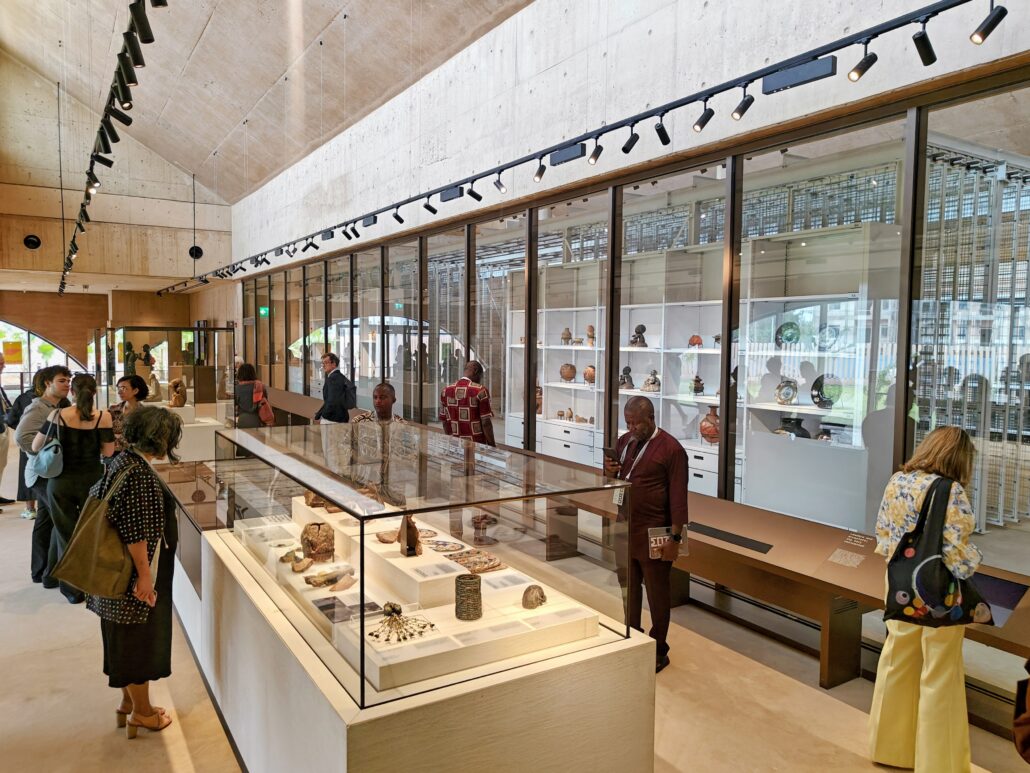
Interior and gallery views of the Museum of West African Art (MOWAA), Benin City, 2025. Photo: Bolaji Alonge.
The fracture is not only political but also cosmological. In the Edo worldview, kingship is sacred, and succession is guided by Osanobua. ⁸ By installing Agho Obaseki as the paramount chief, the British violated not just dynastic order but a metaphysical chain of command.⁵ The displacement of Oba Ovonramwen in 1897 constituted spiritual violence, whose reverberations continue today. Many traditionalists interpret the disagreements surrounding MOWAA as a continuation of unresolved spiritual tensions, resurfacing through the same family line and state mechanisms that again attempt to circumscribe royal authority.⁹
Governor Obaseki defended his engagement with MOWAA during his administration. He noted that he was not a trustee but facilitated an enabling political environment for cultural development.⁷ Furthermore, he reiterated that the project involved multiple stakeholders, including federal and international partners and the Palace, and that substantial investment and MOWAA’s realisation could not have been achieved without such coordination.¹⁰ Significantly, he emphasised that he engaged Prince Ezelekhae Ewuare (“Crown Prince”) to represent the Palace in early discussions.¹¹ The Oba has described Obaseki’s action as unfortunate and divisive, as it reveals an attempt to circumvent him while giving the public and potential funders the impression that the Palace was in support of the initiative. According to the 2025 memorandum by Prince Aghatise Erediauwa, Obaseki and his associates, particularly Phillip Iheanacho and Enotie Ogbebor, were alleged to have “commandeered” the restitution process, attempting to profit from it while giving the impression that the Palace supported the initiative.¹² That memorandum states that Prince Ezelekhae Ewuare’s (“Crown Prince”) involvement was an attempt to legitimise Obaseki’s private initiative, the Legacy Restoration Trust (LRT), which sought funds abroad without the Oba’s consent.¹³ A 2025 Palace press briefing further accused Obaseki of having “contrived” the process around MOWAA, reinforcing claims of usurpation of ancestral authority.¹⁴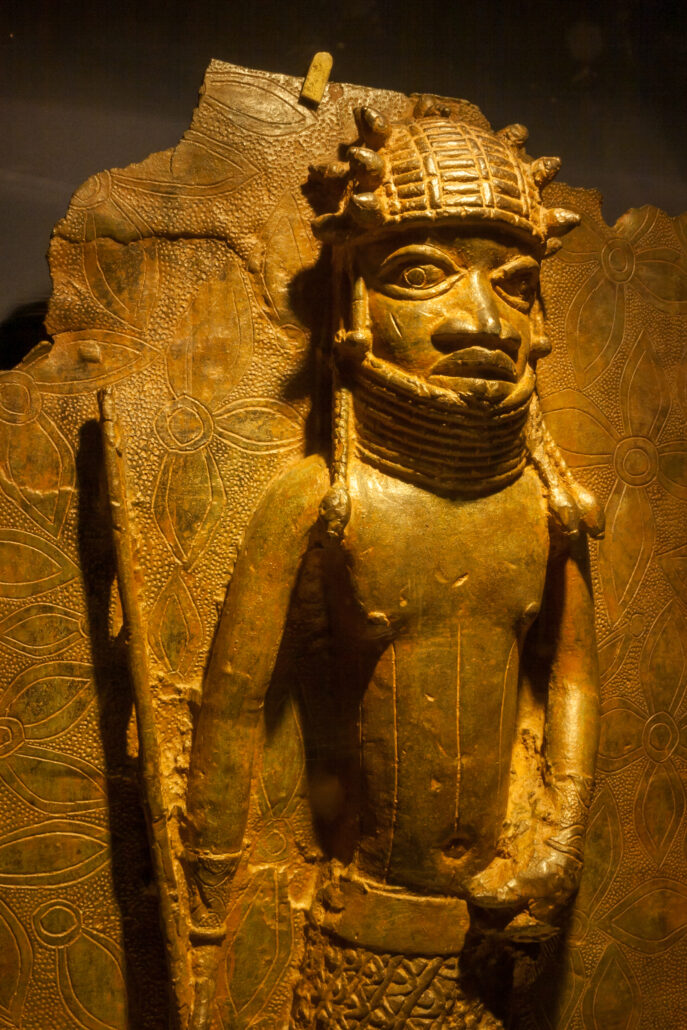
Benin Bronzes at the Horniman Museum. Photo: Mike Peel, CC BY-SA 4.0 via Wikimedia Commons.
In Benin tradition, even though succession follows the principle of primogeniture, the Oba’s first male son does not automatically become Crown Prince. He must first be formally sent by the Oba to Iselu, where he undergoes sacred initiation rites that prepare him spiritually, ritually, and culturally for kingship. Only after completing these rites and being installed as Edaiken, the official, palace-sanctioned heir, does he attain the title of Crown Prince. Until this process is completed, the correct and respectful designation is Prince Ezelekhae Ewuare. Any external use of “Crown Prince” has no standing within Edo spiritual or traditional protocol.
Historical accounts attribute to Oba Akenzua II (40th Oba of Benin, reigned 1933–1978, grandfather of the current Oba), the first public calls for the return of the Benin Treasures as early as 1935.¹⁵ Indeed, the Benin Royal Museum, originally conceived well before Obaseki’s governorship and funded in the 2018 budget with N500 million, was reportedly intended solely to house repatriated artifacts. Meetings by the Benin Dialogue Group in July 2019 confirmed this vision, yet Obaseki and his associates allegedly rebranded it as LRT/EMOWAA/MOWAA, diverting the project from its original conception.¹⁶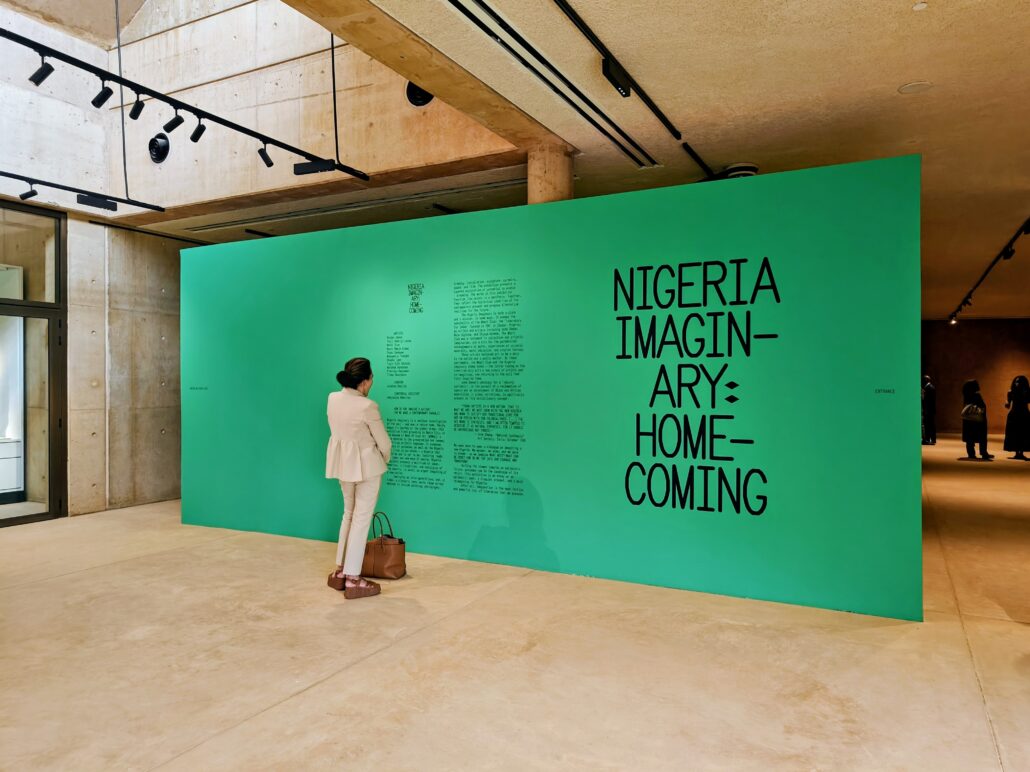 oplus_9437186
Interior and gallery views of the Museum of West African Art (MOWAA), Benin City, 2025. Photo: Bolaji Alonge.
Today, many non-Edo critics frame Oba Ewuare II as an “enemy of progress,” yet this framing collapses under scrutiny. Progress is not universal; it is cultural. Glass façades, monumental architecture, and donor-backed institutions cannot overwrite the Edo understanding that heritage is cosmology, not display.¹⁷ MOWAA facilities include a research institute, conservation laboratories, and a Rainforest Gallery.¹⁸ However, MOWAA’s Director, Phillip Iheanacho, explained that clay replicas by artist Yinka Shonibare were temporarily displayed during the museum’s public opening because the original Benin Treasures remain in the custody of the Oba or the National Museum in Lagos.¹⁹ According to Prince Aghatise’s memorandum, during events at the Smithsonian Institution and the Horniman Museum, Obaseki was present while federal officials allegedly withheld or misrepresented documents concerning the returned artifacts — raising serious concerns about transparency and accountability.²⁰
Beyond architecture, a museum is also a site of artistic canonisation — a space where narratives, legitimacy, and cultural authority are produced. When the foundations of such an institution are contested or misaligned with ancestral protocol, the canon it creates risks reproducing the same distortions it claims to redress. A museum built on shaky cultural ground cannot claim to advance progress; it merely reframes old hierarchies under a new façade.
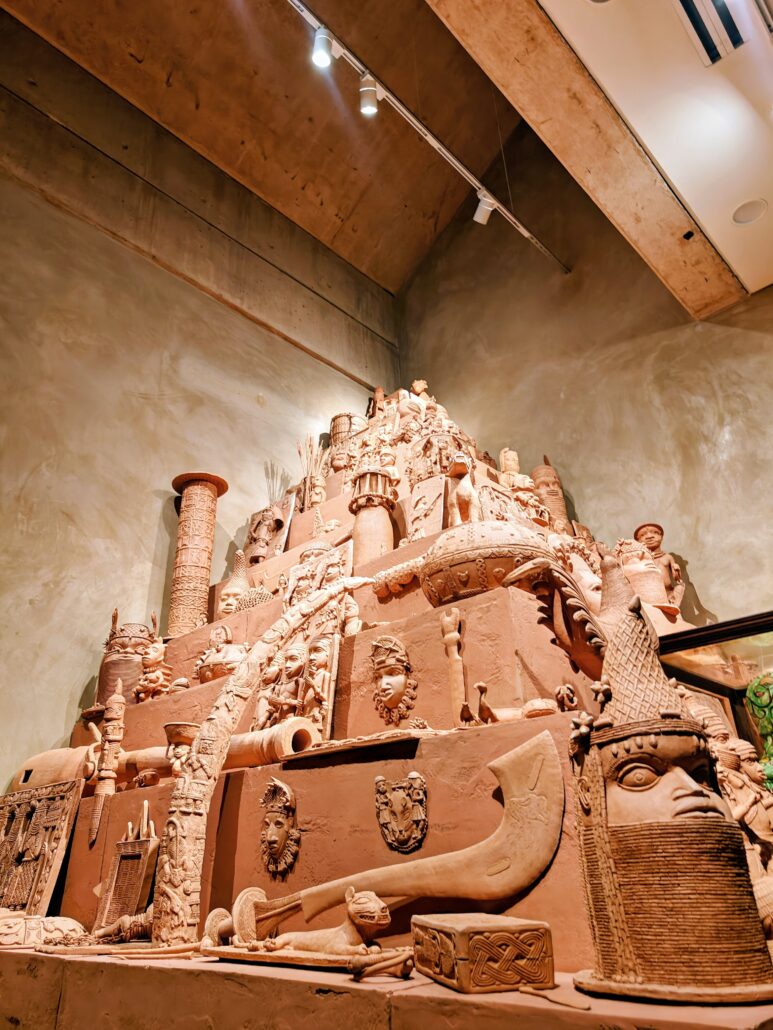 Yinka Shonibare CBE RA, Monument to the Restitution of the Mind and Soul (2024), clay installation at the Museum of West African Art (MOWAA), Benin City. The work reconstructs clay replicas of Benin Bronzes looted in 1897, reflecting on cultural memory and restitution. Photo: Bolaji Alonge, 2025.
Supporters of MOWAA have said the museum wasn’t built to house the Benin Treasures. Yet these same artifacts were central to its fundraising, publicity, and international partnerships. As an artist, I welcome a museum, but when its foundational mandate is riddled with contradictions and protocol breaches, it becomes difficult not to conclude that this is less a museum of antiquities than a museum of iniquities.
Ifeoma Dike observes, “Innovation must work hand in hand with tradition… A museum of Edo civilisation must be built with Edo people, not simply in Edo land.”¹³ True progress requires integrity.
The MOWAA Archaeology Project (2021–2025) adds a further layer of complexity. Conducted under Governor Obaseki’s tenure, it is among the most ambitious archaeological undertakings in recent Nigerian history.²¹ The site lies within the historic palace precinct destroyed in 1897, later occupied by the Benin Central Hospital.²² Excavations, funded by a £3 million grant from the British Museum, uncovered precolonial architectural foundations, wells, workshops, and colonial era deposits.²³ Ore Disu, Director of the MOWAA Institute, noted that over 100,000 pottery shards and other artifacts were recovered.²⁴ Despite the British Museum’s involvement, the Oba has publicly denied the Palace’s involvement.²⁵ Combined with a lack of transparency, this led concerned Edo observers to view the project as extraction under another guise.²⁶ Prince Aghatise further notes that the Federal Government of Nigeria Gazette of 28 March 2023 formally vested ownership of the artifacts in the Oba, yet federal officials and European donors continued to fund and recognise Obaseki’s group, ignoring these legal and cultural directives.²⁷
The irony deepens: the British Museum funds excavations in Edo while declining overtures to return any of the over 900 looted Benin Treasures it still holds, often citing Nigeria’s weak museum infrastructure as justification.²⁸ Yet the British Museum has no moral mandate to dictate how the rightful owner, the Oba and the Benin Kingdom, should care for their own cultural patrimony; such justification echoes the absurdity of negotiating with cultural terrorists, where the perpetrator seeks to impose conditions on the victim.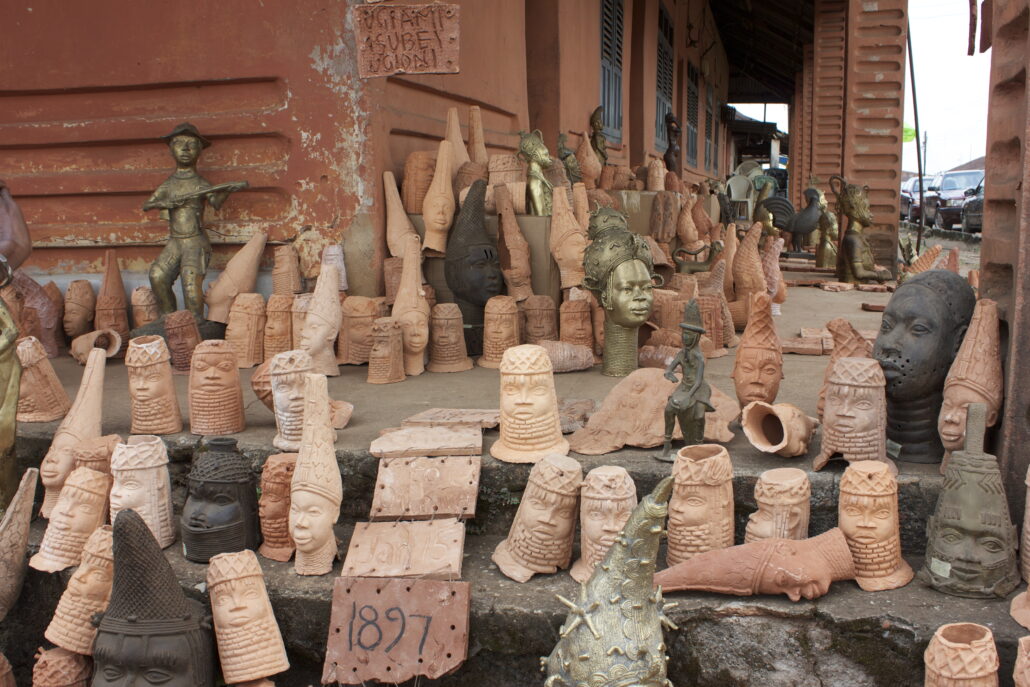
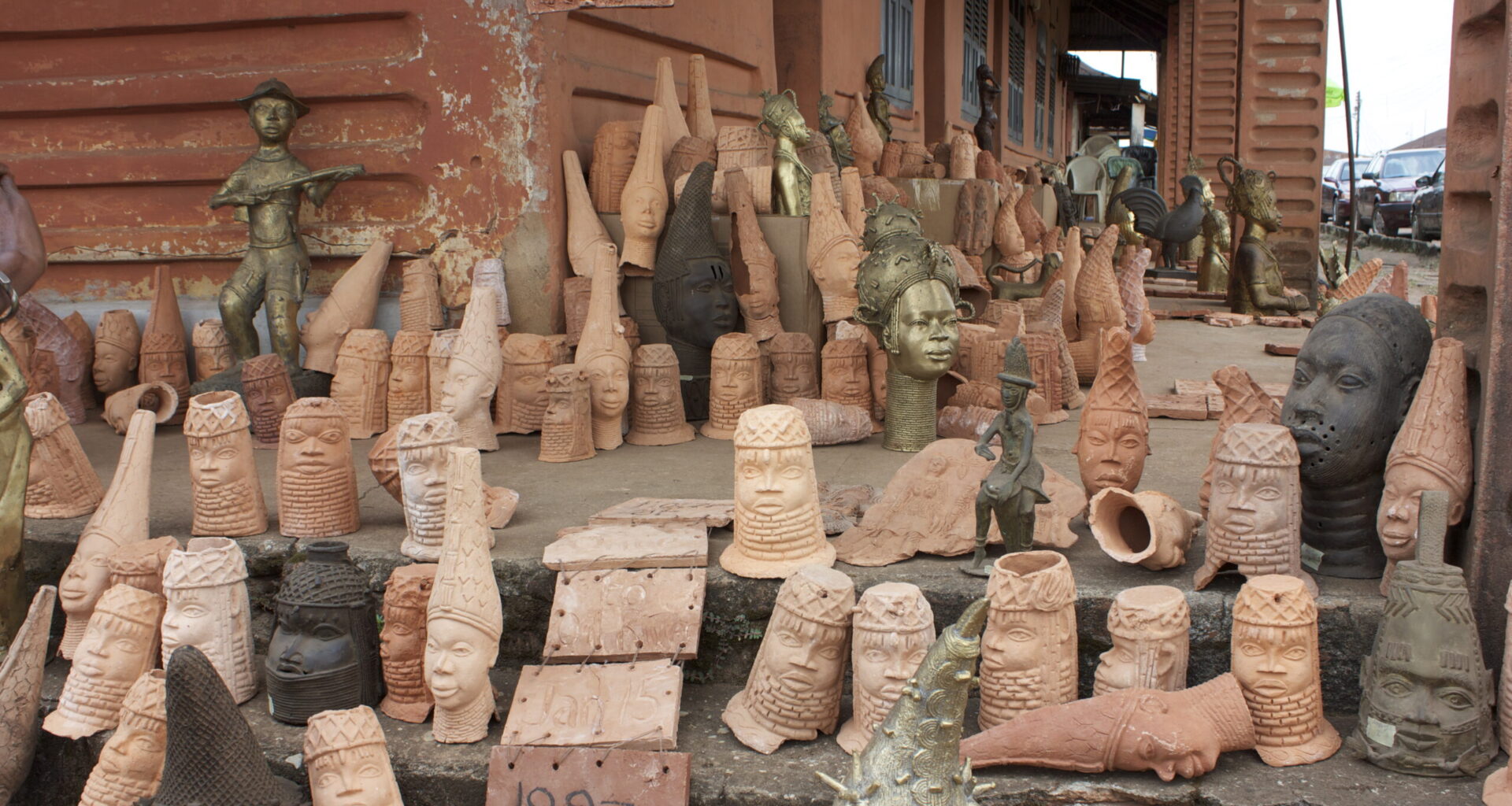
Works by members of the Benin Bronze Casting Guild, Igun Street, Benin City, reflecting the continuity of bronze-casting traditions. Artists include Eric Osa Ogbemudia, Benson Edobor, Anthony Osemwengie, Ikponmwonsa Inneh, Nosakhare Omorodion (Chief Okao), Friday Iyamu, William Edosomwan, Johnbull II Enobakhare, Imuwahen Edebor, Alex Osemwengie, and Peju Layiwola. Terracotta, copper wire, and bronze. Whose Centenary? Ine n’Iguneromwon’s Palace, Benin City, 2014. Photo: Jude Anogwih.
Indeed, the National Commission for Museums and Monuments functions more as a regulatory bureaucracy than a vibrant cultural network.²⁹ Its outstation in Lagos suffers from underfunding, poor climate control, and a lack of curatorial expertise.²⁹ Its sister parastatal, the National Gallery of Art, Abuja, fares no better without proper exhibition space.²⁹ This infrastructure gap forces Nigerian artists to seek validation from Western institutions, aligning their cultural worth with colonial and postcolonial narratives rather than local realities.³⁰ Wealthy Nigerian collectors, whose fortunes are domestically built, frequently direct their philanthropy to Western museums rather than supporting local infrastructure.³¹ This pattern perpetuates a cycle of cultural outsourcing: prestige abroad, underfunded institutions at home. Could this be a form of permanent inferiority? Could these individuals be the black face of colonialism? Wealth extracted from local populations is exported once again to bolster foreign institutions. ³¹
Part of the crisis stems from our failure to situate Nigerian art discourse within our own historical and political continuum — pre-civil war anxieties, post-war reconstruction, the four republics, the military coups, and the economic violence of the structural adjustment years. Without institutions capable of sustaining memory or continuity, discourse collapses into a perpetual recycling of colonial and post-colonial frames, like a rewound cassette. A small circle of gatekeepers mediates value and legitimacy, while most artists remain outside the inner mechanism. Even the discourse on the Benin Treasures rarely extends beyond 1897, even though bronze casting in Benin is an ongoing, living, and evolving practice.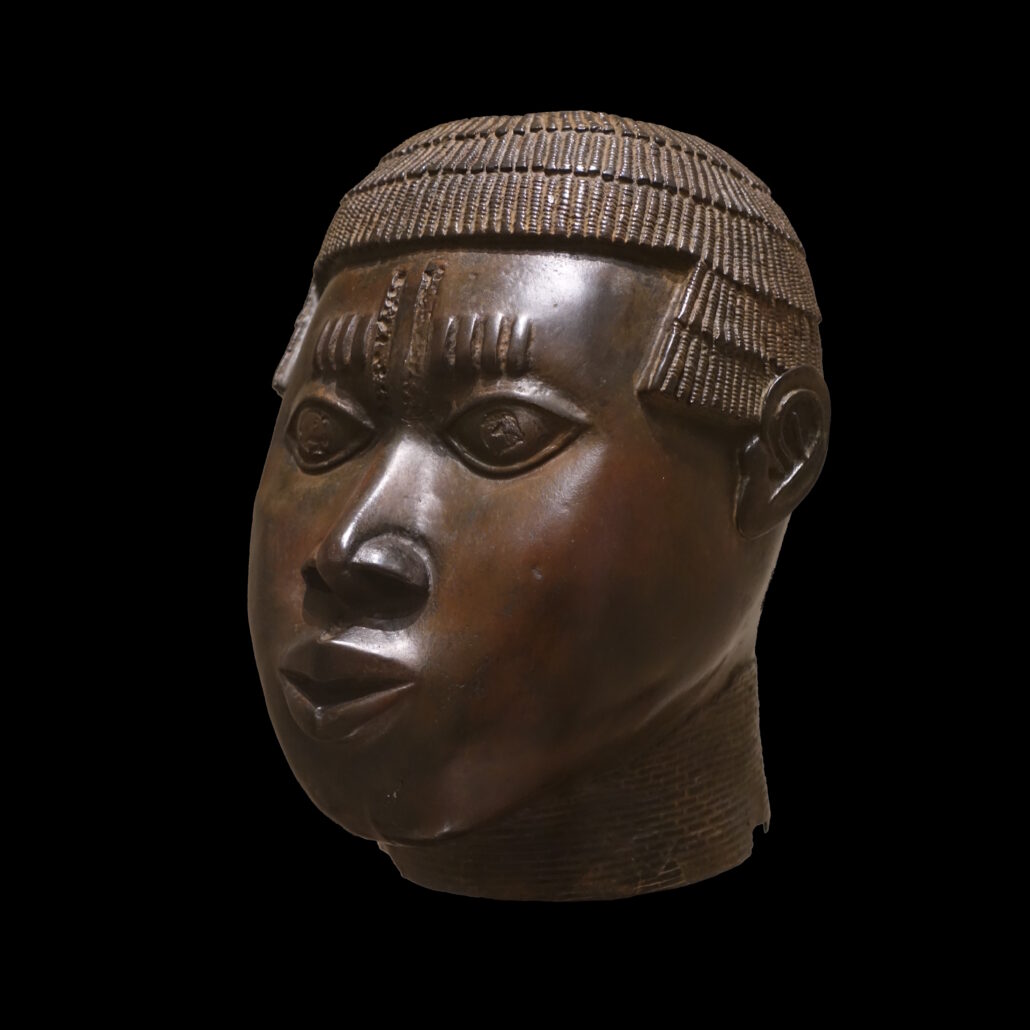
Royal shrine head, Kingdom of Benin, brass. CC BY-SA 4.0 via Wikimedia Commons.
Public trust remains fragile, particularly after Benin natives prevented the planned private opening of MOWAA in November 2025 and locked out invited guests.¹⁹ The tension in the state heightened under Governor Monday Okpebholo, who assumed office in November 2024. His initial interventions to investigate and challenge MOWAA were interpreted by some as an ancestral rebalancing, rather than mere administrative oversight. ¹² For Edo people, the returned Benin Treasures are ancestors, not artefacts. ¹⁴ They represent past Obas and royal mothers, and embody centuries of spiritual technology. Their custodianship resides with the Oba, not modern state institutions. ¹⁴ Unlike other Nigerian royal houses, Benin succession is strictly primogeniture guided by divine order. ⁸ Governors come and go. The dynasty endures. Reconciliation, therefore, must occur on the Oba’s terms, not the state’s. According to Prince Aghatise’s memorandum, attempts by Obaseki and LRT to appear collaborative with the Palace were explicitly disowned by the Oba through press statements and personal warnings to foreign delegations. ³²
When restituted Benin Treasures are returned to the Palace, the Oba performs rites – libations, ancestral invocations, and reintegration into the royal cosmology. ³³ Without these rituals, the treasures remain spiritually inert. The Guardian reported that MOWAA displayed only clay replicas in 2025. ¹⁹ Meanwhile, nations such as the Netherlands and Germany returned Benin Trezes directly to the Oba in ceremonial handovers, reaffirming the Palace’s custodianship. ³⁴
Ifeoma Dike encapsulates the cultural imperative: “Reconciliation must be grounded in humility and transparency… The Palace’s blessings must be formalised.” ¹³ True progress must not merely be architectural. Decolonisation must not merely be rhetorical. Restitution must not merely be logistical. Benin’s healing requires respect for ancestral custodianship, transparent governance, local funding, and Edo self-determination. The Benin Treasures were not merely removed; a cosmic order was broken. To repair it requires more than repatriation. It requires atonement.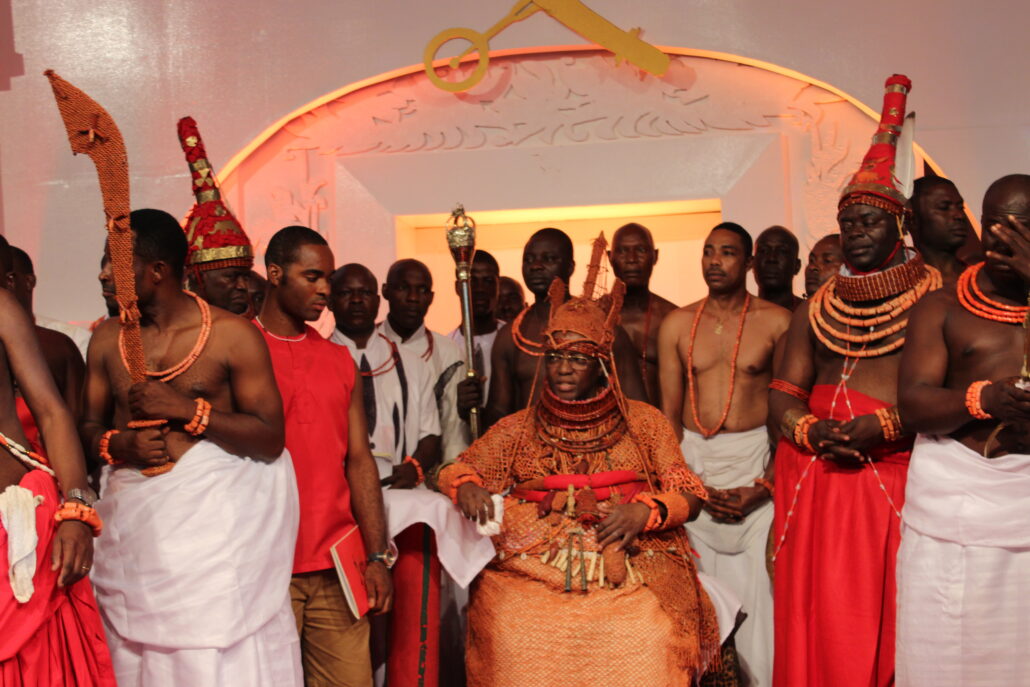
His Royal Majesty Oba Ewuare II, Omo n’Oba n, Edo Uku Akpolokpolo, during his 2016 coronation at Urhopota Hall, Benin City. Photo: Peju Layiwola.
The title Museum of Antiquities or Iniquities is itself a provocation. The “antiquities” of the British – objects they once derided as relics or “idols” – were taken from a living, sacred kingdom and housed in museums, severed from their spiritual context. By being classified as antiques, these treasures lost their ancestral charge and became objects of aesthetic consumption, a profound iniquity against Osanobua and the Edo cosmological order. This moral violation is compounded by the restitution process under MOWAA, executed without transparency, the Oba’s approval, or adherence to palace protocol; the excavation of palace grounds under the governor’s executive powers; and the rebranding of the original Benin Royal Museum. Each of these acts represents a deviation from ancestral and historical prescriptions, turning what might have been a process of healing into another layer of spiritual transgression. True atonement requires returning to the spiritual centre — the Oba and Osanobua — while acknowledging these moral and ritual debts, not merely transferring objects from one building to another.
And so, we return to the beginning — to Osanobua, to the ancestors, to the living Kingdom whose spirit persists.
Oba gha to kpere — ise.
Ayọ̀ Akínwándé is an artist from Lagos working across painting, lens-based media, installation, sound, and performance. His work examines power, socio-political realities, and the interplay of tradition and modernity. He is also a curator, researcher, and writer, with international exhibitions and curatorial projects, including co-curating the inaugural Lagos Biennial (2017).
Footnotes:
Osagiede, Rex. A Discourse on the Edo Belief in Ancestral Reality (Enikaro), 2020.
Oral / archival commentary on Chief Agho Obaseki’s collaboration with the British.
Oral / archival sources on Obaseki’s elevation by the British.
Oral / archival memory of Agho Obaseki’s perceived betrayal.
Godwin Obaseki, Facebook town hall video (user-provided transcript).
Academic analysis on trust, heritage, and legitimacy (Taylor & Francis).
Godwin Obaseki’s public statements (Facebook transcript).
Obaseki’s remarks on involving Prince Ezelekhae Ewuare (“Crown Prince”); clarification added to reflect Edo traditional protocol.
Ifeoma Dike, Video Essay, Nov 2025 (user-provided).
Edo term: Benin Treasures (Ìkpò Ómwan). Osagiede, Rex, 2020.
British Museum, MOWAA Archaeology Project, Benin City.
British Museum, stratified remains, precolonial and colonial layers.
British Museum description of MOWAA Institute, Rainforest Gallery, community engagement.
Project aims: guild documentation, trade networks, and environmental interaction.
Reports on Benin Central Hospital demolition (Digital Plot No. 61977, Zone HI/A12/Ogboka).
Governor Okpebholo revokes museum land title, October 2025.
British Museum funding for archaeological work.
Observation: The MOWAA website lacks a detailed excavation catalogue or storage records.
The Guardian, clay replicas displayed at MOWAA, 2025.
Prince Aghatise Erediauwa, memorandum on Smithsonian/Horniman Museum events and alleged federal misrepresentation.
MOWAA Archaeology Project (2021–2025), British Museum.
Reports on Benin Central Hospital demolition.
British Museum, MOWAA stratified remains.
Ore Disu, transcript of remarks / talk (user-provided).
Oba publicly denies Palace involvement in MOWAA.
Combined lack of transparency interpreted as extraction under another guise.
Federal Government of Nigeria Gazette, 28 March 2023, vesting ownership of artifacts in the Oba.
The British Museum refuses repatriation, citing weak infrastructure at Nigerian museums.
National Commission for Museums and Monuments, Lagos and Abuja offices.
Consequences for Nigerian artists relying on Western validation due to poor local infrastructure.
Wealthy Nigerian collectors are funding Western institutions rather than local projects.
Prince Aghatise Erediauwa, memorandum disowning LRT and issuing warnings to foreign delegations.
Oba’s ritual reintegration of returned Benin Bronzes.
Government press releases from the Netherlands and Germany on the return of Benin Bronzes.