January 15, 2026
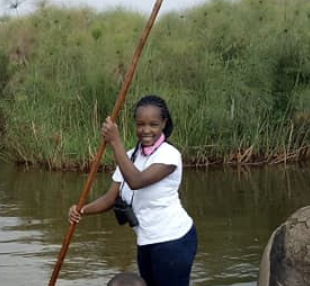
Roniance Adhiambo knew as far back as primary school that she wanted to be an environmentalist. To raise awareness among her young peers, she started environmental clubs in primary school and high school, where she would lead clean up days and plantings. At university, she pursued a degree in wildlife enterprise and management.
Roniance grew up in Nairobi, but her family hails from the Lake Victoria region. As a child, she would spend one month a year there. She loved the lake and its pastoral surroundings, but was also shocked by the amount of pollution she saw, and saddened by the way it caused the community to struggle.
“I started to think maybe I can go back home from where I come from and try to mobilize and clean things up,” says Roniance. “So when I finished my bachelors degree, I began looking for organizations that were working on Lake Victoria.”
This outreach led her to meet Leonard Akwany, former Kenya Lake Victoria Waterkeeper. After explaining the role to her, Roniance packed her bags and moved to Kisumu to begin her professional career as an environmentalist. A few years later, in 2020, Roniance succeeded Leonard and became the Kenya Lake Victoria Waterkeeper.
Lake Victoria is the largest lake in Africa, and eighth largest lake in the world. Kenya borders its shores, as does Uganda and Tanzania. In total, over 30 million people surround the lake. The lake and its surrounding wetlands are home to hippopotamuses, otters, crocodile, and countless species of fish, including several which are found nowhere else in the world. Approximately 2 million people depend directly on the lake by way of the fishing industry. 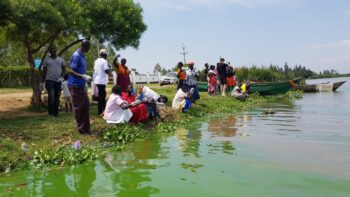
“I love how beautiful the lake is, especially when you see the intact areas. I love even more the fact that it is providing livelihoods to so many people. Women who are widowed and are single mothers, a lot of them are fishmongers,” says Roniance. “A lot of people that I know personally, don’t have any education, but they can still send their kids to school because of the lake. There’s the resource they can get without any capital or literacy. A lot of kids have been educated because of that lake, surviving because of that lake, women are providing for their households because of that lake. And it needs to be protected.”
The bounty that Lake Victoria provides to the community is one of its greatest qualities. However, it also represents one of the lake’s greatest challenges: over-explotation. Too many people are taking too many fish from the lake, too many people depending on one resource. Roniance suggests that newer nets are catching even more fish, including smaller juvenile ones. Rampant and unregulated pollution doesn’t help the problem, nor does destruction of surrounding wetlands, which serve as a breeding ground for fish. As a result, fishstocks are dwindling.
However, the problem is greater than just a loss of biodiversity. The constraining of resources has given rise to jaboya culture, where women have engaged in sex work in exchange for fish. This paradigm has given rise to broader public health implications. HIV rates along the lake are significantly higher than among the general population.
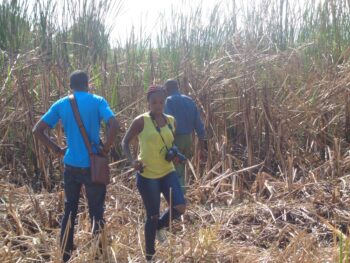 Despite these challenges, Roniance pursues her work enthusiastically. She participates in community education, wetlands restoration and conservation training, water quality monitoring and advocacy, and school programmes, which can include field trips and essay competitions. She is particularly proud of her adopt-a-wetland program, which puts the onus of protecting the region’s resources within the broader community.
“Our main message is this is your resource. You grew up with it. You depend on it. It is up to you to take care of it. You need to be conscious of the diseases you can get from the lake and why it’s important to test water quality,” says Roniance. “If you keep polluting the water, these are the risks. It is you who are here. Not the government person. You are the ones who are using it, so you are the ones who also need to protect it.”
In many ways, it seems her efforts are working. Roniance points to no-fish zones, where fish can breed and repopulate. She is encouraged that these initiatives are being implemented as a result of their education campaigns as Kenya Lake Victoria Waterkeeper, as opposed to payment. She admits there is still a long ways to go, but it’s encouraging to see positive things beginning to happen. Though, of course, she would love to see even more progress.
“In order to have a drinkable, fishable and swimmable Lake Victoria, we need to attack the issues from all fronts. This means we need to have people diversifying their livelihoods, we need to ensure protection of fish breeding areas,” says Roniance. “Advocacy and community education and awareness is also critical to ensure that everyone is doing their part, at their level be it local communities, local governments, county government, private sector, other NGOs national and international, and the national government as well.”
Roniance credits her entire team at Kenya Lake Victoria Waterkeeper and Ecofinder Kenya for their commitment and hard work over the years, and Leonard Akwany for founding and steering a great organization, and appreciation for the continued mentorship and resource mobilization efforts. 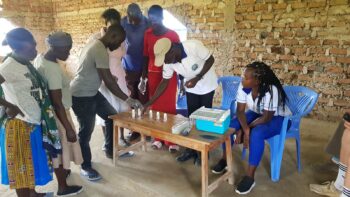
Roniance also credits Waterkeeper Alliance with helping her more effectively protect the lake and the communities that depend on it. Roniance has even received equipment for water quality testing from the Waterkeeper network, which she has, in turn, shared with her community. There is also the connections, the mentorship, the trainings, and the informal education that comes with being a part of this movement.
“Learning and learning and learning,” says Roniance. “Just learning how other Waterkeeper groups get their volunteers, how they keep their work ongoing,. It’s been amazing.”