
Kenya has launched the National Cervical Cancer Elimination Action Plan 2026–2030, marking a major milestone in the country’s efforts to end cervical cancer as a public health threat.
The plan was officially unveiled by Health Cabinet Secretary Aden Duale on Thursday during a national symposium week in Nairobi.
Speaking at the event, CS Duale said the newly launched Action Plan provides a clear, costed, and results-focused roadmap aligned with the World Health Organisation’s global strategy to eliminate cervical cancer. The plan targets the achievement of the 90–70–90 benchmarks: vaccinating 90 per cent of girls against HPV, screening 70 per cent of women, and ensuring 90 per cent of women diagnosed with cervical cancer receive timely treatment.
Key interventions under the plan include the rollout of a single-dose HPV vaccination schedule, expansion of HPV DNA testing, and the introduction of self-sampling to boost screening uptake. The Ministry of Health will also leverage digital health innovations to extend services to women and girls in all 47 counties.
“Cervical cancer is preventable, and no woman should die from it,” CS Duale said. “Our goal is simple and urgent: no girl unvaccinated, no woman unscreened, and no patient left without treatment.”
The Cabinet Secretary highlighted continued government investments to strengthen referral systems, expand cancer treatment infrastructure, build a skilled health workforce, and advance health financing reforms under the Social Health Authority, aimed at making cancer care accessible, affordable, and equitable.
He further warned health facilities against charging for government-supported services, stressing that HPV vaccines must be administered free of charge. To enhance transparency and protect patients, the government will enforce mandatory service charters in all public and private health facilities, clearly outlining free services. Facilities found violating these requirements will face legal consequences.
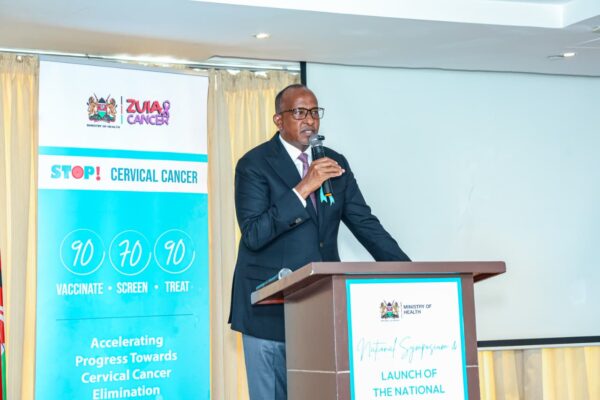 Health CS Aden Duale during the launch of the National Cervical Cancer Elimination Action Plan 2026–2030 in Nairobi on January 15, 2026. (Photo: MoH)
The symposium, convened during Kenya Cancer Awareness Month, brought together women leaders, healthcare professionals, policymakers, development partners, and civil society organisations under the theme “Accelerating Cervical Cancer Elimination: Strong Systems and Community Action for Every Girl and Every Woman.” Participants reviewed national progress and charted the way forward across prevention, screening, diagnosis, and treatment.
Cervical cancer is a type of cancer that develops in the cervix, the lower, narrow part of the uterus that connects the womb to the vagina. It occurs when normal cells in the cervix undergo abnormal changes and begin to grow uncontrollably, forming a malignant tumour. In most cases, cervical cancer is caused by long-term infection with high-risk types of the human papillomavirus (HPV), a common sexually transmitted virus. The disease often develops slowly over several years, starting with precancerous changes that can be detected through screening, making cervical cancer largely preventable when identified and treated early.
Cervical cancer remains a serious and persistent health threat in Kenya, with thousands of women affected each year. According to the most recent national and global estimates, Kenya records about 5,845 new cases of cervical cancer annually, and the disease is responsible for approximately 3,200–3,600 deaths each year, making it one of the leading causes of cancer-related mortality among Kenyan women.
The burden of cervical cancer in Kenya is particularly heavy because many women are diagnosed at advanced stages when treatment is less effective. It is the second most common cancer among Kenyan women after breast cancer and the leading cause of cancer deaths in women, especially in low-resource and rural settings where access to screening and early treatment services remains limited.
The disease is caused primarily by persistent infection with high-risk types of the human papillomavirus (HPV), a sexually transmitted virus. Persistent HPV infections, especially with types 16 and 18, can lead to abnormal changes in cervical cells that may progress to cancer over time if undetected.
Kenya introduced the HPV vaccine into its national immunisation program in 2019, initially using a two-dose schedule targeting girls aged 10–14 years old to protect them before they are exposed to HPV. Vaccination is highly effective and can prevent the majority of cervical cancer cases if administered before exposure to the virus.
In late 2025, Kenya transitioned to a single-dose HPV vaccination schedule, following recommendations from the World Health Organisation and global evidence showing that one dose provides strong, long-lasting protection while making delivery easier, more affordable, and more accessible nationwide.
Despite these efforts, vaccination coverage and screening uptake have not yet reached optimal levels. Barriers such as misinformation, vaccine hesitancy, limited access to health services in some counties, and low awareness contribute to gaps in protection. However, continued political commitment, community mobilisation, and integration of vaccination into school and community health platforms are helping to improve coverage across the country.
Before the shift, the Ministry of Health data suggested that first-dose coverage was around 60 per cent, while second-dose completion lagged at about 38 per cent, meaning many girls were not completing the full course under the older schedule. The single-dose approach is expected to help close that gap.
Despite these policy advances, vaccine uptake remains uneven across the country. In some counties, particularly in the northern and pastoralist regions, coverage is alarmingly low—in some areas, less than 1–2 per cent of eligible girls have been vaccinated. This is largely attributed to myths, misconceptions, and community mistrust; logistical challenges in reaching remote populations; and insufficient community engagement.