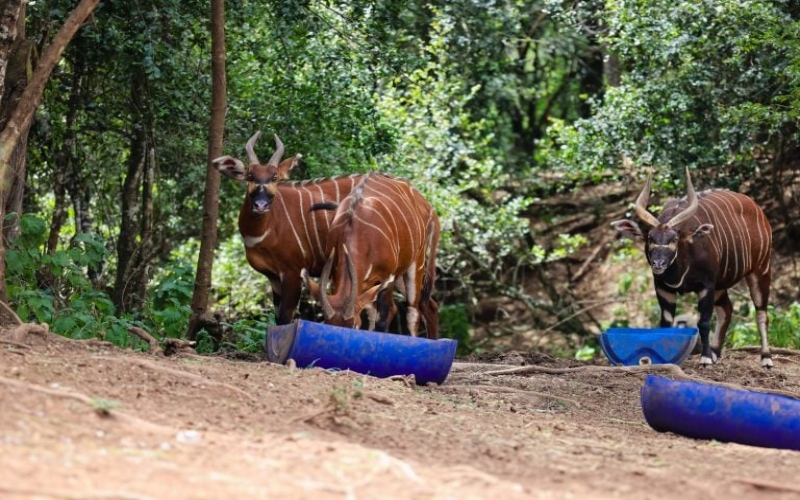
The Kenya Space Agency (KSA) has launched a sophisticated technology-driven project to protect one of the country’s most endangered species, the Mountain Bongo.
The initiative, dubbed Project Centinela, was unveiled on January 16, 2026, at Mount Kenya. It combines satellite technology with field-based conservation to safeguard the rare antelope found only in Kenya’s high-altitude forests.
Recognisable by its reddish-brown coat with white stripes and spiralled horns, the Mountain Bongo faces severe threats from habitat loss, poaching, disease, and climate change.
The project builds on a 2023 agreement between KSA and the Mount Kenya Wildlife Conservancy (MKWC), a non-profit organisation dedicated to protecting the Mount Kenya ecosystem and leading breeding and conservation efforts for the species.
In partnership with Planet, a global provider of high-resolution satellite imagery, Project Centinela integrates Earth observation data with on-the-ground conservation to monitor habitats, detect threats early, and guide recovery strategies.
“This project marks the start of activities under a Memorandum of Understanding (MoU) signed in 2023 between KSA and MKWC to use Earth observation technology to support the conservation of the endangered Mountain Bongo,” KSA noted.
Current statistics show fewer than 100 Bongos remain in the wild across fragmented forests such as Mount Kenya, the Aberdares, Eburu, and Mau, while captive populations now outnumber those in their natural range.
Project Centinela leverages satellite imagery to identify and prioritise critical habitats, track environmental changes, strengthen partners’ capacity for data-driven conservation, and provide early warnings on deforestation, habitat degradation, and climate risks.
According to KSA, the combination of space-based monitoring and fieldwork enables real-time tracking of forest health, supports the safe reintroduction of captive-bred Bongos, and aligns with Kenya’s National Recovery and Action Plan.
“This is more than a partnership. It’s a shared commitment to protect one of Earth’s critically endangered species, for current and future generations,” KSA stated.
The project highlights Kenya’s growing use of space technology to support biodiversity. By integrating satellite data with local conservation efforts, it offers a new model for monitoring habitats, preventing illegal activities, and guiding adaptive management.
Key contributors to the project include Robert Aruho, Head of MKWC, and Planet team members Andrew Zolli, Amy Rosenthal, and Gerald Yegon, alongside KSA staff.