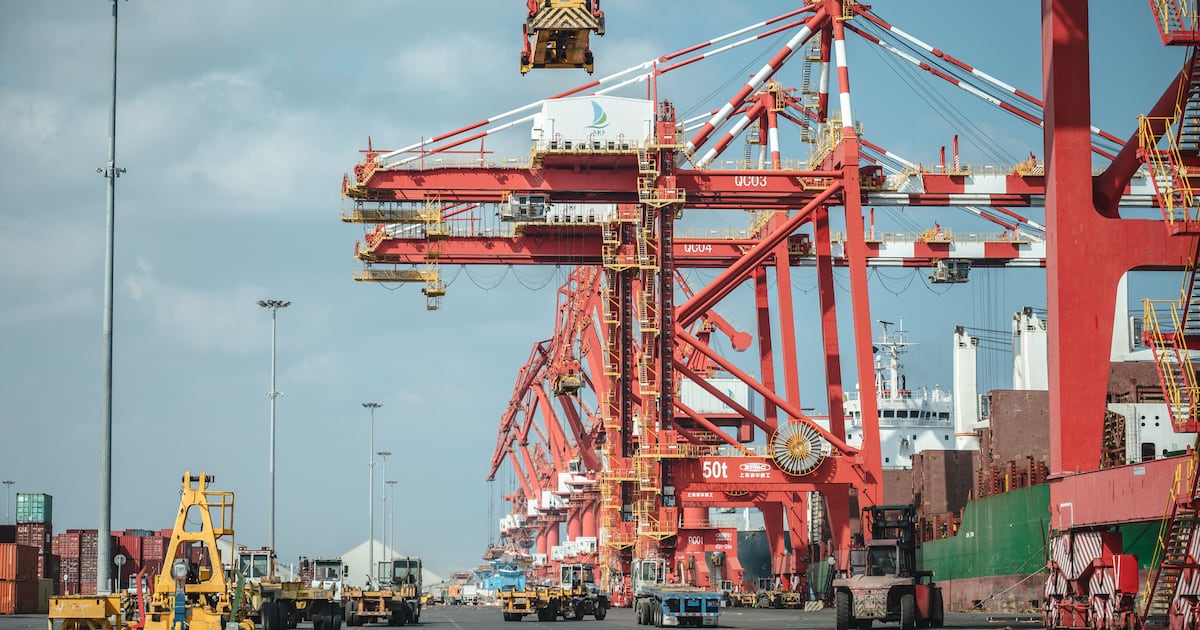
Egypt has agreed to develop seaports in the Horn of Africa nations of Eritrea and Djibouti, part of its campaign to increase pressure on landlocked Ethiopia over its long-running Nile water dispute, sources in Cairo told The National.
Under the agreements signed without fanfare, Egypt will upgrade the strategic Red Sea port of Asab in Eritrea and Doraleh in Djibouti, on the Gulf of Aden, to increase their capacity, and create berths for warships and the scope to post small but elite military contingents.
Both ports lie near the Bab Al Mandeb strait, the southern gate of the Red Sea. Ethiopia, which borders Eritrea and Djibouti, is known to be heavily reliant on Doraleh for the transfer of goods.
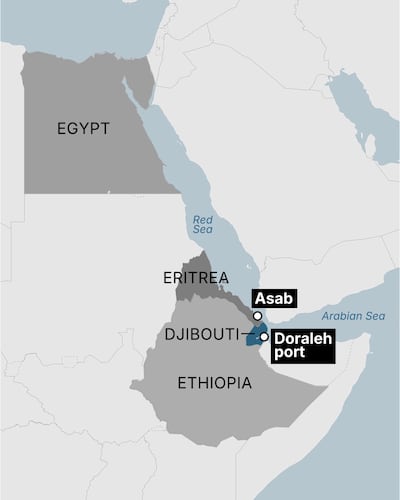
Egypt has more than 2,000km of Red Sea coastline on its mainland and the Sinai Peninsula. It controls the Suez Canal that links the Red Sea to the Mediterranean.
It has repeatedly maintained its strong opposition to landlocked nations such as Ethiopia gaining a territorial foothold on the Red Sea, the main maritime link between Europe, the Middle East, Asia and East Africa.
The discreet signing of Egypt’s agreements with Eritrea took place during a late October visit to Cairo by President Isaias Afwerki, according to the sources who have first-hand knowledge of the deals. The other deal was negotiated and finalised by senior Egyptian and Djibouti officials, they added.
Egypt, already bound to Eritrea and Djibouti by strong political and military ties, will build infrastructure at the two ports to refuel and resupply warships from its southern fleet, including destroyers, submarines, and troop and helicopter carriers, said the sources.
The agreement with Djibouti, they said, also provided for upgrading a road network leading to Doraleh. Neighbouring Ethiopia, landlocked since Eritrea seceded in 1993 after a long civil war, relies heavily on Doraleh for sea access.
“The agreements legitimise our military presence in the two countries,” said one of the sources. “Already Egyptian warships are frequent visitors to the two ports.”
Egypt and Ethiopia have been locked in a bitter dispute for more than a decade over the anticipated effects of a vast hydroelectric dam that Addis Ababa completed this year.
Egypt, which relies on the Nile for nearly all its freshwater needs, views the Grand Ethiopian Renaissance Dam as an existential threat, contending it will reduce its vital share of the river’s water and give Ethiopia unacceptable control over its downstream flow at times of drought.
Egypt and Sudan had been in negotiations with Ethiopia for more than a decade, demanding Addis Ababa enters into a legally binding agreement on the operation and management of the dam.
In response, Ethiopia has repeatedly sought to reassure Cairo and Khartoum that the dam will not harm their interests, while emphasising the project’s benefits for economic development and its sovereign right to operate it as it sees fit.
The gradual filling of the vast reservoir behind the dam, which took place from 2020 to last year, had little effect on Egypt’s share of Nile water, thanks to abundant rain on the Ethiopian highlands.
However, war-torn and downstream Sudan has complained that Ethiopia’s failure to share real-time data on the dam’s operation has caused deadly and destructive flooding in some of its regions.
With the last round of failed negotiations held two years ago, Egypt has been building up alliances and trust with Ethiopia’s neighbours such as Somalia, Djibouti – both members of the Arab League – Eritrea and Kenya, while offering technical expertise in a wide range of fields to many of the 11 Nile Basin nations.
Last year, Egypt began stationing troops and military advisers in Somalia after the two nations signed a defence agreement. Egypt also provided Somalia with weapons and counter-terrorism advisers to aid its fight against Al Shabab, the terrorist group. It also intends to participate in a new African Union peacekeeping mission in the country.
“The lack of serious bilateral or trilateral negotiations on the dam has meant the focus is now more on regional issues that are definitely causing tension between Cairo and Addis Ababa,” said British-based William Davison, managing editor of Ethiopia Insight.
“The tension is focused on Egypt’s participation in the Somalia mission and Ethiopia’s regional maritime ambitions. Clearly, Ethiopia does not want to see Egyptian troops in Somalia, but if that came to pass, it would not necessarily be a game-changer and lead to war between the two nations.
“The overall picture is that the dam is a reality and will continue to be a source of tension. I cannot see the two countries fostering trust and co-operation, but I don’t see them going into armed conflict either.”
UAE jiu-jitsu squad
Men: Hamad Nawad and Khalid Al Balushi (56kg), Omar Al Fadhli and Saeed Al Mazroui (62kg), Taleb Al Kirbi and Humaid Al Kaabi (69kg), Mohammed Al Qubaisi and Saud Al Hammadi (70kg), Khalfan Belhol and Mohammad Haitham Radhi (85kg), Faisal Al Ketbi and Zayed Al Kaabi (94kg)
Women: Wadima Al Yafei and Mahra Al Hanaei (49kg), Bashayer Al Matrooshi and Hessa Al Shamsi (62kg)
UAE v Zimbabwe A, 50 over series
Fixtures
Thursday, Nov 9 – 9.30am, ICC Academy, Dubai
Saturday, Nov 11 – 9.30am, ICC Academy, Dubai
Monday, Nov 13 – 2pm, Dubai International Stadium
Thursday, Nov 16 – 2pm, ICC Academy, Dubai
Saturday, Nov 18 – 9.30am, ICC Academy, Dubai
Mercer, the investment consulting arm of US services company Marsh & McLennan, expects its wealth division to at least double its assets under management (AUM) in the Middle East as wealth in the region continues to grow despite economic headwinds, a company official said.
Mercer Wealth, which globally has $160 billion in AUM, plans to boost its AUM in the region to $2-$3bn in the next 2-3 years from the present $1bn, said Yasir AbuShaban, a Dubai-based principal with Mercer Wealth.
“Within the next two to three years, we are looking at reaching $2 to $3 billion as a conservative estimate and we do see an opportunity to do so,” said Mr AbuShaban.
Mercer does not directly make investments, but allocates clients’ money they have discretion to, to professional asset managers. They also provide advice to clients.
“We have buying power. We can negotiate on their (client’s) behalf with asset managers to provide them lower fees than they otherwise would have to get on their own,” he added.
Mercer Wealth’s clients include sovereign wealth funds, family offices, and insurance companies among others.
From its office in Dubai, Mercer also looks after Africa, India and Turkey, where they also see opportunity for growth.
Wealth creation in Middle East and Africa (MEA) grew 8.5 per cent to $8.1 trillion last year from $7.5tn in 2015, higher than last year’s global average of 6 per cent and the second-highest growth in a region after Asia-Pacific which grew 9.9 per cent, according to consultancy Boston Consulting Group (BCG). In the region, where wealth grew just 1.9 per cent in 2015 compared with 2014, a pickup in oil prices has helped in wealth generation.
BCG is forecasting MEA wealth will rise to $12tn by 2021, growing at an annual average of 8 per cent.
Drivers of wealth generation in the region will be split evenly between new wealth creation and growth of performance of existing assets, according to BCG.
Another general trend in the region is clients’ looking for a comprehensive approach to investing, according to Mr AbuShaban.
“Institutional investors or some of the families are seeing a slowdown in the available capital they have to invest and in that sense they are looking at optimizing the way they manage their portfolios and making sure they are not investing haphazardly and different parts of their investment are working together,” said Mr AbuShaban.
Some clients also have a higher appetite for risk, given the low interest-rate environment that does not provide enough yield for some institutional investors. These clients are keen to invest in illiquid assets, such as private equity and infrastructure.
“What we have seen is a desire for higher returns in what has been a low-return environment specifically in various fixed income or bonds,” he said.
“In this environment, we have seen a de facto increase in the risk that clients are taking in things like illiquid investments, private equity investments, infrastructure and private debt, those kind of investments were higher illiquidity results in incrementally higher returns.”
The Abu Dhabi Investment Authority, one of the largest sovereign wealth funds, said in its 2016 report that has gradually increased its exposure in direct private equity and private credit transactions, mainly in Asian markets and especially in China and India. The authority’s private equity department focused on structured equities owing to “their defensive characteristics.”
Leap of Faith
Michael J Mazarr
Public Affairs
Dh67
Specs
Engine: 51.5kW electric motor
Range: 400km
Power: 134bhp
Torque: 175Nm
Price: From Dh98,800
Available: Now
The%20Roundup
%3Cp%3EDirector%3A%20Lee%20Sang-yong%3Cbr%3EStars%3A%20Ma%20Dong-seok%2C%20Sukku%20Son%2C%20Choi%20Gwi-hwa%3Cbr%3ERating%3A%204%2F5%3C%2Fp%3E%0A
Global state-owned investor ranking by size
1.
United States
2.
China
3.
UAE
4.
Japan
5
Norway
6.
Canada
7.
Singapore
8.
Australia
9.
Saudi Arabia
10.
South Korea
More on animal traffickingTen tax points to be aware of in 2026
1. Domestic VAT refund amendments: request your refund within five years
If a business does not apply for the refund on time, they lose their credit.
2. E-invoicing in the UAE
Businesses should continue preparing for the implementation of e-invoicing in the UAE, with 2026 a preparation and transition period ahead of phased mandatory adoption.
3. More tax audits
Tax authorities are increasingly using data already available across multiple filings to identify audit risks.
4. More beneficial VAT and excise tax penalty regime
Tax disputes are expected to become more frequent and more structured, with clearer administrative objection and appeal processes. The UAE has adopted a new penalty regime for VAT and excise disputes, which now mirrors the penalty regime for corporate tax.
5. Greater emphasis on statutory audit
There is a greater need for the accuracy of financial statements. The International Financial Reporting Standards standards need to be strictly adhered to and, as a result, the quality of the audits will need to increase.
6. Further transfer pricing enforcement
Transfer pricing enforcement, which refers to the practice of establishing prices for internal transactions between related entities, is expected to broaden in scope. The UAE will shortly open the possibility to negotiate advance pricing agreements, or essentially rulings for transfer pricing purposes.
7. Limited time periods for audits
Recent amendments also introduce a default five-year limitation period for tax audits and assessments, subject to specific statutory exceptions. While the standard audit and assessment period is five years, this may be extended to up to 15 years in cases involving fraud or tax evasion.
8. Pillar 2 implementation
Many multinational groups will begin to feel the practical effect of the Domestic Minimum Top-Up Tax (DMTT), the UAE’s implementation of the OECD’s global minimum tax under Pillar 2. While the rules apply for financial years starting on or after January 1, 2025, it is 2026 that marks the transition to an operational phase.
9. Reduced compliance obligations for imported goods and services
Businesses that apply the reverse-charge mechanism for VAT purposes in the UAE may benefit from reduced compliance obligations.
10. Substance and CbC reporting focus
Tax authorities are expected to continue strengthening the enforcement of economic substance and Country-by-Country (CbC) reporting frameworks. In the UAE, these regimes are increasingly being used as risk-assessment tools, providing tax authorities with a comprehensive view of multinational groups’ global footprints and enabling them to assess whether profits are aligned with real economic activity.
Contributed by Thomas Vanhee and Hend Rashwan, Aurifer
Tenet
Director: Christopher Nolan
Stars: John David Washington, Robert Pattinson, Elizabeth Debicki, Dimple Kapadia, Michael Caine, Kenneth Branagh
Rating: 5/5
Oppenheimer
%3Cp%3E%3Cstrong%3EDirector%3A%20%3C%2Fstrong%3EChristopher%20Nolan%3C%2Fp%3E%0A%3Cp%3E%3Cstrong%3EStars%3A%20%3C%2Fstrong%3ECillian%20Murphy%2C%20Emily%20Blunt%2C%20Robert%20Downey%20Jr%2C%20Florence%20Pugh%2C%20Matt%20Damon%3C%2Fp%3E%0A%3Cp%3E%3Cstrong%3ERating%3A%20%3C%2Fstrong%3E5%2F5%3Cbr%3E%3C%2Fp%3E%0A