
Gedion Yilma
In 2025, Ethiopia experienced one of the most dramatic and least interrogated economic disruptions in its modern history. More than 80 percent of federally registered business licenses became inactive in a single year, shrinking the registry from nearly 585,000 in 2024 to just over 100,000. Over 470,000 businesses disappeared from the federal register.
This was not a cyclical downturn, not a sector-specific slowdown, and not a routine statistical correction. It was a systemic shock—one that exposed deep vulnerabilities in Ethiopia’s institutional design, macroeconomic management, and social contract with its private sector.
While the Fifth Labor Market Intelligence Report documents the collapse in detail, it stops short of answering the most consequential questions: what this means for livelihoods, poverty, state revenue, rural–urban linkages, and national stability. When these dimensions are examined together, the collapse emerges not as a registry issue, but as a nationwide livelihood and fiscal crisis.
From License Collapse to Mass Job Loss
If we conservatively assume an average of 10 employees per enterprise, the disappearance of approximately 470,000 federally registered businesses implies the loss of about 4.7 million jobs in a single year. Using a modest household dependency ratio of five persons per worker, this translates into 23.5 million people losing their primary source of income—nearly 18 percent of Ethiopia’s total population. This figure includes only federally registered enterprises. It excludes:
Regionally registered businesses, Informal enterprises, Smallholder farmers, who are not required to register.
As a result, the shock is highly concentrated in Ethiopia’s monetized economy—federally administered towns and cities, major regional urban centers, and trade-linked corridors involved in import and export. This is precisely where: Wage employment dominates, Cash income is essential for survival and Urban poverty responds rapidly to shocks
Urban Poverty Shock: From Vulnerability to Destitution
Urban households lack the subsistence buffers available in rural areas. When employment collapses at scale and speed, poverty dynamics become nonlinear. Millions of households that had: Recently escaped poverty, invested in education or housing and relied on stable wage employment were pushed abruptly back into poverty.
This phenomenon—poverty re-entry—is particularly destabilizing. It erodes trust in upward mobility, discourages human capital investment, and fuels frustration rather than resignation.
The result is not just higher poverty, but poverty volatility, which is far more corrosive to social cohesion.
The Circular Shock: How Urban Income Loss Hits Farmers?
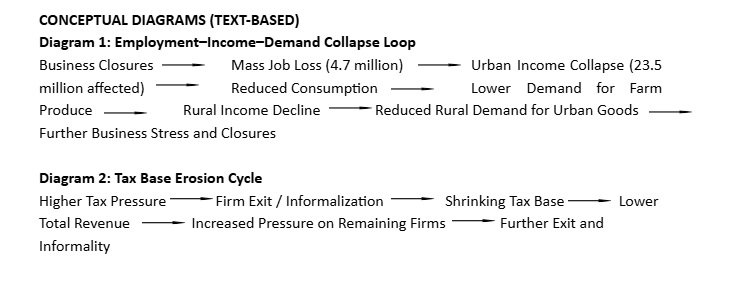
Although smallholder farmers are not part of the licensing system, they are not insulated from the collapse. Ethiopia’s rural economy depends heavily on urban demand for agricultural surplus. Farmers sell food to cities in order to buy complementary goods and services they do not produce: clothing, fuel, medicine, transport, education, tools, and housing inputs. When 23.5 million urban residents lose income, a powerful negative demand shock ripples outward. The Urban–Rural Income Transmission Mechanism: Urban job loss → reduced disposable income →Lower urban consumption → declining demand for food → Reduced farm-gate prices or unsold surplus →Falling rural household income → Reduced rural demand for urban goods and services → Further contraction of urban informal and formal activity
This is a multiplier in reverse. Thus, while farmers are not directly counted in the collapse, they experience: Price suppression for produce, Higher post-harvest losses, Reduced capacity to buy inputs and Increased vulnerability to debt and shocks. The result is nationwide income compression, originating in cities but spreading into rural livelihoods.
Migration, Inequality, and Stability Risks
Large-scale urban income loss creates powerful push factors for migration: Internally, displaced workers return to rural areas ill-equipped to absorb labor and externally, irregular migration accelerates, particularly among youth. This shock disproportionately affects: Youth, Women and low- and mid-skilled urban workers. Meanwhile, asset-based and rent-linked groups are relatively insulated, widening inequality within cities and between urban and rural populations. From a political economy perspective, this combination—job loss, inequality and frustrated expectations—raises risks to peace, security, and social stability.
The Fiscal Earthquake: Birr 47 Billion Lost Every Year
Beyond households, the collapse represents a major and permanent fiscal shock. Assuming conservatively that each of the 470,000 disappeared enterprises paid or collected an average of Birr 100,000 annually through: Payroll and pension contributions, Withholding taxes, Sales and turnover taxes, VAT, Custom and excise taxes and Profit taxes, the federal government faces an annual revenue loss exceeding Birr 47 billion. This estimate excludes: Lost taxes from employees, Reduced customs revenue, Declining excise and consumption taxes, Regional and municipal revenue losses. This is not a temporary gap—it is a structural erosion of the tax base.
Over-Taxation and the Golden Egg Paradox
The most troubling feature of this fiscal loss is that it appears self-inflicted. When compliance costs, enforcement pressure, and effective tax burdens rise faster than firm productivity—especially during inflation and currency depreciation—formal operation becomes unsustainable. Economic theory (the Laffer Curve) predicts exactly this outcome: beyond a certain point, higher extraction reduces total revenue by shrinking the tax base. This episode mirrors the parable of the chicken that laid a golden egg. Impatient to extract more, the owner slaughtered the chicken—only to lose the steady flow forever. In this metaphor: Businesses were the golden-egg layers, the tax system was the extraction tool, Over-taxation and rigid enforcement were the knife and the result: fewer firms, fewer jobs, and less revenue.
Why This Is a Systemic Crisis
Taken together, the collapse represents: A 4.7 million job loss, A 23.5-million-person income shock, A national demand contraction, A Birr 47+ billion annual revenue hole, A retreat into distress informality and A risk to equity, peace, and institutional trust. This is not a statistical anomaly. It is a livelihood crisis with macroeconomic and political consequences.
POLICY WARNING & DECISION NOTE (For Ministry of Finance, MoLS, PMO, Development Partners)
The 2025 collapse of federally registered enterprises has triggered a compound crisis affecting employment, poverty, rural livelihoods, tax revenue, and social stability. The Key Risks if Unaddressed: Entrenched urban poverty and informality, accelerated internal and external migration, Permanent erosion of the tax base, Rising inequality and instability and Loss of trust in formal institutions. The issue deserves a national emergency and urgency.
CONCEPTUAL DIAGRAMS (TEXT-BASED)
POLICY RECOMMENDATIONS (THEORY-ALIGNED & PRACTICAL)
1. Immediate Enterprise Re-Entry Window
Temporary tax amnesty and penalty waiversSimplified re-registration for closed but viable firmsTransitional compliance framework
2. Shift from Extraction to Sustainability
Replace aggressive enforcement with graduated taxationAlign tax obligations with firm size, margins, and inflation reality
3. Urban Employment Stabilization Program
Labor-intensive public works in citiesWage subsidy or payroll tax relief for SMEs
4. Protect the Urban–Rural Demand Link
Support urban food demand (cash transfers, food vouchers)Prevent collapse of farm-gate prices
5. Restore Institutional Trust
Transparent communication on reformsPredictable rules and enforcementClear separation of revenue mobilization from punishment
Final Reflection
The 2025 license collapse is not merely about missing businesses. It is about missing jobs, missing income, missing trust, and missing revenue. Like the keeper of the golden-egg-laying chicken, the system sought immediate extraction and lost a sustainable future. The decisive question is not whether enforcement was legal—but whether it was economically wise, socially just, and fiscally rational.
Editor’s Note : Views in the article do not necessarily reflect the views of borkena.com
__
Support Borkena : https://borkena.com/subscribe-borkena/
Join our Telegram Channel : t.me/borkena
Like borkena on Facebook
Borkena Ethiopian News Youtube Channel
To submit Press Release, send submission to info@borkena.com
Add your business to Ethiopian Business Listing / Ethiopian Business Directory
Join the conversation. Follow us on X (Formerly Twitter) @zborkena to get the latest Ethiopian News updates regularly.