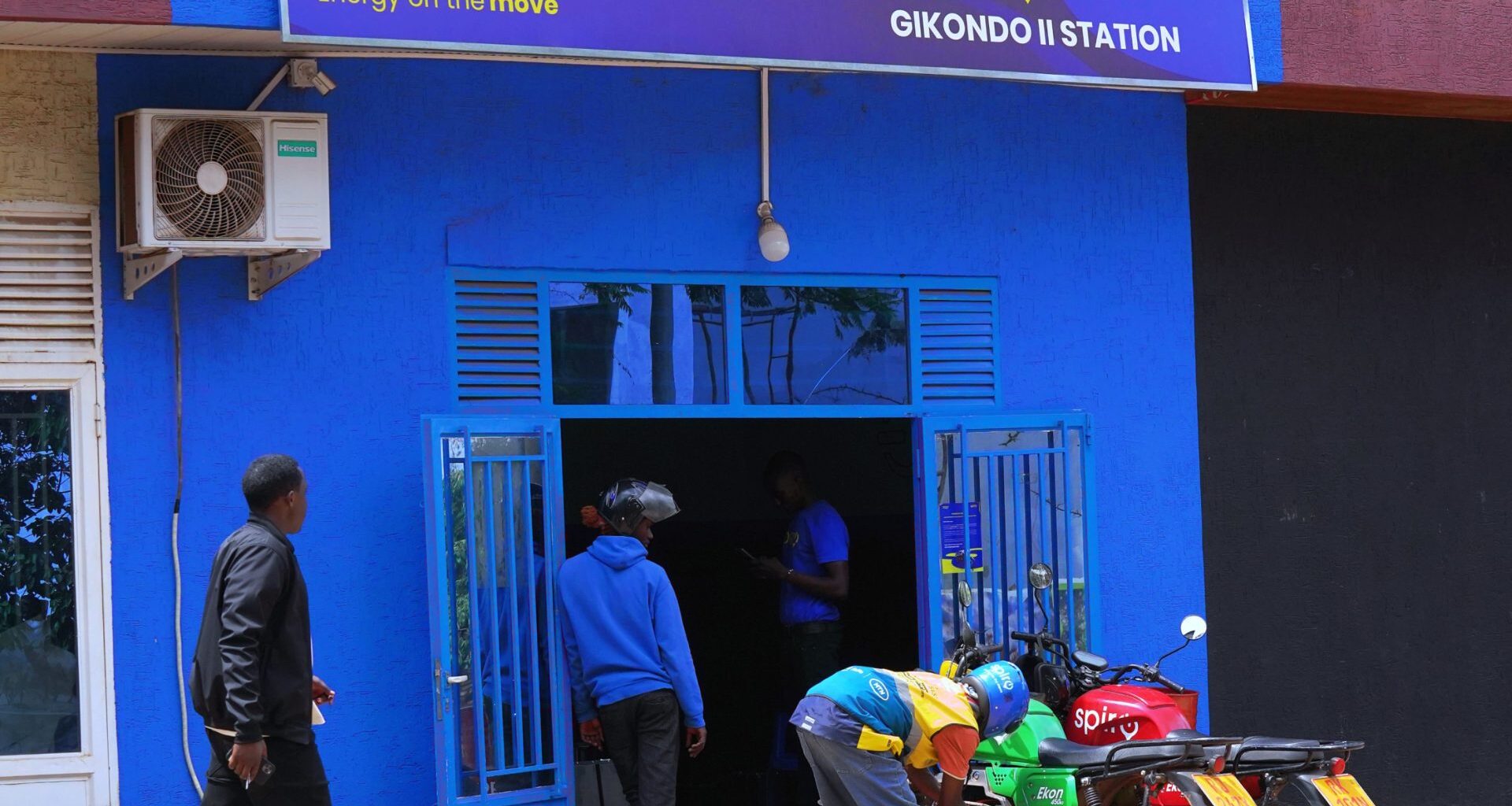
Rwanda has become the first country in Africa to mandate that all electric motorcycles and battery swapping stations are interoperable with one another.
This means that electric motorcycle riders would be able to swap their batteries at any licensed battery-swapping station, rather than being confined to a single operator’s network.
The new regulations are laid out by the Rwanda Utilities Regulatory Authority, stating that existing battery swapping operators have a transitional period of two years to comply with the requirement.
“Manufacturers, assemblers, distributors, authorised dealers and other authorised representatives engaged in the production, importation or sale of electric motorcycles shall ensure that motorcycles are designed, produced and supplied in a manner that is technically compatible and interoperable with approved battery swapping systems available on the market,” the regulation states.
Rwanda is one of Africa’s most progressive EV markets, strategically backing electrification as the nation hopes to curb greenhouse gas emissions by 38% by 2030.
As part of that effort, government institutions are now required to ensure that at least 30% of newly-procured vehicles are fully electric.
The latest regulations appear to be a step forward for e-mobility riders in Rwanda who will no longer be limited to single providers under closed swapping ecosystems.
According to the regulation, interoperability will enable riders to “access and transition between licensed battery swapping operators” in the event of an operator ceasing operations, failing to meet service standards or when a rider chooses to make the switch.
Ngetha Waithaka, General Partner at Norrsken22, an equity firm that invests in e-mobility and technology across Africa, prescribed the new regulation as a major win for Rwanda.
“Rwanda is doing exactly what the African e-mobility sector has been asking for: leading with regulatory certainty,” Waithaka told Zag Daily. “The mandates for battery interoperability matter less for the physical vehicles but more for the signal they send to capital.
“Establishing clear rules de-risks the single largest cost line in African e-mobility – the battery – and regulatory clarity is precisely what will unlock large-scale infrastructure investment.”
However, just how much “regulatory clarity” the new regulation offers is in debate. While new market entrants are expected to have access to a broader customer base, it remains unclear how incumbent operators that have built proprietary ecosystems will adapt and whether a mass hardware and software retrofitting will be in order.
“Greatest impact” felt by commercial riders
According to Waithaka, it is commercial e-motorcycle riders – locally known as boda bodas – that will feel the “greatest impact” of the new regulation.
“Riders will gain the freedom to seamlessly swap batteries at any station nationwide, regardless of the provider,” Waithaka said.
This open-network approach, he added, will “dramatically reduce downtime, maximise daily earnings and provide the exact operational framework required to scale e-mobility across all African markets.”
Mandate presents “significant risks”
Amit Rao, Head of Energy Business at electric mobility provider Spiro, has received the new regulation with a warning.
Spiro sells and leases electric two-wheelers to delivery riders, fleet operators and logistics companies in Rwanda, Kenya, Nigeria and other nations across Africa, with riders able to swap batteries at Spiro stations under a subscription model.
“While we appreciate the intent, mandatory battery interoperability at this stage – when the industry is nascent in Africa – poses significant safety, technical and commercial risks,” Rao said.
“Battery systems differ materially across cell chemistry, voltage architecture, thermal management and BMS logic. Even minor deviations in charging curves or protection thresholds can completely compromise safety which is non-negotiable.”
Waithaka, however, said that an interoperable framework introduces a “healthy question of quality assurance” across different battery providers.
“Just as consumers gravitated toward trusted petrol station brands, the market will naturally coalesce around the best actors – driving up safety, uptime and efficiency standards across the board.”
For Rao, the answer is “standards not mandates”. Rou outlined a suggested framework for Rwanda’s e-mobility sector that includes safety certification for batteries, thermal management validation as a mandatory pre-condition for any interoperability consideration, phased implementation and “protection of operator innovation and investment”.