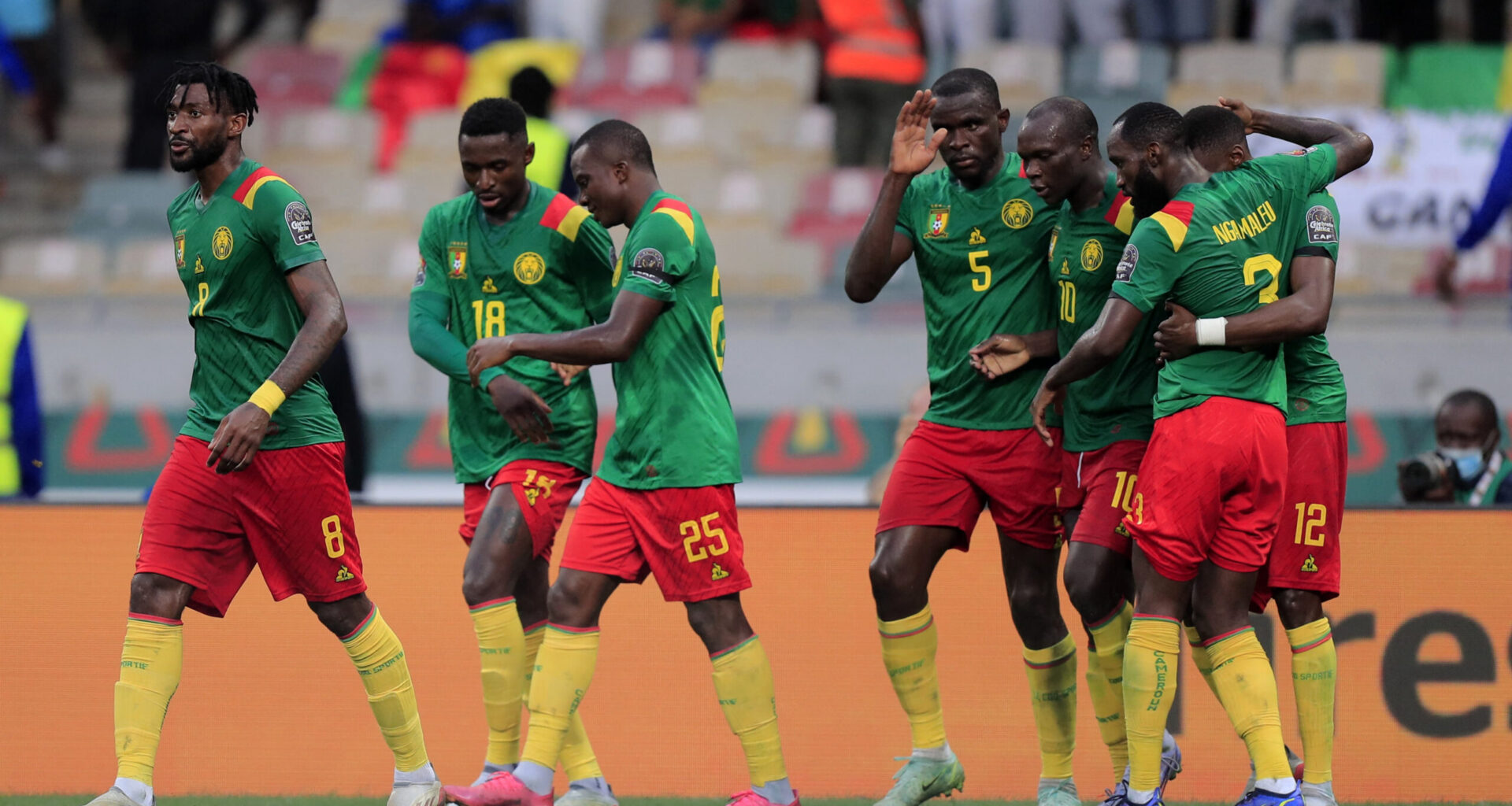
In the 53rd minute, South Africa’s Lyle Foster was tackled by Samuel Kotto. A hearty sweeping challenge, but fairly meaningless in the context of the match.
Cameroon were 2-0 up, controlling the game, and seeming, as their nickname suggests, indomitable.
Despite its insignificance, getting up from the challenge, Kotto looked to the crowd and bellowed a cry of passion, pumping his fist in raw emotion.
From the wreckage of their tumultuous tournament build-up, David Pagou has already instilled a steel within his side: a determination to prove the countless doubters wrong.
Only weeks before AFCON, Samuel Eto’o, president of Fecafoot, the Cameroonian football federation, took it upon himself to sack Belgian manager Marc Brys, after a challenging relationship reached its tipping point.
Pagou was appointed in his place and duly announced the squad he was taking to Morocco. The squad featured significant omissions such as Andre Onana, Eric Choupo-Moting, and Vincent Aboubakar.
However, Brys, too, refusing to accept his dismissal, also drew out his own squad, which included those three initial absentees.
Eventually, the snags were ironed out, and Pagou’s squad was selected to travel to the tournament. But, as a result of farcical civil war-like shenanigans, the Indomitable Lions crashed in people’s estimations.
But yet, here we are.
Pagou’s Cameroon remain unbeaten and are now only three more victories from an unanticipated trophy. Yes, they face the hotly tipped hosts, Morocco, in the quarter-final, but momentum is certainly with the West Africans, who’s to say they can’t continue?
Kotto’s challenge may have changed very little, but it was a challenge that underlined a burning desire to overcome adversity.
At first, Cameroon struggled to find their feet in the game. Bafana Bafana were unfortunate not to take an early lead when Relebohile Mofokeng ballooned his eighth-minute effort over the bar with only the keeper to beat.
And only six minutes later, Foster found the bottom right corner, but the linesman’s flag offered Cameroon a reprieve.
The start was rough and unpolished, but the preparations were rough and unpolished. But, as is now customary, the Indomitable Lions found a way through: in this case, quite literally.
Brighton’s Carlos Baleba’s initial effort was speculative. A full volley from a ball which came down with snow on it. I admit, a slightly out-of-place saying for a match taking place in Morocco, but nevertheless, the effort was ambitious.
Yet, via two deflections, one off a South African and a second off Kotto’s back, the ball broke favourably for Junior Tchamadeu. The flying wing-back demonstrated his attacking credentials by slotting past Ronwen Williams in goal.
After taking the lead in fortuitous fashion, Cameroon grew into the game. South Africa’s chances dried up, and Cameroon began to dominate possession; ultimately, they were deserving of their lead at halftime.
Despite the evident passion and desire, that was never enough to be a difference maker in the match. To win, some star quality was required, and shortly after the break, young starlet Christian Kofane delivered.
The 19-year-old RB Leipzig forward extended his side’s lead with a deftly guided header into the bottom left corner following a cross from Mahamadou Nagida.
From there, it was always an uphill battle for Bafana Bafana, but ‘the boys’ already proved that they can come from behind in their final group stage match against Zimbabwe. So, it wasn’t impossible, just unlikely, as Cameroon hadn’t conceded more than one in a match thus far.
Nevertheless, South Africa kept pushing for a way back into the match. Samukelo Kabini’s effort at the hour mark forced Devis Ebassy into a sharp save low to his left, but the breakthrough wasn’t immediately forthcoming.
Substitute Evidence Makgopa’s close-range strike with only two minutes left on the clock gave the South Africans hope to set up a grandstand finish. But despite another late effort from Makgopa dribbling narrowly wide, Cameroon stood firm to book their place in the quarter-final.
It wasn’t a vintage performance. To play as poorly as they did in the opening 30 minutes is unlikely to go unpunished against Morocco. But the course of the game was a recognition of Cameroon’s growth throughout the tournament so far.
Will their growth be stunted? Only time will tell.
One only has to think back to 2024 when Ivory Coast sacked their manager after their second group stage match to realise that Cameroon should not be written off.
It would be incredibly AFCON after all.