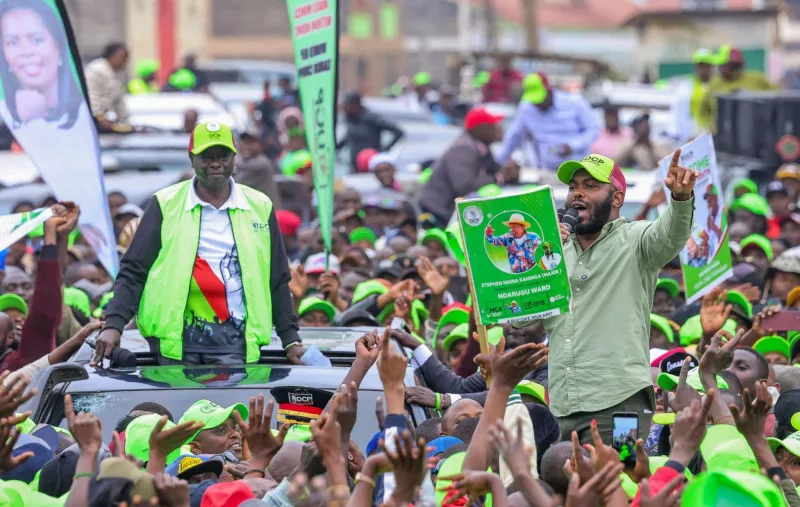
 Gatundu South MP Gabriel Kagombe addressing a DCP rally in his constituency on August 16, 2026/ HANDOUT
Gatundu
South MP Gabriel Kagombe was heckled by residents in his constituency as he
addressed a Democracy for Citizens Party rally, exposing the political
difficulties facing his recent defection.
The MP, who
recently left the United Democratic Alliance, was immediately heckled as soon
as he was invited to address the crowd by former Deputy President Rigathi
Gachagua.
Kagombe
sought to win over the hostile crowd by presenting his move to DCP as a
political transformation, likening himself to Saul, the biblical figure who
became Paul after his conversion.
However,
residents jeered and throughout his speech while waving their DCP hats.
“I came here
as Saul, but now I have become Paul. I have thrown away this hat. Put this one
on me because I have joined the DCP,” Kagombe said as he removed and threw away
his cap, putting on the DCP-branded one.
The
reception came after Kagombe, who was elected Gatundu South MP on a UDA ticket
in 2022, made a dramatic political shift from the ruling party to Gachagua’s opposition
outfit.
Kagombe had earlier cited growing disillusionment among his
constituents over unfulfilled government promises, particularly stalled Mau Mau
roads and unmet commitments to tea farmers, as some of his reasons for his
shift.
He told
Gachagua that he was willing to undergo the party’s vetting process and have
his political record scrutinised before being fully accepted into the DCP camp.
He appealed
to the party leadership to examine his conduct and political history, saying he
would not return to the political camp he had abandoned. He also thanked
Gatundu residents for accepting him despite the hostile reception during his
address.
“Najua hapa kuna vetting committee. Your excellency,
mimi nimekubali. Tukae nao, waniangalie, watu wa akina Gacheri, watu wa akina
Thang’wa, waniangalie kwa makini na waseme kama mimi nafaa…”
Kagombe’s
defection is part of a wider political realignment in Central Kenya, where
several leaders who backed President William Ruto in the 2022 election are
reassessing their political alliances ahead of the 2027 General Election.
Gachagua,
who took over the microphone after Kagombe’s address, leaders supporting Ruto but
willing to decamp to the opposition will have to face the electorate.
“I have told all these leaders who are with
Ruto that I have no problem with them. Let them come to the people. It is the
people who decide,” Gachagua said.
The former
deputy president has been using DCP to build a political base across Mt Kenya
and is working with other opposition leaders to popularise a united opposition
movement ahead of the 2027 elections.
The push has
heightened competition for the Mt Kenya vote, which remains one of the
country’s most politically influential blocs. The region overwhelmingly backed
Ruto in 2022 but has since witnessed growing political divisions following his
fallout with Gachagua.
Many
political leaders in the Central region are expected to make similar moves as
the united opposition continues to popularise its agenda and court politicians
who remain in government-aligned parties.
The realignment
is also unfolding against the backdrop of a renewed battle over the political
identity of Mt Kenya, with rival factions disagreeing on whether the region
should maintain a united political front or be divided into eastern and western
blocs.
Public
Service Cabinet Secretary Geoffrey Ruku has been at the centre of calls for Mt
Kenya East, comprising Meru, Embu and Tharaka Nithi, to pursue a more
independent political and development agenda from Mt Kenya West.
Ruku has
argued that the eastern side of the mountain has historically received a
smaller share of development and political opportunities. He has cited
disparities in infrastructure, including road development, in making the case
for greater consideration of Mt Kenya East.
His position
has, however, attracted resistance from leaders allied to Gachagua, who argue
that dividing Mt Kenya would weaken the region’s collective bargaining power
ahead of the 2027 election.