
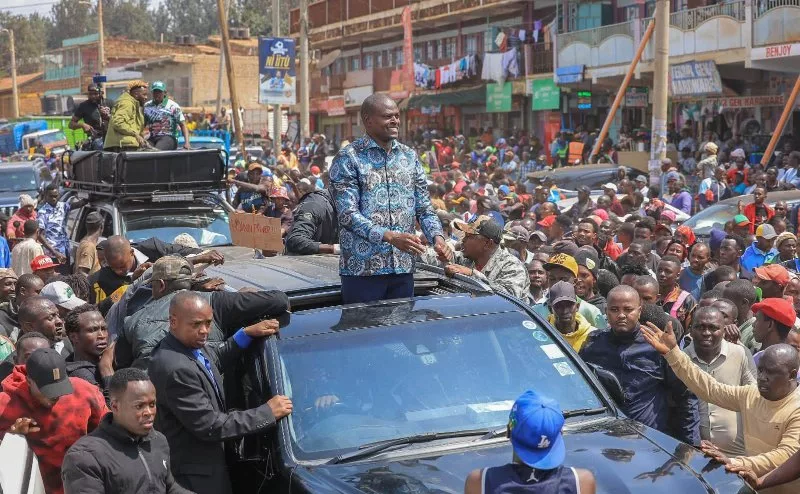
 Kiharu MP and PPK leader Ndindi Nyoro during his meet-the-people tour at Mukuyu, Murang’a, on August 19, 2026 /ALICE WAITHERA
The newly launched People’s Party of Kenya (PPK) has shaken up the political landscape in Murang’a county, the home turf of its leader, Kiharu MP Ndindi Nyoro.
Nyoro has described the party as a grassroots movement focused on the political and economic liberation of the country and outlined what he sees as solutions to some of the challenges facing Kenyans.
But his decision to launch the party and declare his presidential ambitions has unsettled local politics, particularly as the opposition seeks to consolidate its support in Mt Kenya.
A day after unveiling his party, Nyoro began a meet-the-people tour in Mukuyu, near Murang’a town, where he sought residents’ permission to join the opposition while reaffirming his determination to fight what he described as the ills of the Kenya Kwanza administration.
He also announced his presidential bid and said he was willing to work with other opposition leaders in their efforts to unseat President William Ruto.
“If people look at this young man from Kiharu and think he has worked hard, and has made education almost free in the constituency, what would be wrong with that?” he asked a cheering crowd before driving off on the Murang’a-Sagana road, flanked by thousands of supporters.
His move has, however, left some residents uncertain about the direction of Murang’a politics.
Some residents who previously supported the Democracy for Citizens Party (DCP) now feel compelled to back Nyoro, whom they credit with a strong development record in Kiharu.
Others believe he should have either remained in the race for his parliamentary seat or used his new party to consolidate his political base before making a presidential bid.
Maina Murage, a resident of Murang’a town, said Nyoro’s support would be strong if he sought to defend his parliamentary seat, but argued that his entry into the opposition had complicated the emerging balance among opposition leaders.
“Already, we are seeing the opposition leaders struggling to agree on who will be fielded as the presidential candidate. Nyoro has now entered the race and they will now have to go back to the drawing board,” he said.
Murage, however, welcomed Nyoro’s decision to join the opposition, saying it reflected the wishes of many residents.
Another resident, Simon Muigai, said Nyoro’s age could work against him in a presidential contest and questioned what would become of his political career if the bid failed.
“He’s a good leader and we love him, but he should have bought his time before throwing his hat in the ring. He’s just in his early 40s. Even if he were to serve as a CS, what would happen to him if there were regime changes and he’s thrown out?” he asked.
Muigai argued that Nyoro could have pursued the governor’s seat, which he said would have given him an opportunity to strengthen his political base before seeking the presidency in 2032.
But Joshua Githinji strongly supported Nyoro’s decision, saying the Kiharu MP was ready for national politics after demonstrating leadership abilities at the constituency level.
“PPK is not a Murang’a party, it’s a national party seeking to resolve issues facing all Kenyans. We’ve seen hordes of MPs coming to Kiharu to benchmark on his projects, especially on education. They all would say they hoped to develop their areas like Kiharu,” he said.
Githinji said the new party would seek to attract performers rather than career politicians and would distinguish itself by avoiding political insults and confrontations.
He argued the party had unsettled aspirants who had relied on established political parties to secure elective seats without necessarily building their own support among voters.
“This party is focused on what will happen after Ruto is ousted, not just the elections. It’s providing a framework to streamline the country and that is what many Kenyans want. It’s no longer business as usual. Before, when aspirants would be asked what their visions were, they’d answer that it’s to take Ruto home,” he said.
Githinji also welcomed opposition leaders’ acceptance of Nyoro, arguing the creation of his own party would give him a seat among the opposition principals.
He dismissed claims that Nyoro could be a government mole, saying many leaders from the region were elected through the UDA and had not resigned.
“No one has the moral authority to call another one a mole. If we have all decamped from UDA, why would one think their decamping is different from another one’s?” he asked.
But Mwangi Kifeeti, a strong DCP supporter, questioned why the new party had attracted a number of UDA leaders whom he said were waiting to join it and contest elections on its platform.
Kifeeti said the perception that PPK was state-sponsored would take time to disappear and would require Nyoro to work hard to convince voters otherwise.
He insisted that anyone associated with the government would face rejection in the region.
Nyoro has meanwhile sought to distinguish his party from the confrontational politics associated with some political campaigns, saying he would not entertain leaders who insult other politicians or engage in political confrontations.
His move has added another layer to the political contest in Murang’a, where DCP leader Rigathi Gachagua is seeking to consolidate his party’s presence.
Gachagua is scheduled to tour Murang’a and open a DCP office in Murang’a town before proceeding to Kangari and Kandara, a day after Nyoro’s first major political tour under PPK.
His visit is therefore likely to provide an early indication of how the two political formations will navigate their competing ambitions in a county where both are seeking grassroots support.
For now, Nyoro’s presidential bid has transformed what could have been a local political realignment into a much broader contest over who will shape Murang’a and, ultimately, the political direction of Mt Kenya ahead of the election.
Instant analysis
Ndindi Nyoro’s entry into the opposition has disrupted the emerging political equation in Murang’a, where Rigathi Gachagua’s DCP had been building momentum. By launching his own party and signalling presidential ambitions, Nyoro has moved beyond being a local political player to positioning himself in the national succession debate. His challenge will be converting his strong Kiharu support and development record into a broader political base while convincing voters that PPK is more than a personal vehicle. Gachagua’s decision to open DCP offices in Murang’a immediately after Nyoro’s first opposition rally underlines the emerging contest for influence. The two camps’ ability to coexist could shape Mt Kenya’s opposition politics.