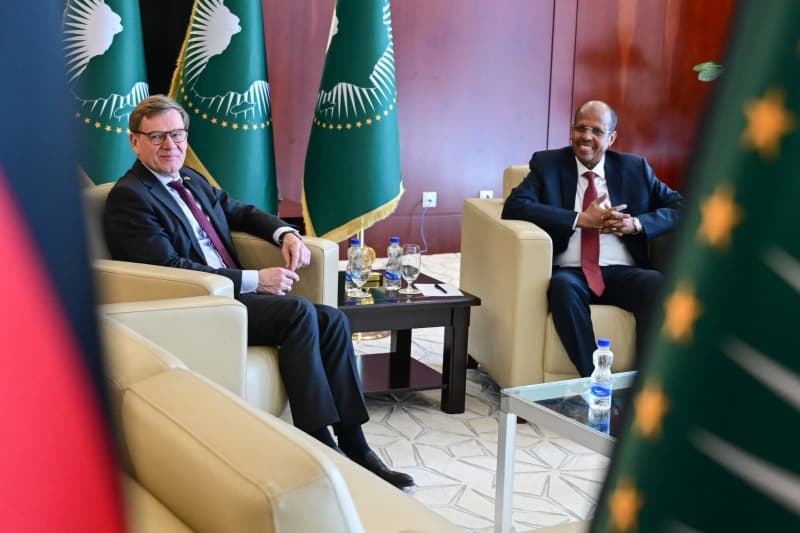
Germany and Ethiopia on Thursday highlighted the importance of the United Nations for conflict resolution, as US President Donald Trump launched a new international body widely considered a challenge to the decades-old organization.
“In times of geopolitical crises, the answer cannot be to withdraw from the international order and seek to replace its central institutions,” German Foreign Minister Johann Wadephul said after talks with Mahmoud Ali Youssouf, chairperson of the African Union Commission, in Addis Ababa.
“We all know that the international order is being disrupted, that creates a sense of uncertainty and unpredictability for the future,” Youssouf said.
“It’s certainly not helpful, nor can we properly plan the full execution of our peace and development agenda in these circumstances. Let us hope that reason and wisdom will prevail over reckless and disrupting decisions that have global impacts.”
Trump signed the founding charter of the Board of Peace at the World Economic Forum in Davos on Thursday.
The US president himself chairs the board, which he bills as a new international organization to spearhead peace-building initiatives.
Countries that contribute $1 billion can secure permanent membership, while others would serve a three-year term. A full list of members has yet to be released by the Trump administration.
Some 60 governments have been invited to join, but few of Washington’s Western allies have publicly accepted, with Hungary and Bulgaria the only European Union members to have signed on so far.
Trump originally conceived of the board as a body to oversee the reconstruction of the Gaza Strip following the two-year war between Israel and the militant group Hamas.
He has since suggested the body’s ambitions could be stepped up to handle conflicts and crises worldwide and said at the ceremony that the board “can spread out to other things” beyond Gaza.
Many analysts see such a suggestion as an attack on the UN, which Trump says he values but has repeatedly criticized for failing to resolve conflicts.
Wadephul acknowledged that the UN is in need of reform to become more effective and representative, in response to a question by a journalist following a meeting with his Ethiopian counterpart Gedion Timothewos.
However, the UN is the international peace organization that the German government supports “and on which we are focusing our efforts,” Wadephul said. “That is why we did not take part in today’s signing ceremony.”
He added that Germany continues to have “a few questions for the American administration” regarding the Board of Peace which would now be discussed.
Wadephul, who arrived in Ethiopia on the heels of a one-day visit to Kenya, highlighted the importance of strengthening ties with the African Union, an intergovernmental organization headquartered in Addis Ababa and made up of 55 member states.
“At a time when the fundamental principles of the world order are being openly questioned, we need partnerships to defend these very principles,” the German minister said.
“We are united by the conviction that integration and rule-based cooperation make us strong.”
Germany and the African Union are looking to launch a strategic dialogue for jointly developing solutions to major global challenges, with Wadephul mentioning peace and security, energy and climate, and migration and mobility as possible areas of cooperation.