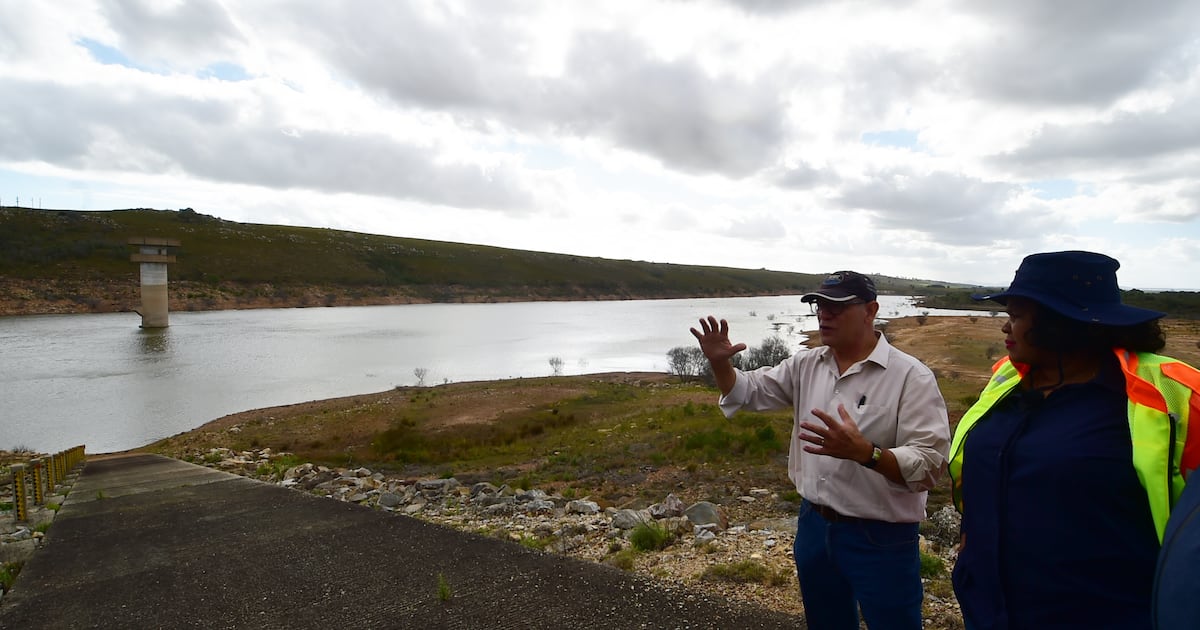
Water security concerns in Nelson Mandela Bay are mounting as Impofu Dam in Humansdorp has dropped to 42.6%, despite being one of the metro’s largest water sources.
The declining levels are a result of low rainfall and rising water demand, keeping the metro firmly in drought territory.
Bay mayor Babalwa Lobishe visited the dam on Tuesday afternoon, accompanied by senior director for water and sanitation Barry Martin and executive director for infrastructure and engineering Joseph Tsatsire, to observe conditions firsthand and receive a briefing on the water situation in Nelson Mandela Bay.
Martin has warned that the metro remains firmly in drought mode, with dam levels critically low and strict water restrictions to be implemented during the peak summer months.
“Our average dam levels in Nelson Mandela Bay have dropped below 50% and are now 47%,” he said.
“We have just come through the holidays and are entering the hottest period of the year, when water consumption is very high.
These imposed restrictions are an indication that the use of water sparingly must become a day-to-day experience. The department looks at the resource and its sustainability over time, which is why these restrictions are in place.
— Joseph Tsatsire, executive director for infrastructure and engineering
“We’ve always been in a drought. The department of water and sanitation has imposed a 25% water restriction, reducing our supply from just over 100 megalitres to about 75 megalitres per day.
“This places critical pressure on the metro and emphasises the need to preserve water.”
Tsatsire has called on residents to make water saving a daily habit, warning that national water restrictions are a clear signal that the sustainability of the metro’s supply remains under serious pressure.
“As a metro, we need to ensure that using water sparingly becomes a way of life. We have seen drought-related fatigue, and we need to reignite the culture of reducing consumption.
“Our focus includes reducing leaks and improving response times, while residents also play their part in cutting daily use. If we save even a litre of water today, it means water will be available for longer as we plan for the future,” he said.
In response, the mayor announced a return to stricter water management measures, warning that water restrictions would be intensified if consumption does not decrease.
Every household must not use more than 50l of water per person per day.
— Babalwa Lobishe, Nelson Mandela Bay mayor
Lobishe said continued lack of rainfall may force stricter enforcement measures if residents and businesses do not immediately reduce water usage.
“We are going back to our water management system to monitor the consumption of every residential home. This will allow us to caution residents and, where necessary, restrict excessive use. While harsher measures are not on the table yet, we may be compelled to act if the situation worsens.
“We will also strengthen metro police efforts to detect and stop illegal water use, including water theft by trucks.”
Lobishe emphasised the urgent need for water conservation, calling on residents and businesses to cut back on non-essential water use immediately.
“Businesses stealing water from our systems will face stricter monitoring as we strengthen means to stop this.
“Every household must not use more than 50l of water per person per day. The sooner we go back to saving water, the better.
“People with swimming pools must understand that they are a luxury we simply cannot afford right now. If anyone wants to swim, we have plenty of beautiful beaches to enjoy instead.”