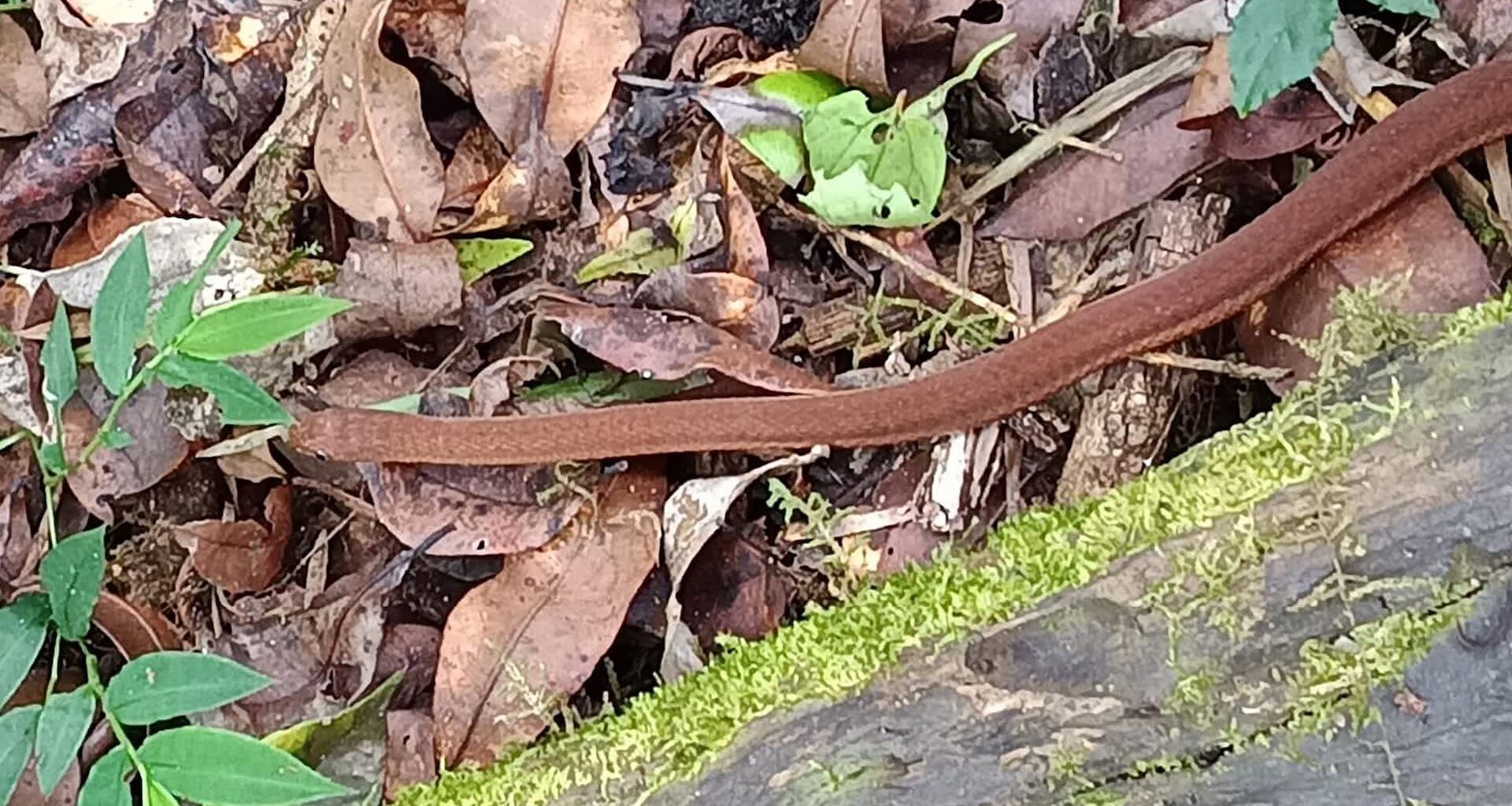

Photo Credit: Abdulkadir M. Hussein
A newly identified snake from Ethiopia’s Harenna Forest survives entirely on bird eggs, swallowing them whole before cracking the shells with specialized bones in its throat.
The find expands a group of African snakes whose members are notoriously hard to tell apart. Researchers were able to confirm the new species only after years of observation, DNA work, and even a hybrid breeding experiment, Pensoft Publishers reported via Phys.org.
Here’s what to know
Researchers revealed the new species in the journal Herpetozoa, with scientists from Germany and South Africa contributing to the effort. They named the snake Dasypeltis albigularis, or the white-throated egg eater.
The animal was discovered in Ethiopia’s Harenna Forest, one of the Horn of Africa’s last remaining major forested areas. The new snake belongs to a group of snakes that is harmless to humans and feeds exclusively on eggs.
One of the unique shared features among the genus is modified vertebrae in the throat that break egg shells prior to swallowing.
About 20 other species are known in the genus, with many of them being difficult to separate by appearance. The snakes are primarily black, brown, or gray with few obvious external distinctions.
At first, researchers did not know that they were dealing with an entirely new species of snake.
“I received a juvenile female of an egg eater that appeared to me to be an already known species, and I started looking for a male to breed it,” said Arthur Tiutenko, the study’s lead researcher. “As she grew to adult size, I noticed morphological differences.”
More background
By outward appearance, the Harenna Forest snake looked much like the montane egg eater, Dasypeltis atra, a black-colored species found in forests across East Africa. But mitochondrial and nuclear DNA testing showed that it was indeed a separate species.
The researchers did identify some visible traits that set the Harenna Forest snake apart from its cousins. Dasypeltis albigularis shows light skin, sometimes with a bluish tint, between its scales, and it has a white throat and belly — the feature reflected in its scientific name, which means “white-throated” in Latin.
Another key to identifying the new species was hybrid breeding.
One test paired the female Harenna Forest snake with a male from a closely related species. The hybrid offspring carried a mix of traits from both parents, giving early evidence that the Harenna snake was distinct.
However, it took seven years for the researchers to complete their investigation and prove that the Harenna Forest snake belonged to a newly discovered species.
Where can I learn more?
The following stories also examine snake discoveries and identification work. They cover newly identified or rediscovered snakes in India, China, and Myanmar.
• In India’s Western Ghats, scientists identified a snake with pointed teeth hidden under a forest log.
• In Sichuan, China, herpetologists rediscovered a rare snake decades after it seemed to vanish.
• DNA testing showed a Myanmar pit viper was its own species, not two lookalikes.
Get TCD’s free newsletters for easy tips, smart advice, and a chance to earn $5,000 toward home upgrades. To see more stories like this one, change your Google preferences here.
