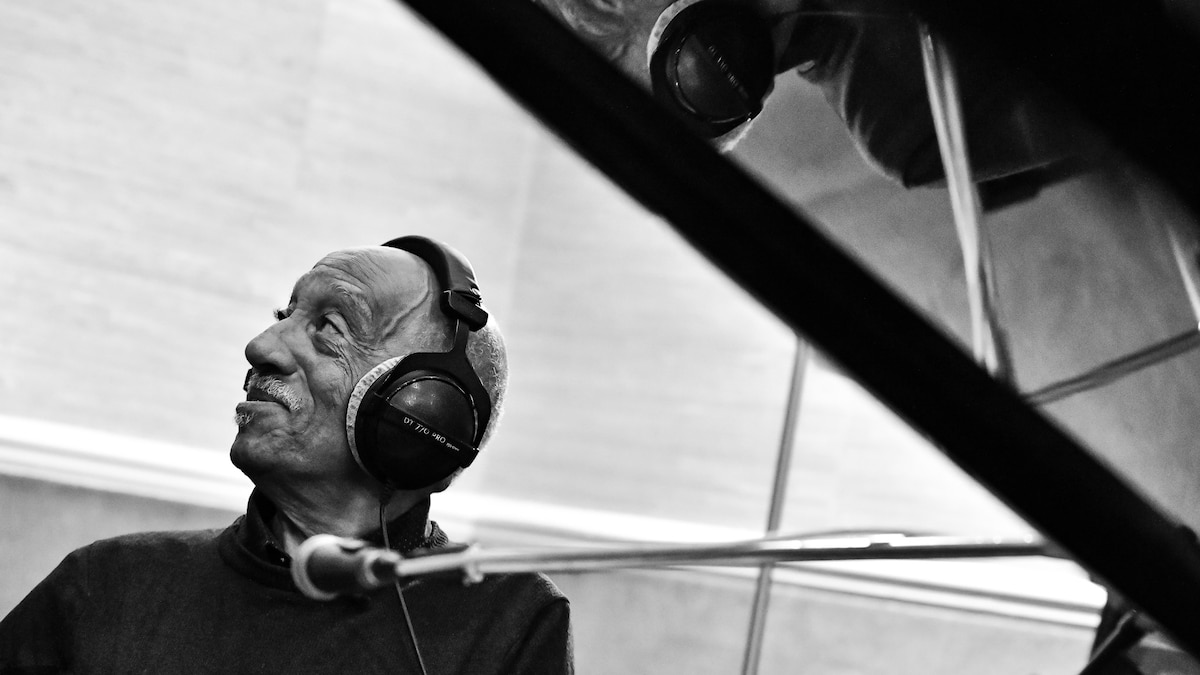
At Berklee, he remembers sitting in class, learning about such figures as Charlie Parker and Miles Davis, and thinking, “How come I don’t become like this? How come I don’t become like these big famous people?” he says. To do so, he realized, “I had to learn how to be myself.”
There had been interactions between modern Western and Ethiopian music before, going back at least to Emperor Haile Selassie’s fascination with military bands, but until Mulatu, they had never been so deliberately realized and sparklingly constructed. More than half a century later, the music remains impossibly alluring. It is propulsive, melancholy, and mysterious—all the traits that one assumes spurred Jim Jarmusch to use it on the soundtrack to his 2005 film Broken Flowers. Thanks to that movie, and the multivolume French compilation of Ethiopian music, Éthiopiques, Mulatu has become embedded in our sonic landscape, both literally (if you’ve eaten in restaurants the past two decades, you’ve almost certainly heard his songs in the background) and through his influence on funk, hip-hop, and other genres. As Mulatu puts it: “I took the four modes of Ethiopia and, on top of them, I built the world.”
“Tezeta (Nostalgia)” by Mulatu Astatke
One thing those early records lacked, though, was an emphasis on the traditional instruments and musicians on which the “Ethio” part of Ethio-jazz was based. The omission seems to have haunted Mulatu all these years. “Always, these people were on my mind,” he says.
In this way, Mulatu Plays Mulatu feels like a kind of atonement, or at least an attempt to repay a perceived debt. Recorded in London and Addis Ababa, the album reinterprets Mulatu’s classics, this time integrating and highlighting traditional instruments. These include the lyrelike krar, the single-stringed masenqo, and the conical drum known as the kebero. Coupled with the playing of the tight band of young, mostly white, British players with whom Mulatu has long toured, the effect is to expand his canon in two directions—toward an ancient past and a dynamic future.