The last half-decade has been a study in emergency. Mass atrocities, climate harms, maritime flashpoints, and information-age evidence have all crowded the international agenda. Yet, crisis can serve as a catalyst in international law. Nowhere is that catalytic effect clearer than in African States’ and advocates’ pivot towards international adjudication, especially the International Court of Justice (ICJ). From The Gambia’s genocide case against Myanmar to small-state coalitions powering the climate advisory opinions and regional and domestic courts that “thicken” compliance, African practice is showing how crisis doesn’t suspend law; it accelerates it.
This piece argues that litigants from Africa and the African diaspora are doing more than “using” courts during emergencies. They are actively shaping doctrine: widening access for small and middle-power States, normalizing evolved provisional-measures practice, re-centering evidence and monitoring, and helping to translate climate risk into hard-law duties. The result is a jurisprudential toolkit forged in crisis but designed to outlast it.
The Catalyst Frame: From Exception to Accelerant
Traditional narratives cast crisis as the space outside law: where necessity, emergency, or “political questions” dominate. Recent African-led or Africa-centered dockets challenge that reflex. They show that emergency can be a medium for legal development, that is, a channel through which jurisdictional gateways, evidentiary baselines, and remedies evolve.
Two levers tell the story. First, standing and access: who can credibly seize the “world court” in moments of mass harm? Second, remedies and compliance: when the Court speaks (on reparations, on monitoring, on cross-regime obligations) how are those words converted into practice?
Small States, Big Law: The Gambia’s Genocide Case
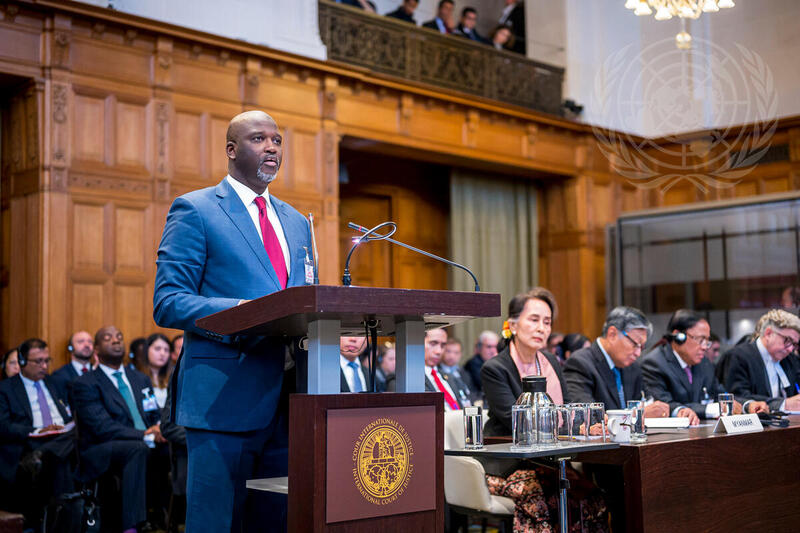
In 2019, The Gambia, one of the world’s smallest countries, filed a case under the Genocide Convention against Myanmar for atrocities against the Rohingya. In January 2020, the ICJ unanimously indicated provisional measures requiring Myanmar to prevent genocidal acts, preserve evidence, and report regularly to the Court. That order, followed by a 2022 judgment rejecting Myanmar’s preliminary objections, did three things of lasting significance.
First, it reaffirmed erga omnes partes standing: any State party may invoke the obligations of the Genocide Convention, even absent a special or direct injury. Second, it strengthened the reporting dimension of provisional measures, effectively building a feedback loop that treats interim relief as an evolving regulatory baseline rather than a single freeze-frame. Third, it normalized evidence preservation as an urgent obligation in atrocity settings: critical in an age of open-source investigations and the destruction of digital traces.
The Gambia’s move also seeded a broader practice: coalition litigation by or on behalf of smaller States that can mobilize treaty obligations to counter large-State impunity. It is not incidental that, in the years since, more States have grown comfortable invoking community-wide treaty duties separate from direct injury.
While the Court’s January 2020 provisional measures order in The Gambia v. Myanmar marked a doctrinal leap (requiring Myanmar to prevent genocidal acts, preserve evidence, and submit periodic compliance reports) it also revealed the limits of enforcement in politically sensitive cases. The reporting mechanism, in theory, converts interim relief into a quasi-regulatory compliance practice, enabling the ICJ (and the broader international community) to monitor conduct between merits phases. This is a step forward for compliance. But, it has its limits: in practice, the reports submitted by Myanmar (the first on 22 May 2020) are classified and only accessible to the Court and The Gambia, and it is not clear whether the Court has tools to assess accuracy, compel detail, or sanction omissions. This lack of public disclosure of the reports, and the absence of a verification mechanism, means critical information – such as evidence destruction, displacement patterns, or obstruction of investigations – may go unchallenged. Still, the fact that such reports are required at all, and can be cited by other actors (United Nations bodies, sanctions committees, civil society), has normatively strengthened the view that compliance with provisional measures is not optional, and that omissions in such reports can (theoretically) trigger diplomatic and economic consequences even absent judicial contempt powers.
Climate Harm and Advisory Power: African Coalitions in The Hague and Hamburg
Crises are not only kinetic. They are also slow-onset, cumulative, and existential (nowhere more so than climate change). Here, African and small-island leadership again helped move the law. In March 2023, the United Nations General Assembly, driven by a coalition led by Vanuatu and supported by many African States, requested an advisory opinion from the ICJ on States’ obligations “in respect of climate change.” In July 2025, the Court answered: it identified applicable treaty, customary, law-of-the-sea, and human-rights rules; confirmed that its task was legal and within jurisdiction; and set out present-tense obligations of prevention and cooperation across regimes. Among its headline holdings, the Court recognized the Paris Agreement’s 1.5°C limit as the parties’ agreed primary temperature goal and held that Nationally Determined Contributions (NDCs) are obligations of result to be prepared, communicated, and maintained, with implementation governed by a stringent due-diligence standard.
In parallel with and now reinforced by the International Tribunal for the Law of the Sea (ITLOS)’s 2024 advisory opinion, the ICJ affirmed ITLOS’s position that anthropogenic greenhouse-gas emissions (GHGs) constitute “pollution of the marine environment” under UNCLOS and that Part XII applies. As a result, States must protect and preserve the marine environment under Article 192 through measures that meet a stringent due-diligence standard. States must also take “all measures necessary” under Article 194 to prevent, reduce, and control GHG pollution: assessed against objective criteria such as best available science and international rules and standards. Critically, the ITLOS opinion added that fulfilling UNFCCC/Paris duties is not necessarily sufficient to satisfy UNCLOS Article 194.
For Africa (home to vast coastlines, climate-exposed agriculture, and fast-growing cities) the implications are immediate. Advisory opinions from both the ICJ and ITLOS are formally non-binding, but they cascade: after the ICJ and ITLOS opinions, climate-treaty obligations, UNCLOS duties, and customary rules inform each other, giving courts and regulators concrete benchmarks for due diligence, cooperation, and environmental impact assessment, and giving coastal States an additional law of the sea hook for mitigation and adaptation demands. In short, with ITLOS anchoring GHGs in the law of the sea and the ICJ now clarifying general obligations of prevention and cooperation (plus the legal bite of the 1.5°Cand NDC aspects of the opinion), crisis again has functioned as an accelerant, converting diffuse risk into actionable legal standards.
Remedies With Teeth: Reparations and Method in DRC v. Uganda
If interim measures are the law’s life support, reparations are its reconstructive surgery. Here too, recent jurisprudence with African parties marks a shift from symbolic awards to method-driven quantification. In Armed Activities on the Territory of the Congo (DRC v. Uganda), the Court’s 2022 reparations judgment awarded US$325 million across heads of damage (personnel injury and loss of life; property damage; natural resources), while setting out evidentiary approaches to valuation and causation in complex conflict settings. The judgment, following merits findings dating to 2005, has become a template for structuring reparations claims in future conflicts.
The methodology matters: it normalizes the use of demographic and econometric evidence; it recognizes aggregate harm and reasonable inference where granular proof is impossible; and it builds a bridge to domestic proceedings (courts, reparations programs, and administrative claims) that need concrete numbers and categories, not just declarations.
Beyond The Hague: Regional Ecosystems that “Thicken” Compliance
African regional courts translate and extend these global developments. The African Court on Human and Peoples’ Rights has built a practice of provisional measures in situations of extreme gravity and urgency: orders that, while distinct from the ICJ, share the same logic of preventing irreparable harm pending merits adjudication. During the Libya crisis in 2011, for example, the African Court granted provisional measures at the African Commission’s request—early evidence of a continental emergency toolkit.
Meanwhile, the Economic Community of West African States (ECOWAS) Court of Justice has used crisis (corruption-driven education collapse and government crackdowns on peaceful protests) to advance socio-economic rights enforcement. For instance in 2010, in SERAP v. Nigeria, the Court affirmed the justiciability of the right to education and rejected arguments that it was merely a “directive principle,” creating leverage for civil-society monitoring and budgetary compliance.
Accordingly, these forums do not duplicate the ICJ; they complement it. Where the ICJ sets high-level obligations and, at times, remedies, regional courts enable repeat-player enforcement, local monitoring, and urgent interim protection in contexts the ICJ may never reach. This assists in “thickening” compliance with essential international law obligations, by dispersing complementary compliance efforts across a diversity of jurisdictions. For practitioners, the insight is strategic: litigation ecosystems matter more than individual wins.
Maritime Disputes Without the Gunboats: Somalia v. Kenya
Crises in Africa are not all about mass atrocities or climate: the maritime domain shows how legal processes can defuse or at least structure contestation. In Maritime Delimitation in the Indian Ocean (Somalia v. Kenya), the ICJ’s 2021 judgment delimited the maritime boundary in the Indian Ocean, rejecting Kenya’s equidistance-shift arguments and clarifying the role of uti possidetis-style colonial lines in contemporary delimitation (uti possidetis is a principle in international law which holds that the borders of a newly independent state are the same as the administrative borders it had preceding independence). Due to overlapping claims to a 38,000 sq mile (100,000 sq km) maritime area rich in oil, gas, and fishing resources, Somalia and Kenya were poised for escalating diplomatic and military tensions, with Kenya at one point threatening to withdraw from the ICJ process and both countries suspending key bilateral engagements.
The ICJ’s judgment in Somalia v. Kenya resolved the boundary using equidistance principles and rejected Kenya’s claim to a previously agreed maritime boundary (thereby clarifying legal entitlements and providing a neutral, rules-based outcome). Although Kenya both withdrew from the case and rejected the Court’s ruling, relations between Kenya and Somalia did not devolve further into military action. Accordingly, this ICJ case exemplifies how technical adjudication in fraught settings can stabilize relations and enable resource governance without military escalation. In considering crisis as catalyst, this example provides that lesson that in resource-rich or geopolitically sensitive seas, law can be a de-escalator: it has the potential to channel the crisis of competing claims into charted lines and predictable obligations.
The Road Ahead
The ICJ’s climate advisory opinion and process has crystallized into a rare global seminar on State duty and intergenerational equity, with African coastal and island States as leading voices. ITLOS has already marked greenhouse gases as “marine pollution,” signaling that the era of climate exceptionalism may be over for the law of the sea. At the same time, genocide-convention litigation is maturing interim relief into a compliance practice: not merely an urgent plea. Maritime delimitation continues to show how law can structure rivalry without force.
For practitioners, scholars, and policymakers, the through-line is uncomplicated: crisis accelerates law when litigants are ready (with jurisdictional pathways, evidence strategies, and remedial blueprints that courts can adopt quickly). The task ahead is to consolidate these gains: develop templates for provisional-measures requests; share cross-case evidence protocols; mainstream reparations design; and connect The Hague’s words to Arusha’s and Abuja’s enforcement energy.
In a world of overlapping emergencies, the question is not whether law can keep up with crisis. It is whether we can continue to seize the unique opportunities that crisis brings to build better law: and whether the coalitions that pioneered that approach, many of them African, will be supported to keep going.
FEATURED IMAGE: The Agent of The Gambia, Abubacarr Marie Tambadou, Minister of Justice and Attorney General of the Gambia, speaks on the first day of the December 2019 hearings before the International Court of Justice. Seated at the front is the Agent of Myanmar, Aung San Suu Kyi, Union Minister for Foreign Affairs of the Republic of the Union of Myanmar (via UN Media).