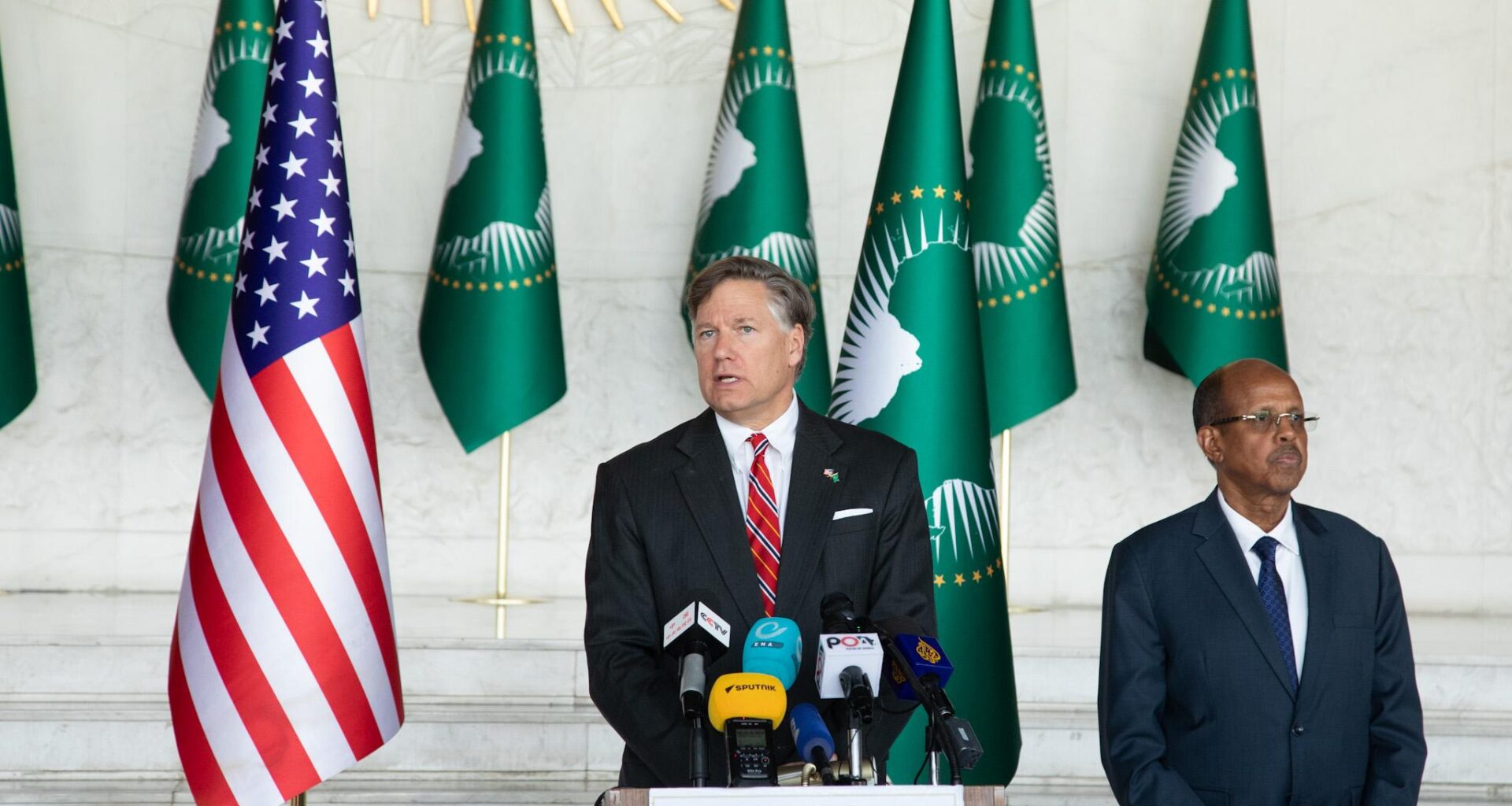
Addis Ababa — The United States and the African Union have taken a decisive step toward reshaping Africa–U.S. economic engagement with the launch of a Strategic Infrastructure and Investment Working Group (SIWG), signaling a shift from aid‑driven cooperation to long‑term, investment‑led partnership.
The agreement was announced following high‑level talks between U.S. Deputy Secretary of State Christopher Landau and Mahmoud Ali Youssouf at the African Union Commission headquarters in Addis Ababa.
Both sides reaffirmed that economic growth is foundational to peace, security, and long‑term stability across the continent, and that quality infrastructure, private‑sector investment, and trade integration are central to Africa’s future trajectory.
From Assistance to Strategic Investment
At the core of the agreement is a shared recognition that Africa’s development path must be anchored in durable, profitable investment rather than traditional foreign assistance.
The newly established SIWG will bring together senior officials and technical experts from the U.S. government and the African Union Commission to:
Identify AU‑backed infrastructure projects suitable for U.S. private sector investment
Mobilize innovative financing tools and blended capital
Align U.S. engagement with Africa’s continental development priorities
The initiative is explicitly informed by Agenda 2063, the African Union’s long‑term blueprint for transformation, as well as flagship frameworks such as the African Continental Free Trade Area and the Programme for Infrastructure Development in Africa (PIDA).
Priority Sectors: Infrastructure, Trade, and Digital Transformation
According to the joint statement, the SIWG will focus on trade‑enabling and growth‑driving sectors, including:
Transportation and logistics corridors
Energy networks and power connectivity
Critical minerals and commodities supply chains
Digital infrastructure and continent‑wide digital transformation
Regulatory harmonization to support cross‑border trade
Health security and resilient supply systems
By combining the AU’s convening authority and regional expertise with U.S. capital markets and innovation capacity, the partnership aims to unlock projects that create jobs, strengthen value chains, and increase two‑way trade between Africa and the United States.
A Platform for Long‑Term Economic Alignment
Officials on both sides framed the SIWG as more than a technical forum. It is intended to serve as a strategic platform that shapes Africa–U.S. economic cooperation for years to come, aligning public policy with private investment at scale.
The working group reflects a broader recalibration of U.S. engagement with Africa — one that recognizes the continent not as a peripheral partner, but as a central player in global growth, supply chains, and geopolitical stability, particularly as Africa’s population remains the youngest and fastest‑growing in the world.
Positioning Africa in Global Economic Architecture
For the African Union, the agreement reinforces efforts to position Africa as an integrated investment destination rather than a collection of fragmented markets. For the United States, it signals an intent to compete through partnership, transparency, and long‑term value creation, rather than short‑term extraction or dependency.
As global competition for infrastructure, minerals, digital systems, and trade routes intensifies, the SIWG underscores a shared understanding: Africa’s economic future will be built through strategic collaboration, not charity.
United States Africa partnership, African Union investment strategy, US AU Strategic Investment Working Group, Africa US trade relations, Agenda 2063 development, African Continental Free Trade Area AfCFTA, Africa infrastructure investment, US private sector Africa, Africa economic growth strategy, Addis Ababa diplomacy, African Union Commission, US State Department Africa, Africa trade corridors, PIDA infrastructure Africa, Africa digital transformation, Africa logistics corridors, Africa energy networks, Africa critical minerals supply chains, US Africa investment framework, Africa job creation investment, Africa economic security, Africa US cooperation, Africa regional economic communities, Africa trade facilitation, Africa regulatory harmonization, Africa health security infrastructure, Africa development financing, Africa blended finance, Africa infrastructure financing, Africa investment platforms, US Africa strategic partnership, Africa growth markets, Africa young population economy, Africa global supply chains, Africa trade integration, Africa investment climate, Africa capital markets, Africa sustainable infrastructure, Africa economic diplomacy, Africa foreign investment strategy, Africa industrialization, Africa cross border trade, Africa digital economy, Africa connectivity infrastructure, Africa long term development, Africa economic transformation, Africa peace and prosperity, Africa strategic investment, Africa US economic alignment, Africa global competitiveness
Related