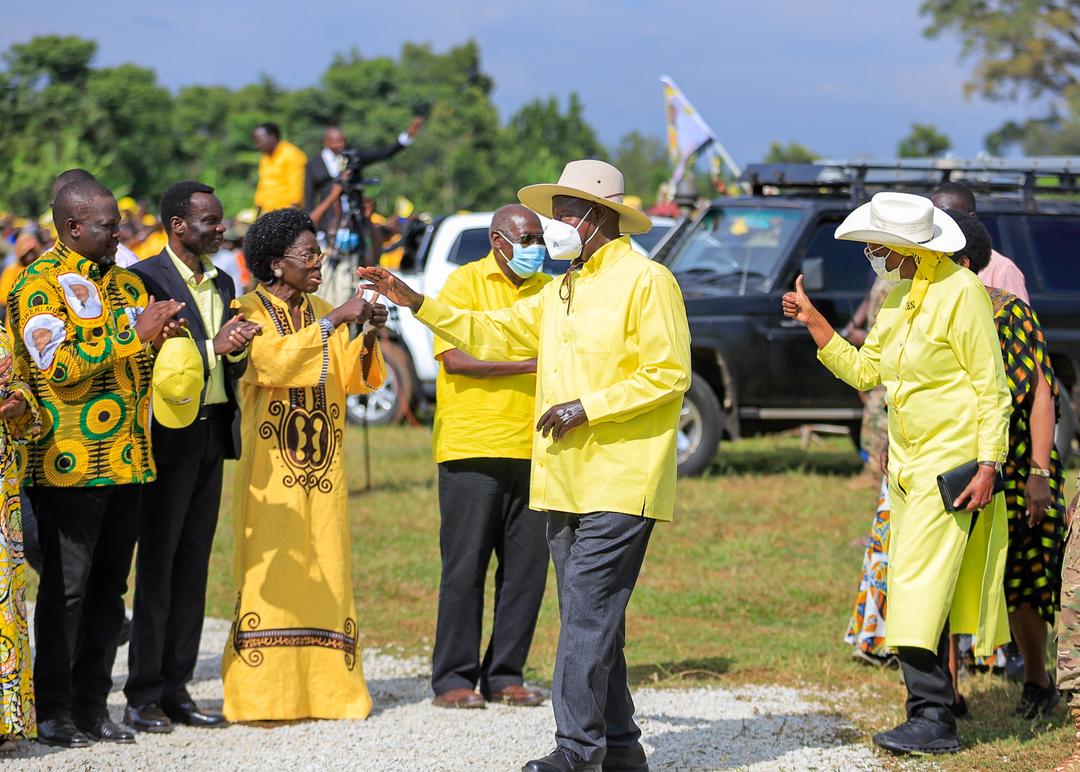
For former vice president Speciosa Wandira Kazibwe, former secretary general of the ruling National Resistance Movement (NRM) Justine Kasule Lumumba, and former minister Daudi Migereko, it is a race against time. Together with the former executive director of Kampala City Council Authority (KCCA) Dorothy Kisaka, and Uganda’s former Deputy High Commissioner and Permanent Representative to the United Nations Human Settlements Programme Agnes Kadama Kalibbala, they are members of what is known as the regional coordinating team for the campaign of the NRM in Busoga sub-region.
NRM has chosen to do things differently. This time round, it does not have a national campaign taskforce. Ms Lumumba says it instead has coordinating committees through which the secretariat is working to deliver victory. “It was decided that the Secretariat would take the lead in coordinating the elections. So the Secretariat formed the committees to work with campaign teams in the districts. Logistics for the party’s activities are sent to the districts, but there must be leaders in the regions who help the Secretariat to make sure those logistics are received and put to good use,” she explains.
The resources include money, campaign paraphernalia like T-shirts, baseball caps, posters, guidebooks, campaign messages and others. The biggest talking point in all previous elections has been the decision by NRM to always form parallel committees, which have often been deployed much to the chagrin of local teams, but Mr Migereko, who is also the vice chairperson of the Busoga coordinating team, says that will not be happening again. “This time, the campaigns are under the district executive committees (DECs). The DECs are working with the parishes and the villages.
Each district leadership is in charge of the campaign in that particular district. The regional coordinating team is working with the districts in each of the regions,” he says. There have also been quarrels over money going to the wrong people, but by the comments of Mr Meddie Ntuyo, the NRM’s secretary general in Jinja City that too, that too has been sorted. “The facilitation for the campaigners has been reaching the real people in Busoga, unlike what used to happen during the previous election, where the Kampala-based team failed to deliver the money,” Mr Ntuyo says.
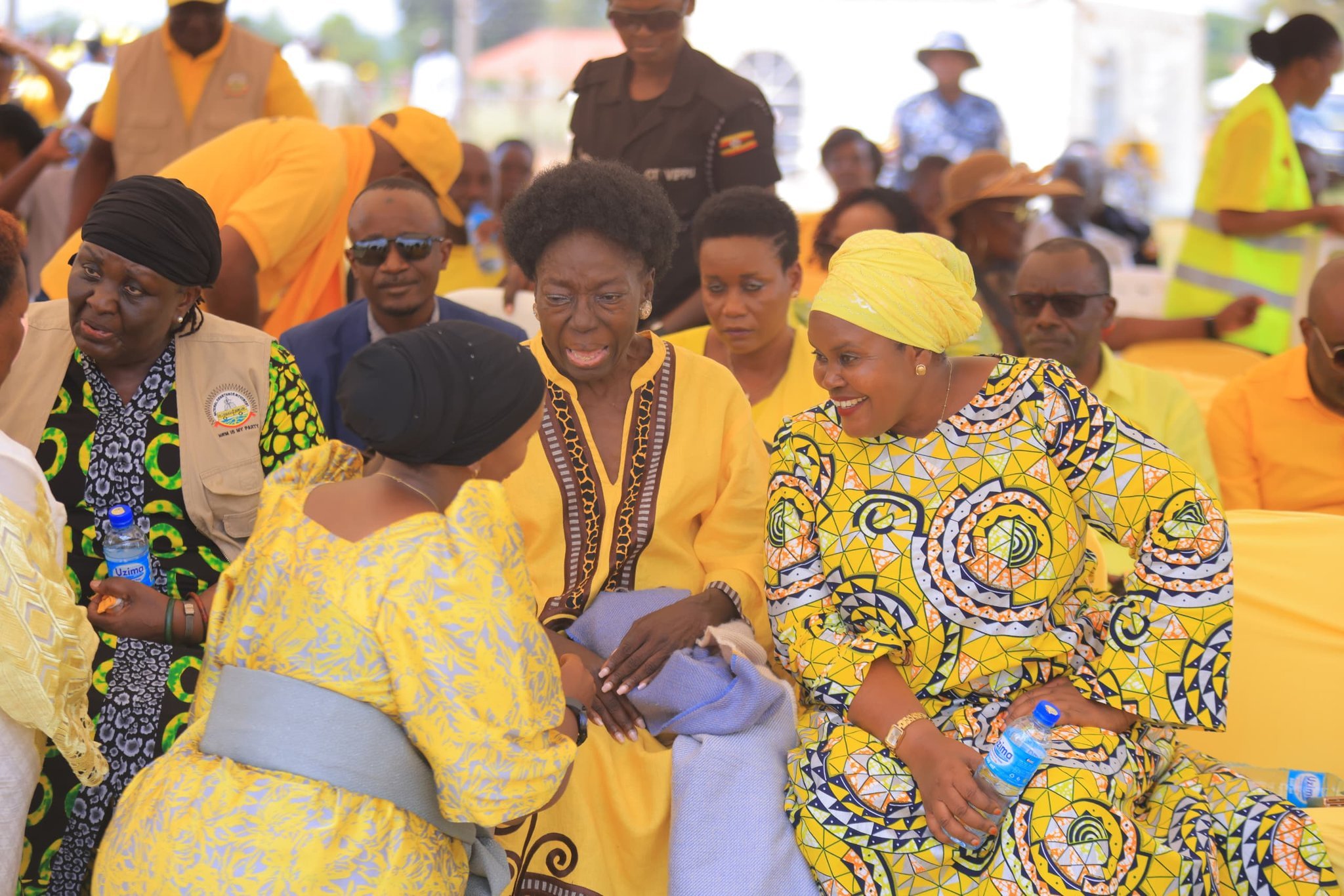
For the case of Busoga, the coordination team and campaign teams are backed up by campaign teams headed by First Deputy Prime Minister and Minister for East African Affairs, Ms Rebecca Kadaga, and another headed by the minister for the Presidency, Ms Milly Babalanda. Ms Kadaga has introduced a new dimension to the campaign. She introduced the hospital-focused campaign, which targets health workers, patients, and caretakers, many of whom may find it difficult to attend large political rallies due to their responsibilities or medical conditions.
Her team, which is headed by Ms Hellenah Namutamba, the minister for tourism in Busoga Kingdom, has been visiting health facilities in the region to not only converse for support, but also show patients and caretakers some “yellow love” in the form of hampers containing, among other things, water, food, and detergents.
All the campaign teams have been working to ensure Busoga votes for the NRM. It should be remembered that Busoga voted against the NRM in 2021. Its presidential candidate, Mr Museveni, garnered 404,862 votes while the presidential candidate of the National Unity Platform (NUP), Mr Robert Kyagulanyi, also known as Bobi Wine, garnered 437,059 Votes. The margin of 32,197 votes may appear small, but it assumes immense significance given that it was the first time since 1996 that Busoga region voted against Mr Museveni.
Mr Deo Atukunda, the Busoga Regional Election Officer, told the media in March last year that only 70,906 new voters had been added to the voters’ register in the region. That pales considerably given the increments experienced in the period between 2016 and 2021. According to The Uganda Elections Atlas, a product of the Great Lakes Institute for Strategic Studies (GLISS), there were 1,519,554 registered voters in Busoga in 2016, which rose to 1,800,378 in 2021. Assuming that there were no deaths or transfers during the voter registry update exercise, add the 70,906 new voters to the 1,800,378 voters who were on the register in 2021, and the stake will be 1,871,284 registered voters.
The task of the various campaign teams is quite simple – get the Busoga vote to swing back to the NRM. The simplicity is, however, limited only to the conciseness of the mission and clarity of purpose. Truth is that there is nothing simple about the task at hand. Matters are not helped by the fact that Busoga has a long history of never making a U-turn once it breaks ranks with a sitting government or political organisation.
In the 1960s, for example, Busoga was a stronghold of the ruling Uganda Peoples Congress (UPC), but the arrest on February 22, 1966, of five Cabinet ministers, including Grace Ibingira, Dr Emmanuel Lumu, George Magezi, Balaki Kirya and Mathias Ngobi, who was from the region, resulted in the commencement of an estrangement of the relationship between the party and the region.
The subsequent arrest and conviction of the first vice president and Kyabazinga of Busoga, Sir William Wilberforce Kadhumbula Nadiope, on charges of insurance fraud was perceived as the highest form of betrayal on the part of president Milton Obote, who Busoga had earlier embraced mostly because Nadiope had introduced Obote as his son, Obbo, whom he had begotten in Lango. “This is my son Obbo. I begot him in Lango, but the people of Lango added ‘te’ to his name, meaning that he was Obbo the son of the Basoga,” Nadiope is reported to have said while campaigning for UPC and Obote in Busoga.
Obbo is the name given to male members of the royal families of Busoga.
It, therefore, follows that the region celebrated the fall in January 1971 of Obote’s UPC government in the coup that brought Idi Amin to power and voted mostly for the Democratic Party (DP) during the 1980 elections. By the time the Obote II government fell in July 1985, all the region’s MPs except Prof Yoweri Kyesimira had “crossed to” to UPC, thanks to threats by Dr Luwuriza Kirunda, who was the minister for Internal Affairs and secretary general of UPC, to lock them up if they did not defect. The violent manner in which UPC stalwarts Elliot Eliad Waako and Wilberforce Bulolo were killed by mobs in Kaliro and Busiki counties following the 1985 coup was testimony that the region had never really forgiven UPC.
The question now is whether it will rediscover its love for NRM. The biggest challenge is how to turn around NRM’s political fortunes in such a short period of time. Some of the watchers of Busoga’s political landscape argue that 2021 was a product of time and years of being taken for granted. They think that the NRM believed that Busoga would never vote against it, even if it had nothing to show for years of chanting NRM/ Museveni slogans. Proponents of that school of thought argue that the failure to fulfil a raft of promises is testimony that Mr Museveni took Busoga for granted.
Some of the unfulfilled promises include failure to tarmac the 58km Kamuli-Bukungu and the Jinja – Kamuli Road via Mbulamuti roads; the January 2005 promise to give Busoga Shs11 billion to implement an agricultural zoning programme; the January 18, 2006, promise to give Busoga Kingdom $1.5 million to set up a call centre; the 2019 promise to avail Shs12 billion for purposes of setting up a sugar mill and two skilling centres related to the sugar industry.
And it was not like Mr Museveni was not aware that unease was growing over his government’s failure to fulfil his promises. On June 16, 2014, former Bugabula North MP Andrew Allen warned Mr Museveni that his government’s constant supply of hot air would one day come back to bite. “Mr President, the Basoga clap hands and vote wholesale for NRM, but they have concerns you may not know, especially the many other unfulfilled campaign pledges,” Mr Allen said.
Mr Museveni was livid. He accused Mr Allen of ignorance.
“I wonder how old that young man is. He must be above 18 since he is an MP, but he lacks historical perspective of how far we have come,” Mr Museveni said.
Mr Allen’s prophecy came to pass in 2021. There is a thinking that if the promises had been fulfilled, it would have mitigated the youth unemployment and niggling poverty that precipitated Opposition leader Kizza Besigye’s decision to name Busoga as “the headquarters of poverty”.
One of the biggest questions that arose following the NRM’s defeat in Busoga in 2021 was whether the NRM could regain support in the region.
Mr Migereko, who was one of those involved in a post-election assessment to establish the causes of the NRM’s poor performance, was optimistic that it could be done. “What caused this is well known, and the interventions are also known. The situation will change once those issues are addressed,” Mr Migereko said in March 2022. Some watchers say that the problem is that the party has hardly lifted a finger to address what precipitated its bad performance.
“Recently, when sugar mills reduced the prices of sugarcane to Shs90,000 per tonne, we intervened immediately and ensured that prices returned to at least Shs125,000 per tonne. One thing I must say is that our team instantly takes up whatever matter comes up,” Mr Migereko says. Ms Lumumba weighs in, saying the party’s leaders have also been working to fix some of the challenges in the communities. “In some cases, where the government or the party has no money, we use our connections to get well-wishers to help fix a problem in the community. We have also intervened in other areas like roads and health centres thanks to those connections,” she says.
The relationship between NRM and Busoga was further complicated following changes in the party after the 2021 elections. On May 24, 2021, Ms Kadaga contested for Speaker of the 11th Parliament at Kololo Independence Grounds as an independent candidate after the Central Executive Committee (CEC) of the NRM chose the late Jacob Oulanyah as the party’s flagbearer. Ms Kadaga garnered 197 votes against Oulanyah’s 310 votes, but party chairman Museveni owned up to campaigning against her by placing phone calls to NRM MPs on the eve of the election to remind them to stick to the party position of voting for Oulanyah. Some of her supporters in Busoga considered that a betrayal.
Less than three weeks after that election, Mr Museveni wrung changes at the NRM Secretariat and dropped Ms Lumumba as secretary general. She was named minister for General Duties in the Office of the Prime Minister. Her feelings about that demotion have never been made known, but she still commands quite a following in Bugiri where she comes from and other parts of Busoga. Then in August last year, Ms Kadaga lost the race for the post of Second National Vice Chairperson of the NRM to Ms Anita Among, the Speaker of Parliament. That defeat again sparked off anger in Busoga among her supporters.
Mr Museveni has always been a versatile political operator. One of his biggest strengths has always been the ability to read into political situations and make the best out of them. That is why it came as a surprise that Ms Kadaga’s strength as a major political hog in Busoga’s politics seemed to have eluded him despite her warnings during the August 21, 2025, meeting of the National Executive Committee (NEC) of the NRM that the CEC election had the capacity to “cause problems” in her community. The CEC election left the party’s leaders in Busoga deeply polarised, but Mr Migereko says those divisions have since been sorted out.
The CEC elections were also thought to have led to bad blood between Mr Museveni and Ms Kadaga. That fuelled fears that the NRM’s vote would be negatively affected, but Mr Samuel Kawuta, the assistant Resident District Commissioner in Jinja downplays those fears. “Opposition were using the gaps between the President and Ms Kadaga to penetrate Busoga, but once Ms Kadaga came out to tell people that they should forget what happened during the CEC elections and support NRM, we started gaining momentum,” Mr Kawuta said.
It, however, still looks like it is still a race against time.