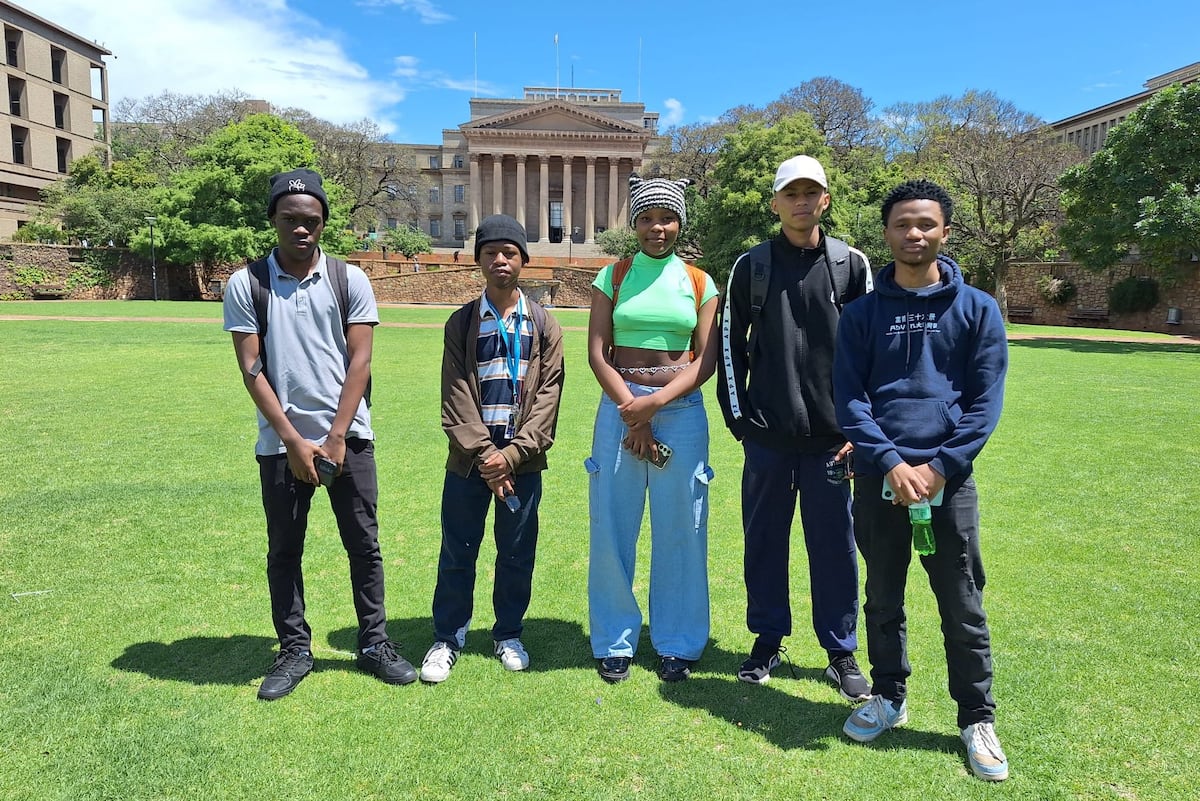
Ayathandwa Ziqula is sitting on a bench at the University of the Witwatersrand’s Braamfontein campus, in Johannesburg. His eyes light up as he recounts how he’s the first student from his public high school to be admitted to the prestigious university, popularly known as “Wits.”
In this 19-year-old’s quiet pride, there’s a powerful sentiment, one that resonates 30 years after a historic victory over the darkness of colonialism and apartheid. There’s hope for the future of a country, as well as for the future of an entire continent. And there are big dreams about providing opportunities and harnessing the potential of the vast pool of young people in South Africa, as well as across the African continent.
“If someone like me, from a working-class background, can study computer science at the second-best university in the country, something’s being done right. However, it’s clear that there are still [issues],” Ziqula acknowledges, surrounded by a group of peers who are between 18 and 21 years old. They all belong to the so-called “Generation Z,” those born between the mid-1990s and 2010.
The conversation with them takes place on an unstable spring day in the Southern Hemisphere, alternating between violent downpours and radiant moments. It’s as if the climate were an atmospheric portrait of the hopes and fears of the country and the continent.
These shortcomings, these fears, can be seen and understood everywhere in “Joburg,” the familiar name for South Africa’s economic capital. For instance, this morning in Alexandra Township, an informal settlement, a group of children are playing soccer on a small pitch along the Alex Mall. This shopping center is located on a hill at the eastern edge of the shantytown. From there, one can take in the vast expanse of this impoverished urban area, where the sunlight bounces off the aluminum roofs.
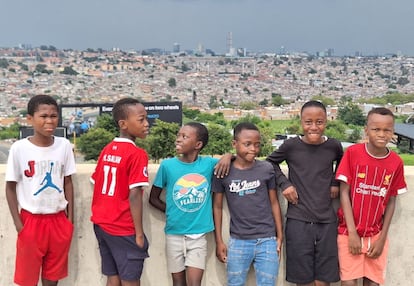 Children, pictured on November 24, 2025, along the side of the Alex Mall, a shopping center located on the eastern edge of Alexandra, a Johannesburg shantytown that’s visible behind them. Alexandra borders Sandton, considered to be the wealthiest neighborhood in Africa, which can be seen further in the background. Andrea Rizzi
When asked where they live, the children point to their homes, scattered across the horizon of Alexandra and its surroundings. If you venture deeper into the neighborhood, the signs of poverty and unsanitary conditions are evident. It’s also clear that the harsh material and social conditions create a fertile ground for crime.
Nelson Mandela lived in the shantytown for a time during his youth. From there, he moved to a compound run by the Witwatersrand Native Labour Association. And he would later go on to study law at Witwatersrand University, like Ziqula.
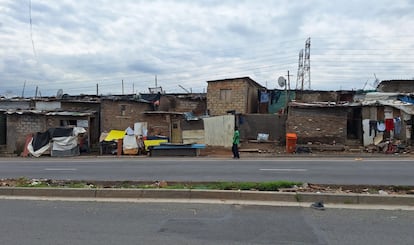 Shacks in the central area of the Alexandra neighborhood in Johannesburg.Andrea Rizzi
Just beyond “Alex,” as the community is known, a few skyscrapers mark the spot where the Sandton neighborhood is located. It contains the wealthiest square mile in South Africa.
This juxtaposition serves as a stark reminder of the social injustice that still plagues the country, considered to be the most unequal in the world according to its Gini coefficient of income distribution. According to data from the World Bank, the richest 10% of the population owns 80% of household wealth.
Between Alex and Wits — between these two extremes — lies the balance sheet of post-apartheid South Africa, reflecting the hopes and fears about the country’s future, which are embodied in its youth.
Across the country, 60% of the population is under 34, according to official statistics. If we broaden the scope to Africa, however, the data is even more staggering. Of course, such a vast continent has diverse dynamics, but the common denominator is a powerful demographic boom marked by a massive pool of young people. Africa today has approximately 1.5 billion inhabitants. And, by 2050, there are projected to be 2.5 billion Africans. According to UN projections, that same year, a third of the world’s youth will be African.
These young people are striving to make their way in the world and are highly politically aware. They’ve recently led significant protests in several African countries.
“I want to create a company, a start-up. Here, in South Africa, to provide jobs for local people,” Ziqula affirms. He’s trying to develop an app to make it easier for students to use the university’s internal minibuses. His father is a driver — “he earns minimum wage,” the young man says — and his mother has passed away.
Next to him, 18-year-old Mathapelo Moala listens to the conversation. She, too, says that she wants to stay in South Africa. When asked what her dream is, she answers without hesitation: “A stable job.” Her answer isn’t surprising, given the labor market data. People between the ages of 15 and 34 make up half of the working population, totaling almost 21 million. In the first-quarter of this year, the unemployment rate among them was 46%, or nine points higher than a decade ago.
In the affluent Fourways neighborhood, one can see the depressing scene of unemployed people of all ages who — separated along the sidewalks by gender — hold up signs indicating their specialties, waiting for someone to hire them for the day.
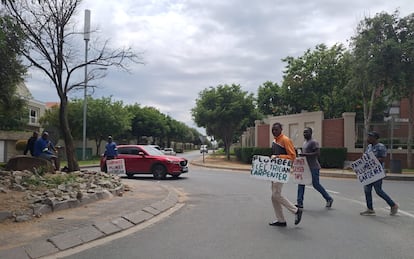 The Fourways neighborhood, an affluent area of Johannesburg, where men and women gather in search of work.Andrea Rizzi
When asked about the social issues that concern her the most (besides unemployment), Moala points to the cost of living, gender equality and violence. The latter is a rampant plague afflicting the country, and not because of the nonexistent “white genocide” that Trump denounces and has used as an argument to boycott the 2025 G20 Johannesburg summit. The American president has also refused to invite the South African government to the 2026 meeting, set to be held in Miami.
The plague of violence includes ordinary crime, as well as appallingly high rates of femicide. A study by the South African Medical Research Council estimated that, between April 2021 and March 2022, approximately 2,400 women were murdered, which the center considered to be the highest rate in the world.
Young people’s awareness of this issue appears to be very high. Upon learning that the newspaper interviewing him strongly advocates for progress toward gender equality in its editorial line, 21-year-old Deon Masango, another Wits student, urges, with calm yet tremendous determination, that this stance be maintained.
Ziqula places particular emphasis on the need to improve educational systems. “The essential [element] for achieving progress [is having] an educated and disciplined citizenry,” he says.
“In Africa, we see the civic engagement of young people, which is becoming a positive force in numerous countries. [They’re] contributing to stronger institutions and more responsive governance,” Beatrice Grace Alouch Obado explains. She’s an associate professor of International Relations and Sustainable Development at IE University and Schiller International University.
“Kenya is a clear example. Today, we have a new constitution; we have a multi-party system [and] we have freedom of speech, because, for decades, young people have taken to the streets and have fought to achieve this,” Alouch Obado continues. She participated in the T20 – the G20’s think tank – and has previously served as international coordinator for the European Network for Information and Action on Southern Africa (ENIASA). This is a group of more than 100 NGOs within the European Union (EU) working to promote peace, democracy and sustainable development in Southern Africa.
“In a neighboring country, like Tanzania, we saw the recent elections and how young people also took to the streets to protest against internet [outages] and power cuts. There they are: the youth, with their mobile phones. So, that’s a point of encouragement. What I observe is that Africa’s youth want democracy… and there’s a gap between their demand for democracy and the supply that sometimes exists. That’s why they take to the streets with their attitude, [waging a] fight for freedom of expression [and] for more transparency,” the expert comments.
Significant Gen Z mobilizations have also taken place in Madagascar, Morocco, and Botswana.
The young people from Wits navigate various emotional currents: pride, hope, fear. They navigate them handily, showing a willingness to get involved. When the interview ends, they ask this reporter if he can stay and have lunch with them: they have questions about the G-20 summit that just took place in their city, as well as thoughts about what’s going on in the world.
Sign up for our weekly newsletter to get more English-language news coverage from EL PAÍS USA Edition