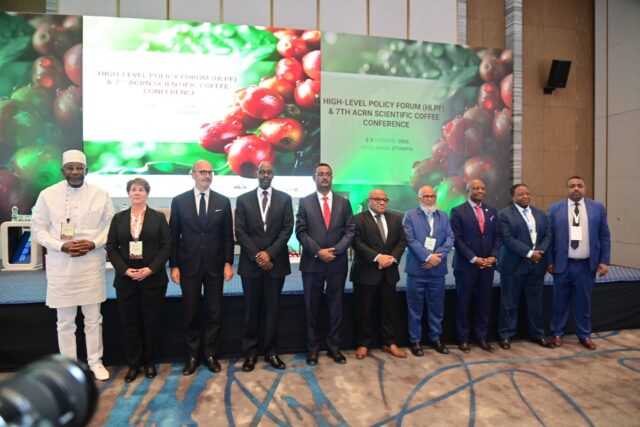
ADDIS ABABA – African governments, international institutions, and private sector leaders convened today in Addis Ababa for the High-Level Policy Forum held during the Third African Coffee Week, issuing a strong call for coordinated action to safeguard the future of Africa’s coffee sector amid escalating climate and market pressures.
Organised by the Inter-African Coffee Organisation (IACO), the African Union’s specialised agency for coffee, in collaboration with UNIDO, the Forum is being held under the theme “Advancing Climate Resilience and the Transformation of the African Coffee Sector.” The event is taking place at the Skylight Hotel and brings together ministers, ambassadors, development partners, regulators, researchers, and industry executives from across Africa and beyond.
Opening the Forum, senior representatives of the Ethiopian government, IACO member states, the African Union, UN agencies, and international partners underscored the strategic importance of coffee to Africa’s economies, livelihoods, and export earnings. Coffee supports millions of smallholder farmers across the continent but faces growing risks from climate change, regulatory shifts, and limited value addition.
The High-Level Policy Forum is anchored in the ACT Programme, Advancing Climate-Resilience and Transformation of the African Coffee Sector, a continental framework structured around five pillars: climate resilience, value addition, compliance with international market standards, research and knowledge sharing, and social inclusion.
Day One discussions focused on five outcome-oriented policy panels, each aimed at producing actionable recommendations and investment pathways.
The first panel addressed social inclusion and sustainable livelihoods, emphasising the need to place farmers, women, and youth at the centre of sector transformation. Speakers highlighted inclusive business models, access to finance, decent work, and skills development as essential to long-term resilience in coffee-growing communities.
The second panel examined value addition and industrial transformation, noting that Africa still exports the majority of its coffee as green beans while capturing a small share of global value. Panelists discussed policies and investments needed to expand local processing, roasting, branding, and SME participation, including opportunities under the African Continental Free Trade Area.
Climate change dominated the third panel on climate resilience and adaptation, where experts outlined climate-smart production systems, agroforestry, resilient varieties, early-warning systems, and the role of climate finance in supporting smallholder farmers. Participants stressed that adaptation must move from pilot projects to scalable, financed solutions.
The fourth panel focused on research, innovation, and knowledge sharing, calling for stronger integration of scientific research, data, and digital tools into policymaking and private sector decision-making. Regional research collaboration and South–South knowledge exchange were identified as key enablers of productivity and quality improvement.
The final panel addressed market access and compliance with international standards, with particular attention to the European Union Deforestation Regulation. Speakers discussed traceability systems, certification costs, digital solutions, and how harmonised African standards can help transform compliance from a barrier into a competitive advantage.
The day concluded with the official launch of African Coffee Sustainability Standards, led by the African Organisation for Standardisation, a milestone aimed at strengthening market access and regulatory alignment for African coffee producers.
The High-Level Policy Forum continues tomorrow with further engagements and follow-up discussions aimed at consolidating policy recommendations, partnership commitments, and implementation pathways under the ACT Programme.