Welcome to Foreign Policy’s Africa Brief.
The highlights this week: Officials from African nations attend a critical minerals summit in Washington, fighting flares up again in Ethiopia’s Tigray region, and South Africa temporarily withdraws from the G-20.
Sign up to receive Africa Brief in your inbox every Wednesday.
Sign up to receive Africa Brief in your inbox every Wednesday.
Sign Up
By submitting your email, you agree to the Privacy Policy and Terms of Use and to receive email correspondence from us. You may opt out at any time.
Enter your email
Sign Up
Loading…
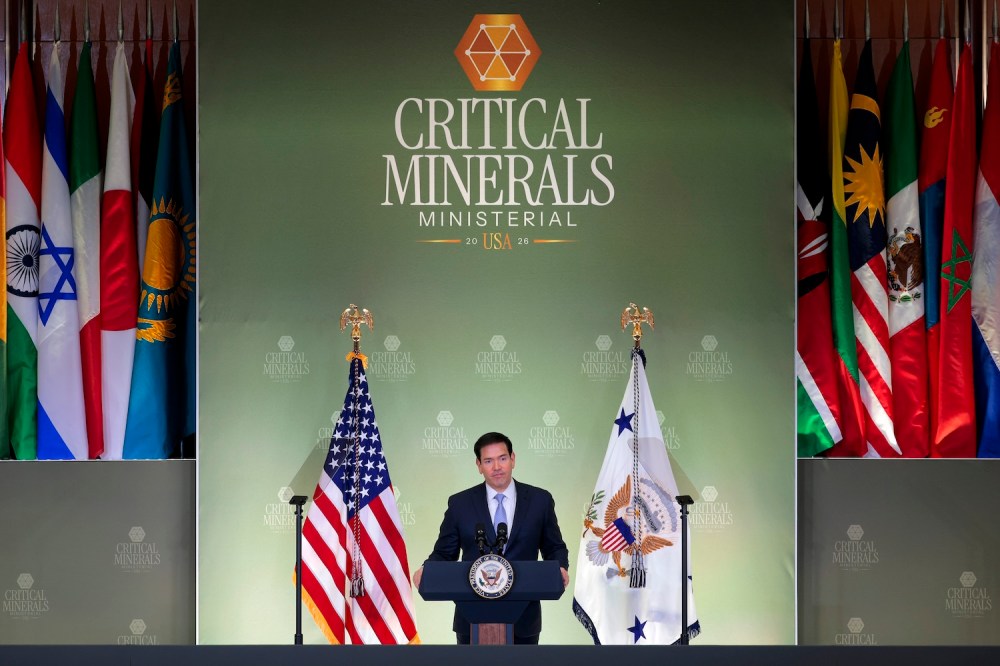
Officials from African countries including Angola, the Democratic Republic of the Congo, Gabon, Guinea, and Nigeria attended a critical minerals summit in Washington on Wednesday.
Around 50 nations from around the world were represented at the meeting, hosted by U.S. Secretary of State Marco Rubio. U.S. Vice President J.D. Vance proposed a trading bloc to counter China’s supply chain dominance and export controls of rare earths.
The summit comes just after the U.S. government announced a nearly $12 billion critical minerals stockpile dubbed “Project Vault,” which will be supported by $1.67 billion in private capital along with a $10 billion loan from the U.S. Export-Import Bank.
Although U.S. officials have described Africa as “peripheral” to Washington’s interests, African engagement is necessary to its efforts to dismantle Beijing’s chokehold on the list of critical minerals that Washington imports in large quantities.
That list includes tantalum, used heavily in the defense and aerospace sectors, and manganese, which is critical for steelmaking. More than half of the world’s tantalum comes from African nations, including Congo, Nigeria, and Rwanda. Meanwhile, South Africa is home to an estimated 80 percent of the world’s known manganese reserves, and Gabon supplies 63 percent of the United States’ manganese imports.
The summit comes at a heated time for U.S.-Africa relations. U.S. President Donald Trump’s approach to Africa focuses on “commercial diplomacy.” According to his National Security Strategy, released in November, U.S. interests on the continent center primarily on its “abundant natural resources” and seek to avoid “any long-term American presence or commitments.”
Although African nations are eager to strike trade deals with Washington, they are facing U.S. visa bans; health aid cuts; and rhetorical attacks, particularly against Nigeria and South Africa.
So far, Washington’s dealmaking with African nations has not brought significant breakthroughs on critical minerals.
Last year, under the U.S.-brokered pact with Congo and Rwanda to end fighting in eastern Congo, the Congolese government agreed to give U.S. companies preferential access to strategic mineral reserves in exchange for U.S. security support.
Yet the deal remains shaky, even as state-owned Congolese miner Gécamines prepares to ship copper and cobalt to the United States. And there has been no rush of U.S. companies moving in to directly supplant China, whose firms own more than 80 percent of Congo’s copper mines.
The deal does not provide a huge incentive for Rwanda to retreat from eastern Congo and give up vast revenue gained from access to Congo’s minerals through the M23 militant group, said Vanda Felbab-Brown, a senior fellow and security expert at Brookings.
“The reality is that the security on the ground is very poor, and you would need to have very high-risk-taking companies to be willing to start direct mining operations,” Felbab-Brown told Foreign Policy. The deal “was very undercooked from the beginning,” she said.
Still, many African nations are committed to striking transactional, short-term deals with the United States while also minimizing their risks through trade deals with other global powers.
Notably, Nigerian President Bola Tinubu sent his wife—Oluremi Tinubu, who is Christian—to lead Nigeria’s delegation in Washington at a moment when Abuja is offering security cooperation to placate Trump’s threats of further strikes in northern Nigeria to allegedly protect Christians. Tinubu has not traveled to Washington since Trump was elected, instead visiting Turkey and Gulf nations to strike trade deals in recent weeks.
“For Nigeria, the calculus is pragmatic rather than ideological. Facing insurgency, banditry, and maritime threats, Abuja is seeking flexibility, not alignment,” Solomon Ekanem wrote this week in Business Insider Africa.
Meanwhile, Guinea, the world’s top bauxite exporter, is forging deals with Trump while also expanding mining projects with Beijing.
Wednesday, Feb. 4: Rubio hosts the inaugural Critical Minerals Ministerial in Washington.
The U.S. House Foreign Affairs Committee holds a hearing on “Defending Religious Freedom Around the World” that is set to discuss Nigeria.
Tuesday, Feb. 10: The U.N. Security Council holds a briefing on South Sudan.
Clashes resume. Northern Ethiopia’s Tigray region saw significant renewed fighting last week for the first time since the Tigray war ended in 2022.
The Ethiopian federal army and allied Amhara militias clashed in western Tigray with the armed wing of the Tigray People’s Liberation Front (TPLF), the region’s ruling party. Passenger flights to the area were suspended, and residents rushed to withdraw cash from banks. A drone strike from the fighting has killed one local aid worker.
Tigrayan officials accused the federal government of withholding regional funds and “openly breaching” the 2022 peace deal, which ended two years of civil war. In a letter to the African Union, the TPLF said it was open to a mediated dialogue. Addis Ababa claims that the TPLF has forged ties with neighboring Eritrea and is “actively preparing to wage war against Ethiopia.”
Meanwhile, a U.S. federal judge on Friday temporarily blocked the Trump administration’s Feb. 13 deadline to remove refugee status granted to more than 5,000 Ethiopians. The temporary protected status shields migrants from deportations in places experiencing armed conflict and other humanitarian issues.
Extended emergency. Tunisian President Kais Saied has extended a state of emergency until the end of this year. The law has been in effect since November 2015, following a terrorist attack in the country, and is regularly renewed as a tool against dissent.
The emergency measures grant security forces expanded powers to restrict movement, ban public gatherings, and conduct searches. Saied has ruled by decree since a power grab in 2021 despite repeated protests against his rule.
G-20 minus one. South Africa—the only individual African nation that is a member of the G-20—has temporarily withdrawn from engagements with the group at the request of the United States. In November, Trump said that South Africa would not be invited to G-20 events hosted by the United States, which is chairing the forum in 2026.
Pretoria is keen to mend trade ties with Washington, but key sticking points remain—including Trump’s false claims of a white genocide in South Africa and Washington’s opposition to Pretoria’s genocide case against Israel at the International Court of Justice.
Poverty reduction. Ghana’s multidimensional poverty rate fell to 21.9 percent in the third quarter of 2025—down from 24.9 percent in late 2024—with more than 360,000 people lifted out of poverty between the second and third quarters of 2025, according to the latest data from the Ghana Statistical Service.
Driven by improvements in nutrition and education, the total number of Ghanaians living in poverty dropped to 7.2 million people in 2025 from 8.1 million people in late 2024—but significant regional inequality remains, the body warned.
The reduction in poverty comes as economic growth in Africa this year is set to outpace Asia.
Fela’s posthumous recognition. Afrobeat pioneer Fela Kuti became the first African artist to receive a Grammy Lifetime Achievement Award on Sunday, honored nearly 30 years after his death in 1997.
Known for using music to fight Nigerian military rule, Fela mixed jazz, funk, calypso, and traditional Yoruba beats to deliver a unique sound. His 1976 album, Zombie, criticized soldiers’ mindless loyalty to autocracy and impunity in committing human rights abuses. More than 1 million people attended his funeral in Lagos in 1997.
His son, Femi Kuti, accepted the Grammy award on behalf of his father. “Our father’s legacy lives on,” Kuti said. “His music continues to inspire and unite people across the world.”
LGBTQ+ artists. A new exhibition at the Smithsonian National Museum of African Art in Washington showcases LGBTQ+ contemporary artists across Africa and its diaspora, including South African visual artist Zanele Muholi, Ugandan sculptor Leilah Babirye, and Kenyan filmmaker Jim Chuchu.
While more than half of African nations have repressive laws against LGBTQ+ communities, Gabon, Botswana, Mozambique, Angola, Cape Verde, and the Seychelles have all scrapped colonial-era laws criminalizing homosexuality in recent years.
The exhibition, Here: Pride and Belonging in African Art, which opened Jan. 26, runs until August and features nearly 60 works of art.
Digital manipulation. A monthslong investigation by Sami Sabir for the Arab Reporters for Investigative Journalism found more than 140 Facebook accounts, most of them fake, promoting Moroccan Prime Minister Aziz Akhannouch’s ruling party while spreading misinformation on rival politicians between January 2022 and August 2025.
Facebook’s parent company, Meta, and the Moroccan government have not responded to the allegations.
Nkrumah’s tax ideas. In Africa Is a Country, Rachel Etter-Phoya argues that the tax reform ideas of Ghana’s first president, Kwame Nkrumah, are being revived today through the African Group’s proposal to establish a U.N. Framework Convention on International Tax Cooperation. The resolution, due to be finalized in 2027, seeks to ensure fairer global taxing rights.
“All countries lose out to tax abuse, but the impacts are greatest for those most historically plundered nations,” Etter-Phoya writes. “The scale of the losses and the inability (or unwillingness) of the club of rich countries … to effectively and inclusively address the problem is why African countries are acting.”