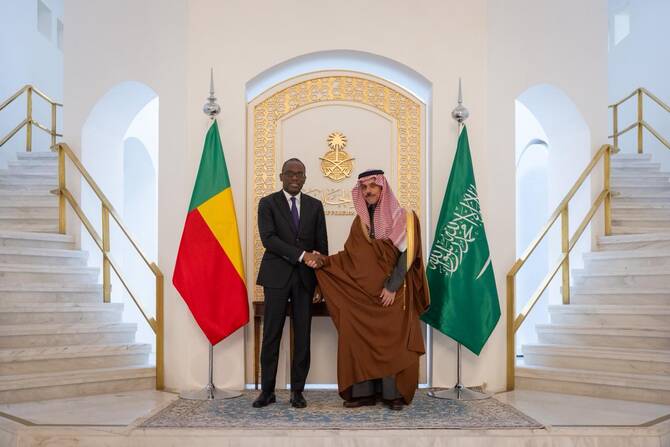
When Prince Faisal bin Farhan received Benin’s Foreign Minister Olushegun Adjadi Bakari in Riyadh this week, the official statement was short, polite, and predictable.
But the strategy behind the meeting was anything but.
This was not ceremonial diplomacy. It was targeted engagement, reflecting how Gulf powers — led by Saudi Arabia — are quietly repositioning themselves across Africa as global power balances shift and traditional Western influence weakens.
A New Gulf Playbook in Africa
Saudi Arabia’s Africa strategy has evolved. Where earlier engagement focused on major economies and religious diplomacy, today’s approach is more surgical. Smaller, politically stable African states like Benin offer something increasingly valuable: access without friction.
Benin sits at a strategic crossroads:
A stable West African democracy
Proximity to Sahel security dynamics
Atlantic access linked to regional trade routes
Diplomatic flexibility in multilateral forums
For Riyadh, this makes Benin a low‑risk, high‑influence partner.
Why This Meeting Matters More Than It Looks
Africa is no longer a peripheral concern for Gulf capitals. It is becoming a secondary theatre of influence, alongside the Red Sea, Horn of Africa, and Indian Ocean corridors.
Saudi Arabia is expanding:
Food security partnerships
Infrastructure and logistics links
Diplomatic coordination in international institutions
Religious and cultural soft power
And it is doing so quietly, country by country, while African states continue to negotiate largely on their own.
The Power Imbalance Africa Still Ignores
Here’s the uncomfortable truth:
Gulf states engage Africa strategically. Africa often responds transactionally.
Bilateral meetings like this deliver short‑term gains — funding, visibility, cooperation pledges — but they also fragment Africa’s leverage. When states negotiate individually, external powers set the terms. When regions or blocs negotiate together, power shifts.
That collective leverage remains underused.
Africa Is Being Chosen — But On Whose Terms?
Saudi Arabia is not expanding into Africa because the continent is weak. It is expanding because Africa is undecided — politically, economically, and strategically.
Undecided regions attract competition.
Competition brings opportunity — but only for those who negotiate from strength.
Without coordinated African positioning, today’s courtship risks becoming tomorrow’s dependency.
Saudi Arabia Africa relations, Benin Saudi Arabia diplomacy, Gulf states Africa strategy, Middle East Africa influence, Saudi foreign policy Africa, West Africa geopolitics, Africa Gulf relations, Prince Faisal bin Farhan Africa, Benin foreign policy, Africa global power shift, Saudi investment Africa, Africa diplomacy 2026, Gulf Africa influence, Riyadh Africa strategy, Africa foreign relations, Saudi Arabia West Africa, Africa emerging powers, post‑France Africa, Africa multipolar world, Africa international relations, Africa strategic partners, Africa sovereignty, Africa global competition, Africa geopolitics analysis, African diplomacy today, Africa power politics, Africa development partners, Africa foreign influence, Africa global south, Africa economic diplomacy, Africa political strategy, Africa international alliances, Africa non‑aligned future, Africa global relevance, Africa voice media, TVOA Africa, Africa perspective news, Africa world affairs, Africa strategic autonomy, Africa diplomacy explained, Africa foreign engagement, Africa policy analysis, Africa international power, Africa rising influence, Africa strategic importance, Africa global realignment, Africa and Middle East relations, Africa future diplomacy, Africa power map, Africa global strategy, Africa geopolitical shift, Africa international competition, Africa sovereignty debate, Africa economic power, Africa diplomacy platform, Africa foreign interests, Africa policy voice, Africa narrative control, Africa media perspective, Africa leadership strategy, Africa global positioning, Africa international leverage, Africa future power, Africa diplomatic evolution, Africa political economy, Africa strategic voice, Africa geopolitical landscape, Africa influence race, Africa global crossroads, Africa multipolar era, Africa strategic partnerships, Africa international stage, Africa world politics
Related