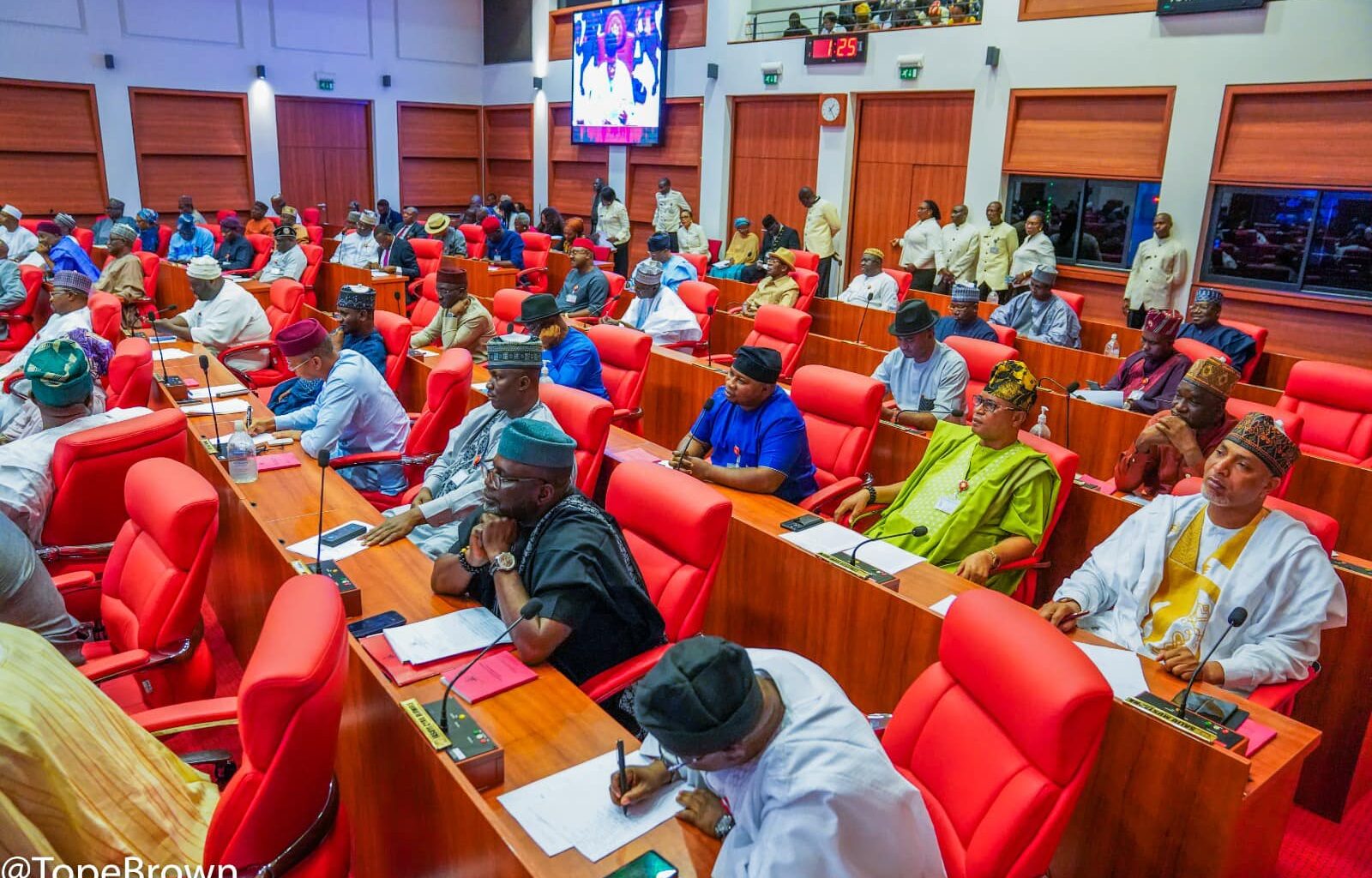
The Senate on Wednesday passed a bill to amend Nigeria’s Electoral Act, strengthening the country’s electoral system and aligning it with current realities.
The amendment bill was approved after lawmakers engaged in over five hours of debate and clause-by-clause consideration.
The clauses were examined at the Committee of the Whole, after which the Senate President, Godswill Akpabio, announced their passage following a majority voice vote.
The bill had generated controversy since its introduction in the upper chamber. Unlike the House of Representatives, where it passed without dissent, several provisions sparked disagreement among senators, prompting the Senate to establish an ad hoc committee to harmonise the contentious clauses.
The ad hoc committee was chaired by the Senator representing Ondo Central, Adeniyi Adegbonmire.
Details of the disputed clauses were not immediately clear, as most deliberations were held behind closed doors.

For instance, on 29 January, when the bill was first scheduled for passage, senators went into a closed-door session that lasted over three hours without reaching a resolution. The Senate subsequently constituted the ad hoc committee and rescheduled consideration of the bill.
On Tuesday, lawmakers again met in a closed-door session for over five hours but were unable to reach a compromise, leading to a further deferment until Wednesday, when the bill was eventually passed.
What the amended Act provides
One of the major decisions taken by the lawmakers was the rejection of the proposal to make the electronic transmission of election results from polling units to the Independent National Electoral Commission’s Result Viewing Portal (IREV) mandatory after vote counting.
Instead, under Clause 60, the Senate retained the provision in the 2022 Electoral Act that allows election results to be transmitted to the collation centre.
On voter identification under Clause 47, lawmakers rejected a proposal to allow alternative forms of identification for voting other than the Permanent Voter Card (PVC). Rather, they replaced “smart card readers” with the Bimodal Voter Accreditation System (BVAS) for accreditation and voting, thereby retaining the PVC as the sole mandatory means of identification at polling units.
Initially, the bill had proposed that since BVAS does not read the microchip embedded in PVCs, the card should no longer be compulsory for voting, allowing the use of the National Identification Number (NIN), Nigerian passport, or birth certificate. However, the Senate disagreed with this proposal and retained the PVC as the primary mode of voter identification.
On Clause 22, which prescribes penalties for PVC-related offences, lawmakers rejected a proposed 10-year jail term for the buying and selling of PVCs. Instead, they retained the two-year imprisonment term and increased the fine from ₦2 million to ₦5 million.
Regarding proof of non-compliance, the Senate deleted Clause 142, which would have allowed parties to prove non-compliance solely through original or certified documents without oral evidence. The lawmakers, during the clause-by-clause consideration, argued that the provision would amount to a “waste of time in court.”
On ballot paper inspection, Clause 44 retained the existing procedure, which gives political parties two days to submit written approval or disapproval of their representations on sample ballot papers. INEC is also required to invite parties to inspect sample electoral materials at least 20 days before an election.
The Senate amended Clause 28 of the electoral timetable by reducing the period within which INEC must publish a notice of election from 360 days to 180 days.
Under Clause 29, the deadline for political parties to submit their list of candidates was reduced from 120 days to 90 days before the election.
To curb vote buying, lawmakers amended Clause 22 to impose stiffer penalties, increasing the fine for offenders from ₦500,000 to ₦5 million.
On post-election disputes, the Senate amended Clause 136 by removing the power of election tribunals to declare winners outright in certain circumstances. The amendment now provides that, where a candidate is found not to have been validly elected for failing to secure a majority of lawful votes, a rerun election shall be conducted, with the disqualified candidate and the sponsoring party barred from participating.
This section contradicts the provision of the 2022 Electoral Act, which provides that where an election tribunal nullifies an election on the ground that the candidate with the highest votes was not qualified, the candidate with the second-highest number of valid votes should be declared elected.
Akpabio addresses criticisms
Responding to criticisms over the Senate’s decision on electronic transmission of results, Mr Akpabio insisted that the amendment did not abolish electronic transmission.
“Distinguished colleagues, the social media is already awash with reports that the Senate has literally rejected electronic transmission of results. That is not true. What we did was to retain the electronic transmission, which has been in the Act and was used in 2022.
“So please, do not allow people to confuse you. If you are in doubt, we will make our final votes and proceedings available to you if you apply. This Senate under my watch has not rejected the electronic transmission of results. It is in my interest as a participant in the next election for such to be done. So please don’t go with the crowd.
“We have retained what was in the previous provision by way of amendment. That was all we did. The previous previous has made allowance for electronic transmission. So it is still there as part of our law. We cannot afford to be going backwards,” Mr Akpabio said.
The upper chamber passed the Electoral Act Amendment Bill a few hours after the Independent National Electoral Commission (INEC) urged it to pass the bill.
At a meeting with the Civil Society Organisations (CSOs) in Abuja, the commission’s Chairman, Joash Amupitan, had asked the Senate to expedite action on the bill to avoid negatively impacting its plan and preparations for the 2027 polls.
The House of Representatives has since passed the bill and transmitted it to the Senate for concurrence.