By Temesgen Assefa
Addis Ababa, January 6, 2026 (ENA)—For millions of people around the world, 7 January is Christmas Day when mainly Orthodox communities in Europe, Africa and the Middle East, which make up more than 12 percent of all Christians, celebrate the big day weeks after most of the Western world.
This is because they use a different calendar, called the Julian calendar, to work out when Christmas should be.
In Ethiopia, unlike in the Western world, Christmas is celebrated not only by the Ethiopian Orthodox Tewahdo believers but also by some Protestant, and Catholic denominations in the country.
On the last day of their fast that lasts 40 days, all members of the denominations and the Orthodox church gather with their family and friends to host a giant feast.
The period of fasting is not merely a physical challenge; it is a time of spiritual renewal and a commitment to faith. The fasting culminates in the joyous celebration of Christ’s birth, emphasizing purification and spiritual readiness among the faithful.
In Ethiopia, Christmas Day is called Genna. On the Eve, the Christians attend churches to participate in all-night prayer services.
Worshipers gather for an extended Mass, dressed in traditional white clothing symbolizing purity, where they sing, chant, and listen to the priests’ sermons. Religious songs fill the churches, with congregant singing in unison to express joy for the birth of Christ.
At the Ethiopian Orthodox Tewahdo churches, traditional instruments such as the kebero (drum) and tsenatsel (sistrum) accompany the melodies, creating an atmosphere of reverence and jubilation.
Beyond Meals, A Collective Festivity
On Christmas Day or Genna, families come together to share a festive meal that often includes Doro Wet, spicy chicken stew, served with Injera, a sourdough flat bread, and a variety of vegetarian dishes.
These communal meals nourish not only the body but also foster connections among family members and friends.
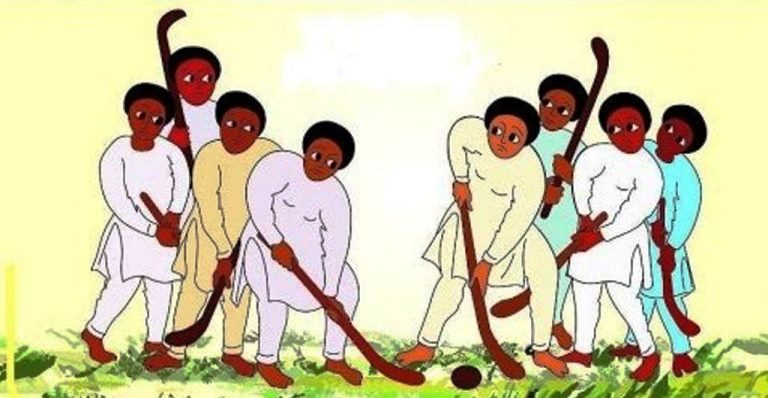
In a display of solidarity and joy, communities often partake in games like Genna, a form of field hockey played outdoors on Christmas Day, which not only fosters community spirit but also symbolizes joy and celebration.
In the vibrant game of Genna, players wield wooden sticks, also known as Genna, to strike a round, sturdy wooden ball called Erur. Clad in traditional attire and shoes, participants demonstrate their respect for cultural heritage.
Legend has reveled that the origins of game of Genna are rooted in the joy of the shepherds who upon hearing news of Christ’s birth, leaped with glee, using their wooden sticks to celebrate.
This game embodies a playful spirit that transcends age hierarchies and provides a unique freedom for the youth.
Before the match begins on an open field, two competing teams select their leaders, while two elders from the crowd are appointed as referees. Typically starting in the afternoon, the game continues until sunset, creating a lively atmosphere.
The game draws crowds, turning the day into a collective festivity that transcends individual households.
This engaging tradition draws participants of all ages, emphasizing the celebration of community and the love that binds its members together.
Such activities help create a festive atmosphere that extends beyond the family unit, illustrating the holiday’s communal nature.
The act of sharing meals and participating in communal activities emphasizes the importance of togetherness, reinforcing that love is at the heart of the holiday.
Families often make a point of visiting neighbors and friends during Genna, extending the spirit of unity beyond immediate circles.
This practice fosters camaraderie and strengthens community ties, echoing the belief that Christmas is a time not just for individual celebration but for collective joy and support.
Above all, Ethiopia’s Christmas, or Genna, embodies a richness that transcends the traditional perceptions of a holiday.
It is a celebration deeply woven into the fabric of love, spirituality, and community. As Ethiopian Christians gather to share their faith, traditions, and heartfelt connections, they remind the world that the true spirit of Christmas lies in love, compassion, and unity.
In a global landscape often overshadowed by commercialization, Genna invites believers to embrace a deeper significance, one that highlights the importance of community, the warmth of familial bonds, and the unwavering spirit of faith.