By Caleb Ta
Independent Researcher in African Political Affairs & Human Rights Advocate
Abstract
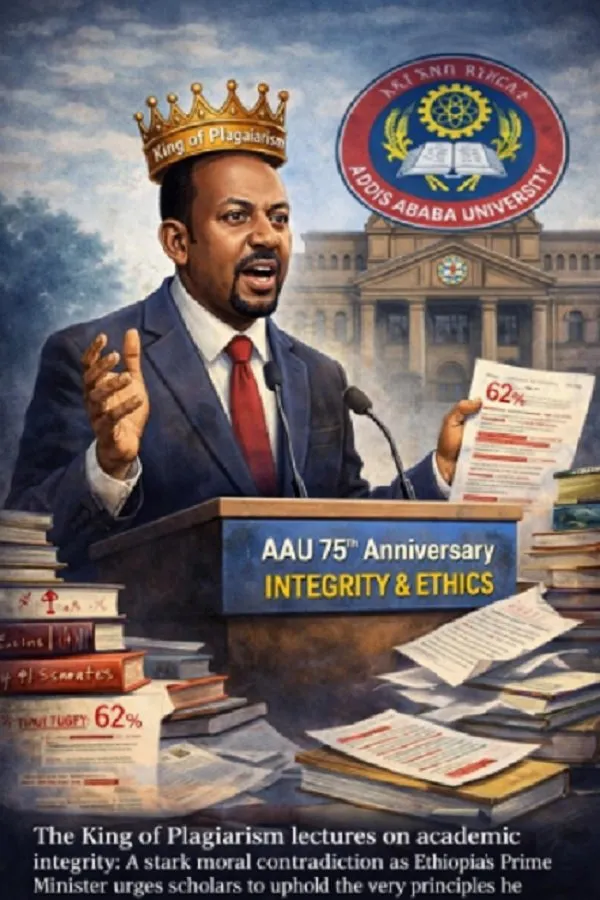
On January 2, 2026, Prime Minister Abiy Ahmed delivered a keynote lecture at Addis Ababa University’s 75th anniversary, urging Ethiopia’s intellectual community to drive national development through critical thinking, innovation, and ethical scholarship. However, Abiy’s own academic integrity has been called into question due to credible allegations of plagiarism in his 2017 doctoral dissertation. This article critically examines the ethical and moral implications of a public lecture on intellectual responsibility given by a leader accused of academic misconduct. Using documented evidence and prior university precedents, the analysis highlights the contradiction between the Prime Minister’s call for integrity and his contested scholarly record, underscoring the importance of ethical leadership in fostering trust and accountability in higher education.
Introduction
On January 2, 2026, Prime Minister Abiy Ahmed addressed the Addis Ababa University (AAU) community to commemorate the institution’s 75th anniversary. In his lecture, he positioned Ethiopian scholars as the driving force for national development, emphasizing the transformative potential of research, innovation, and critical thinking in advancing the “Medemer State” agenda (AAU, 2026). The speech called upon intellectuals to cultivate ethical responsibility, engage in deep analysis, and translate academic research into practical solutions for the country’s socio-economic challenges.
Yet, while Abiy Ahmed exhorted others to uphold ethical and scholarly standards, a troubling backdrop undermines the credibility of his message: allegations of extensive plagiarism in his own doctoral thesis. This raises serious ethical and moral questions about the suitability of his lecture, particularly given the principles he advocated.
Evidence and Analysis of Plagiarism
Abiy Ahmed’s 2017 PhD dissertation, Social Capital and its Role in Traditional Conflict Resolution: The Case of Inter-religious Conflict in Jimma Zone of the Oromia Regional State in Ethiopia, has been subjected to scholarly scrutiny and plagiarism detection analysis (de Waal et al., 2023). Turnitin, a widely recognized plagiarism detection tool, reported similarity scores of approximately 62–64% in the literature review chapter alone, with all 41 pages containing text copied from United Nations Development Program (UNDP) reports and other sources without proper attribution. Such scores are exceptionally high for doctoral-level work, where originality is a fundamental requirement.
Plagiarism, especially at the graduate level, is not a minor ethical lapse; it represents a violation of the core principles of scholarship, including honesty, accountability, and the responsible creation of knowledge. Universities worldwide have revoked doctoral degrees for far less extensive breaches (de Waal et al., 2023). Addis Ababa University itself previously rescinded a Master’s thesis for plagiarism and formally adopted policies prohibiting academic dishonesty, establishing clear precedents for enforcing integrity in academic work.
Moral and Ethical Implications
The moral dimension of this controversy is stark. By delivering a lecture on intellectual responsibility while his own academic credentials are contested, Abiy Ahmed embodies a profound ethical contradiction. His public exhortation for scholars to cultivate rigor, integrity, and critical thinking stands in direct tension with allegations of academic misconduct in his own record. This contradiction is not merely symbolic; it actively undermines the authority of the message and erodes trust between the government and Ethiopia’s higher education institutions.
For the Ethiopian intellectual community, this represents a pivotal moment. Scholars, students, and administrators are ethically compelled to demand clarity and accountability. Ethical leadership is inseparable from the principles one advocates; when those in positions of power fail to uphold the standards they promote, the credibility of both the message and the institutions they represent is jeopardized.
Furthermore, political authority cannot substitute for scholarly legitimacy. By conflating his role as Prime Minister with that of a moral and intellectual guide, Abiy risks signaling that academic and ethical standards are negotiable for those in power. This has broader implications for governance, civic trust, and the cultivation of a culture of integrity within Ethiopia’s universities.
Institutional Responsibility and Accountability
Addis Ababa University has a clear mandate to safeguard academic standards. Previous actions—including revocation of plagiarized theses—demonstrate that the institution possesses both the capacity and the precedent to address misconduct at the highest levels. The unresolved questions surrounding Abiy Ahmed’s dissertation call for a decisive, transparent, and ethically consistent response. Universities cannot remain neutral when academic integrity is compromised at such a scale, particularly when the individual in question is in a prominent position of political power.
Academic institutions play a critical role in establishing societal norms of honesty, fairness, and accountability. Failing to investigate or act on credible allegations of plagiarism undermines both the value of academic degrees and the moral authority of Ethiopia’s educational system.
Conclusion
The lecture delivered by Abiy Ahmed at Addis Ababa University, advocating intellectual responsibility and ethical leadership, is fundamentally compromised by credible allegations of plagiarism in his own doctoral work. Ethical and moral principles require that leaders not only preach integrity but embody it. Until Addis Ababa University addresses the unresolved concerns regarding Abiy Ahmed’s dissertation, any call for ethical scholarship from him remains aspirational at best and hypocritical at worst.
The Ethiopian academic community, and society at large, must insist on transparency, accountability, and consistency in enforcing academic standards. Genuine national progress and intellectual-driven prosperity are contingent not on rhetoric from a contested podium but on the alignment of moral authority with scholarly credibility.
Editor’s Note : Views in the article do not necessarily reflect the views of borkena.com
__
Support Borkena : https://borkena.com/subscribe-borkena/
Join our Telegram Channel : t.me/borkena
Like borkena on Facebook
Borkena Ethiopian News Youtube Channel
To submit Press Release, send submission to info@borkena.com
Add your business to Ethiopian Business Listing / Ethiopian Business Directory
Join the conversation. Follow us on X (Formerly Twitter) @zborkena to get the latest Ethiopian News updates regularly.