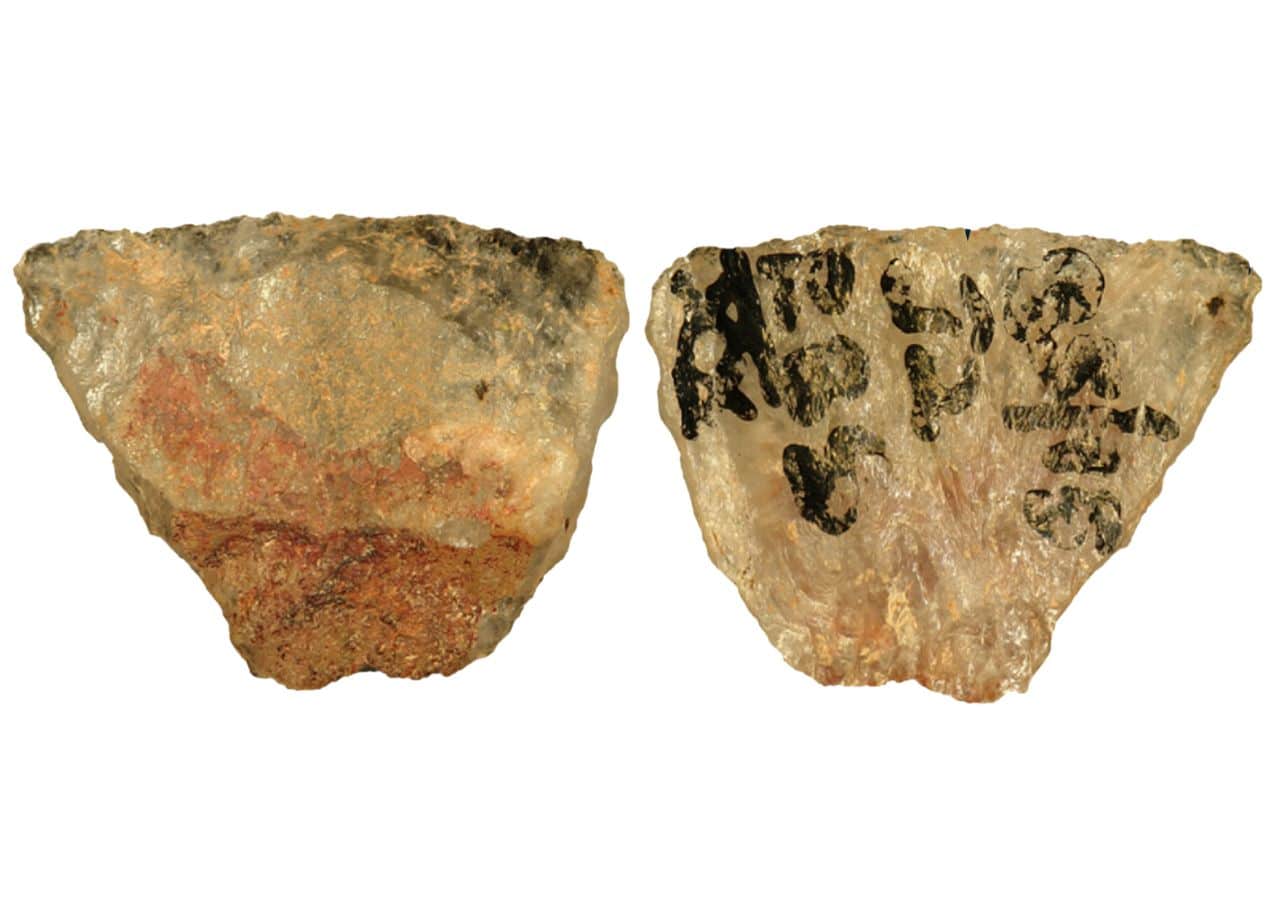
Microlith 001 showing the reddish poisonous adhesive residue still adhering to the dorsal backed portion of the tool. Credit: Sven Isaksson / CC BY 4.0
Researchers have identified what is now considered the world’s oldest evidence of arrow poison, traced to 60,000-year-old quartz arrowheads discovered at the Umhlatuzana Rock Shelter in KwaZulu-Natal, South Africa. The findings show that early humans in the region combined advanced hunting tools with plant-based toxins, offering new insight into prehistoric innovation.
Chemical tests on the ancient arrowheads revealed residues from Boophone disticha, a poisonous plant known locally as gifbol. Still used by traditional hunters today, this plant contains toxic alkaloids that can be lethal in small doses. The discovery marks the earliest direct proof of humans using plant-derived poison on weapons for hunting.
Early humans and the origins of complex hunting
Professor Marlize Lombard from the University of Johannesburg explained that these results confirm early humans in southern Africa had already developed the bow and arrow long before previously believed. She said the use of poison in this context also suggests they understood how to enhance their hunting methods by exploiting natural toxins.
The study, published in the journal Science Advances, was conducted by a team of researchers from South Africa and Sweden. Their work involved a detailed chemical analysis of organic residues, led by Professor Sven Isaksson at Stockholm University.
Isaksson said the discovery is the outcome of years of close cooperation between institutions in both countries. He described the analysis as complex but said the findings strongly support continued research in early human behavior.
Isaksson also pointed to a key breakthrough in the study. He said that similar chemical compounds were detected on arrowheads dating to around 250 years ago, preserved in Swedish museum collections.
These arrows, collected during the 18th century, were coated with the same plant-based poison. According to Isaksson, this continuity highlights how knowledge about toxic plants was preserved across centuries.
Cognitive skills behind the world’s oldest arrow poison
The researchers identified two main substances in the arrowhead residues: buphandrine and epibuphanisine, both of which are found in Boophone disticha. These compounds are known to remain chemically stable over long periods, which helped confirm their presence despite the tools being buried for thousands of years.
Professor Anders Högberg of Linnaeus University said the use of arrow poison would have required patience, planning and an understanding of how cause and effect work. He added that such behavior signals a high level of cognitive development in early humans.
This direct evidence of poison use not only expands understanding of ancient technology but also reveals that the world’s oldest arrow poison was part of a much broader pattern of intelligent and strategic survival.