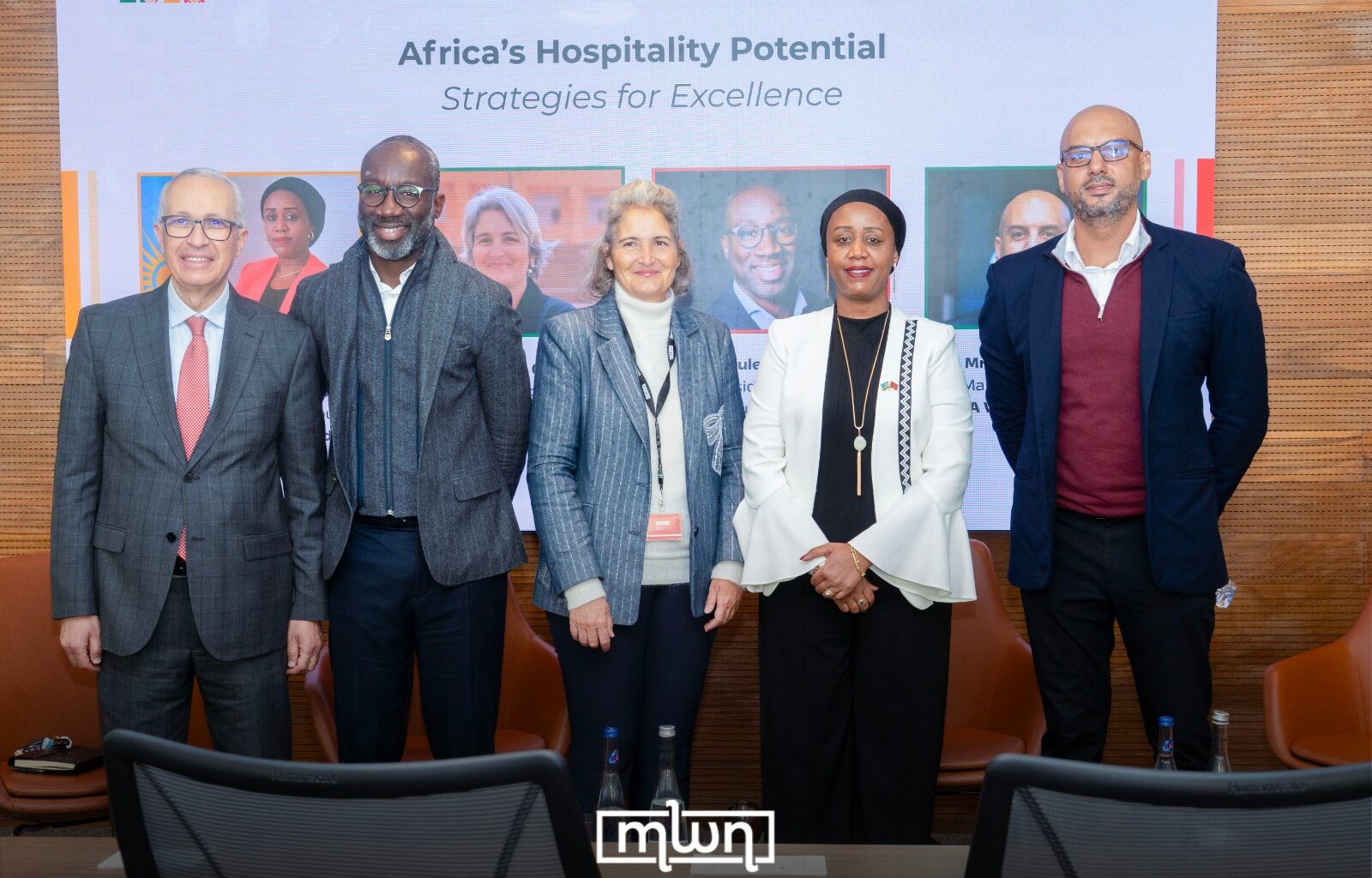
Benguerir – The School of Hospitality Business and Management (SHBM) at University Mohammed VI Polytechnic (UM6P) organized today the fifth edition of its Internship Networking Forum (INF) at the Benguerir campus. Second-year SHBM students orchestrated the event under the theme “Africa Welcomes the World: Hospitality Beyond Borders.”
The forum presented a comprehensive conference on “Africa’s Hospitality Potential: Strategies for Excellence,” examining competitiveness, sustainability, and innovation in the hospitality sector. Distinguished speakers shared expertise on Africa’s ascending prominence in global hospitality markets.
Adeline Carton, Director of Academic Services at UM6P, inaugurated proceedings by articulating the university’s dedication to developing hospitality talents capable of meeting international standards while preserving African cultural foundations.
“We form professionals capable of evolving in multicultural environments, service leaders, ambassadors of the economy, and agents of environmental change and impact,” Carton declared.
She reinforced UM6P’s commitment to accompanying students toward their first employment opportunities, positioning the forum as a vital conduit between academic formation and professional careers.
 First-year SHBM students at UM6P joined today’s INF in Benguerir, connecting with industry professionals under a theme celebrating African diversity.
Rwanda served as guest of honor
Transitioning to international perspectives, Shakilla K. Umutoni, Ambassador of Rwanda to Morocco, served as the guest of honor and keynote speaker. Ambassador Umutoni articulated Rwanda’s transformation of its hospitality sector through the Visit Rwanda initiative
She detailed key assets, including luxury hotels and the Kigali Convention Center, alongside a strong emphasis on sustainability and conservation through ecotourism, particularly mountain gorilla protection. Innovation was presented as a third pillar, reflected in global partnerships with brands such as Arsenal FC and Paris Saint-Germain.
 Shakilla K. Umutoni, Ambassador of Rwanda to Morocco.
“Hospitality is not merely an industry. It is a reflection of our values, our openness, and our shared aspiration for sustainable development,” Ambassador Umutoni proclaimed.
The ambassador elaborated on Rwanda’s key tourism initiatives, including MICE tourism for international conferences, community-based tourism integrating cultural experiences, digital transformation through e-visa systems, and expanded air connectivity via Rwanda Air.
She noted that more than 40 Rwandan students are currently enrolled at UM6P, illustrating the depth of Rwanda-Morocco bilateral cooperation forged through landmark state visits by President Paul Kagame and King Mohammed VI in 2016.
Advancing to industry operations, Souleymane Khol, Vice-President Operations Premium, Midscale & Economy for Accor Morocco, unveiled the company’s African strategy.
Accor functions as Morocco’s premier hotel operator with 43 hotels nationally and approximately 200 across Africa.
Khol shed light on Accor’s strategic transformation from asset-heavy to asset-light operations, focusing on three pillars: operational excellence through human resources development, expansion through opening additional hotels across Africa, and innovation by developing new brands adapted to local markets.
“Our first asset is human resources. What makes the difference between one hotel and another is the quality of these human resources,” Khol asserted.
Accor’s contemporary strategy revolves around selling expertise rather than physical assets, he said, adding that this has positioned the company as operators who guarantee operational excellence for investors seeking profitable hospitality ventures.
‘The future is African’
Progressing to entertainment infrastructure, Kyle Schofield, Managing Director of QA Venue Solutions and partner in Zaria Group, addressed sports and entertainment’s function in hospitality development.
Schofield showcased the Kigali Sports City model, featuring the BK Arena, which has orchestrated over 400 events since 2019, accommodating 300,000 to 400,000 annual visitors and generating over $65 million in economic impact.
The venue has hosted international events, including Basketball Africa League and UCI competitions, demonstrating the sports infrastructure’s capacity to stimulate hospitality demand.
“We believe in the future of Africa, and we believe that the future is Africa,” Schofield proclaimed, outlining Zaria Group’s vision to develop world-class sports and entertainment ecosystems across Africa.
He elaborated on creating venues that generate extensive hospitality opportunities, including hotels, restaurants, and event facilities, while leveraging African music and athletes to drive global entertainment and create employment opportunities across multiple industry sectors.
Most importantly, Schofield passionately advocated for leveraging Africa’s demographic advantage, noting: “We are the youngest continent across the entire globe.”
He spoke of his vision for 2035, stating that Africa’s youth provides a distinct competitive edge in driving industries around sports and entertainment. “We have got an advantage because of the youth that we have in Africa,” Schofield proclaimed, connecting this demographic strength to the student-led nature of the forum itself.
He stressed the importance of training and employing young Africans to host world-class events, ensuring that the continent utilizes its abundant local talent rather than importing expertise from outside Africa.
Africa’s hospitality market accelerating rapidly
Students participated in networking and speed-recruitment sessions, connecting directly with industry professionals to secure internship opportunities.
 Students participated in networking and speed-recruitment sessions, connecting directly with industry professionals to secure internship opportunities.
The event incorporated a live podcast session on “Doing Business in Africa,” providing practical insights into the continent’s hospitality landscape. Cultural activities celebrated Africa’s heritage as inspiration for contemporary hospitality practices.
Participants attended a masterclass by Demilade Oluwasina, an entrepreneur and educator specializing in entrepreneurship development across Africa.
Oluwasina has collaborated with institutions including Alibaba Business School, African Leadership University, and UNCTAD, contributing extensive experience in digital business, marketing, and hospitality sectors across over 10 African countries.
 Morocco’s hospitality sector is sustaining strong momentum.
Morocco’s hospitality sector is sustaining strong momentum valued at approximately $0.88 billion in 2025 and projected to reach $1.17 billion by 2030 with a 5.89% compound annual growth rate.
The kingdom welcomed 19.8 million tourists in 2025, marking a 14% year-on-year increase. This historic performance brought Morocco within reach of the 20-million-visitor milestone for the first time, confirming tourism as a central pillar of national growth.
Looking ahead, the ministry projects arrivals to reach 26 million by 2030, in parallel with Morocco’s preparations to co-host the 2030 FIFA World Cup alongside Portugal and Spain. The target reflects a sector increasingly defined by efficiency, sustainability, and its capacity to generate value across regions.
Broadly, Africa’s hospitality market continues to demonstrate significant upside, valued at $11.4 billion in 2024 and projected to reach $16.3 billion by 2032. The continent welcomed 74 million international visitors in 2024, reflecting 7% growth, while tourism revenues climbed to an estimated $1.6 trillion.
The sector is expected to generate more than 3 million jobs across Africa by 2030, including 200,000 positions in Morocco alone. Meeting this demand will require over 10,000 additional hospitality managers, underscoring the growing need for skilled leadership and specialized training across the industry.
SHBM, established in 2020, is committed to advancing excellence in hospitality education and has become the first École Hôtelière de Lausanne (EHL)-certified school in Africa in 2024, enhancing graduates’ credentials through dual UM6P state diplomas and EHL certificates.
The school has expanded from 27 initial students to six cohorts totaling 240 students, preparing ethical leaders for the expanding African hospitality sector.