Welcome to Foreign Policy’s Africa Brief.
The highlights this upcoming year: High-stakes elections are scheduled in Ethiopia and other countries, Sudan’s and South Sudan’s crises may converge, and instability in the Sahel will likely continue to spread to anglophone nations.
Sign up to receive Africa Brief in your inbox every Wednesday.
Sign up to receive Africa Brief in your inbox every Wednesday.
Sign Up
By submitting your email, you agree to the Privacy Policy and Terms of Use and to receive email correspondence from us. You may opt out at any time.
Enter your email
Sign Up
Loading…
High-Stakes Elections
Africa’s political landscape in 2026 will likely be shaped by high-stakes elections in countries including Ethiopia, Somalia, and Uganda. Experts widely anticipate that these elections will be “tick-box” exercises with largely predetermined outcomes. This could drive widespread youth-led protests, similar to those seen in several African nations in 2025.
What happens in Ethiopia will be especially impactful for global affairs. U.S. President Donald Trump’s transactional foreign policy has led to a realignment of geopolitical partnerships in the Horn of Africa. This has been marked by a decline in traditional U.S. diplomatic engagement; the rise of rival powers, including China and the Gulf states; and shifting alliances, such as the new Egypt-Eritrea axis to combat Ethiopia’s influence in the region.
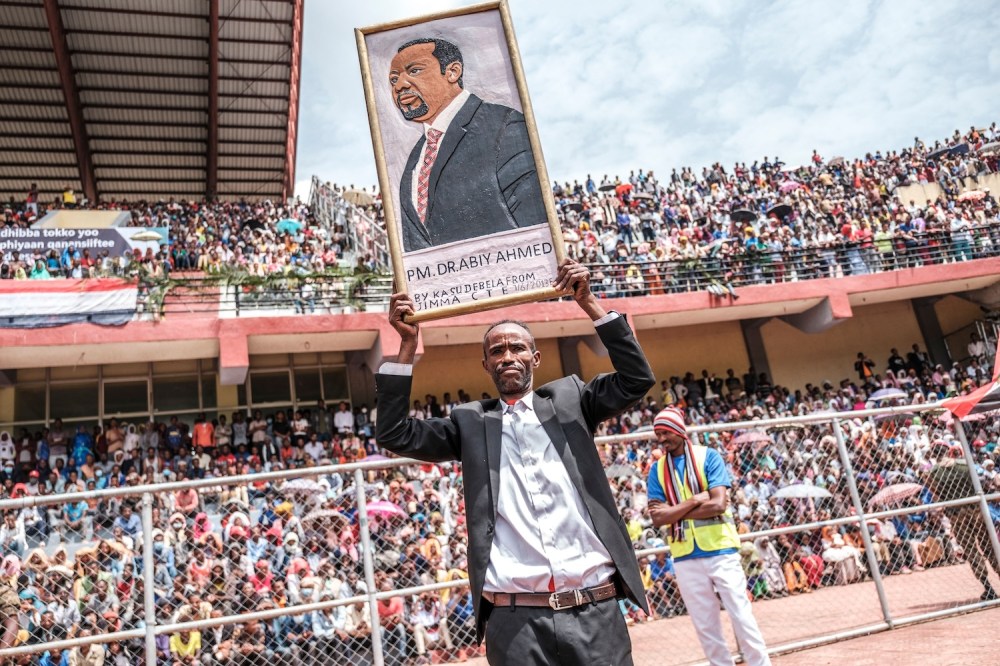
Ethiopia’s elections in June are set to consolidate one-party rule under the Prosperity Party amid a worsening security crisis in the country’s Tigray, Amhara, and Oromia regions. Both the government and Tigray’s ruling party, the Tigray People’s Liberation Front, accuse each other of violating the terms of the 2022 peace deal that ended a two-year civil war.
Insecurity may derail voting in several Ethiopian regions—and the election could spark further instability and accusations of illegitimacy.
Compounding this is the possibility that tensions may continue to escalate with neighboring Eritrea. Ethiopian Prime Minister Abiy Ahmed has demanded access to the port of Assab on the Red Sea, which he frames as an existential issue for Ethiopia, the world’s most populous landlocked country. Eritrea has dismissed this push as a “toxic agenda” of “irredentism.”
Meanwhile, Ethiopia is facing a severe cost-of-living crisis and rising poverty amid expansive fiscal reforms, which could fuel recruitment for regional insurgencies ahead of the vote.
Human Rights Watch has sounded the alarm on a government crackdown on independent media and civil society groups. And major opposition parties, such as the Oromo Federalist Congress and the Oromo Liberation Front, could boycott the elections as they did the 2021 election, adding to fears that Abiy’s Prosperity Party will lack genuine competition.
African Elections Scheduled for 2026
Jan. 15: Uganda holds general elections.
April 12: Benin holds a presidential election.
June 1: Ethiopia holds general elections.
Aug. 13: Zambia holds general elections.
Dec. 5: Gambia holds a presidential election.
Dec. 22: South Sudan holds general elections.
What We’re Watching in 2026
Sudan’s civil war. In Sudan, there is little hope for a peace agreement in the near term that will end the country’s nearly three-year civil war. Fighting has recently intensified in Kordofan, as the paramilitary Rapid Support Forces (RSF) looks to seize the region from the Sudanese Armed Forces (SAF).
The Trump administration’s efforts to bring the war to an end under the so-called Quad nations—composed of Egypt, Saudi Arabia, the United Arab Emirates, and the United States—have seen little progress. This is largely due to arms suppliers to the conflict, including the UAE, facing few consequences and the warring leaders’ reluctance to engage in talks.
Ultimately, both the RSF and SAF oppose a peace plan that would weaken their authority and create a path toward democracy.
South Sudan crisis. Meanwhile, South Sudan has been on the brink of civil war since a fragile power-sharing agreement between President Salva Kiir and opposition leader Riek Machar fell apart in March with Machar’s arrest. Since then, Kiir has increasingly concentrated power around his family members.
Analysts fear that Sudan’s and South Sudan’s conflicts may be converging. South Sudan gained independence from Sudan in July 2011, ending more than two decades of civil war. The country’s first postindependence elections are scheduled for December 2026 after being postponed numerous times, but many increasingly doubt whether a democratic vote will be held anytime soon.
In February, the RSF formed a rival Sudanese government with the Sudan People’s Liberation Movement (SPLM)-North, an offshoot of South Sudan’s SPLM, which spearheaded the country’s independence push and now runs the government under Kiir. The SAF believes that Kiir is backing the new RSF alliance.
Sahel coup-tagion. Instability is worsening across the Sahel and West Africa following a coup in Guinea-Bissau in late November and a failed coup attempt in Benin in early December.
In recent years, the military juntas in Burkina Faso, Mali, and Niger have formed a regional confederation known as the Alliance of Sahel States as a counter to the Economic Community of West African States (ECOWAS). Russian mercenaries have also replaced United Nations and West African troops in the junta-led nations, all of which are former French colonies.
Meanwhile, the al Qaeda-linked Jamaat Nusrat al-Islam wal-Muslimin (JNIM) and the Islamic State-Sahel Province have strengthened their attacks in the region.
Since September, JNIM has launched economic warfare in Mali through oil blockades that have paralyzed the country. Armed groups have also cut off food and essential supplies to thousands of people in Burkina Faso. The region’s humanitarian situation will likely worsen in 2026.
Junta-led nations may try to woo more nations to join their alliance as political instability spills over into bordering anglophone nations. Yet France is actively seeking to strengthen trade and diplomatic ties with the region’s anglophone countries, such as Nigeria. Already, a Nigerian-led ECOWAS intervention to stop Benin’s recent coup received surveillance assistance from Paris.
That pivot, however, may widen the schism between ECOWAS—which is headquartered in Nigeria’s capital of Abuja—and the junta-led francophone nations in the upcoming year.
Fighting in Congo. A recent Trump-brokered peace deal has failed to halt conflict in the eastern Democratic Republic of the Congo between the government and Rwanda-backed M23 rebels—and will likely continue to have little impact in the new year.
Rwanda accuses Congo of working with the Democratic Forces for the Liberation of Rwanda (FDLR), a Hutu rebel group opposed to Rwandan President Paul Kagame whose members include militants involved in the 1994 Rwandan genocide. Congo, meanwhile, says Rwanda is funding M23 to destabilize the country so it can exploit its vast mineral wealth.
The Trump administration’s accord requires that Rwanda withdraw its troops fighting alongside M23 and that Congo root out the FDLR. M23, however, was not included in the talks. For now, neither side has backed down, and there have been few sanctions against Rwanda, which has benefited enormously from minerals smuggled by M23, according to U.N. experts.
Somalian vote. Somalia is due to hold general elections by the spring, but there are doubts about whether the vote will go ahead.
Tensions are rising over reforms implemented ahead of the elections. The reforms shift the country from a complicated indirect system, in which clan leaders elect members of Parliament who then vote for a president, to a “one person, one vote” ballot.
The semiautonomous regions of Puntland and Jubaland have clashed with the federal government over the change, which critics argue will centralize power in Mogadishu and weaken regional sovereignty. Opponents also argue that the reforms will benefit incumbent President Hassan Sheikh Mohamud.
Meanwhile, jihadi group al-Shabab has capitalized on the political infighting and fragmentation, which have distracted politicians from counterinsurgency operations, by intensifying attacks, including an assault on a high-security prison in Mogadishu in October.
Parliament’s term expires in April, while Hassan’s mandate expires in May, but there are talks of a unilateral extension by the federal government, which is likely to further inflame tensions.
At the same time, Israel’s historic recognition of the breakaway territory of Somaliland last week could further disrupt regional stability, emboldening al-Shabab as well as states such as Ethiopia in pursuit of port access.