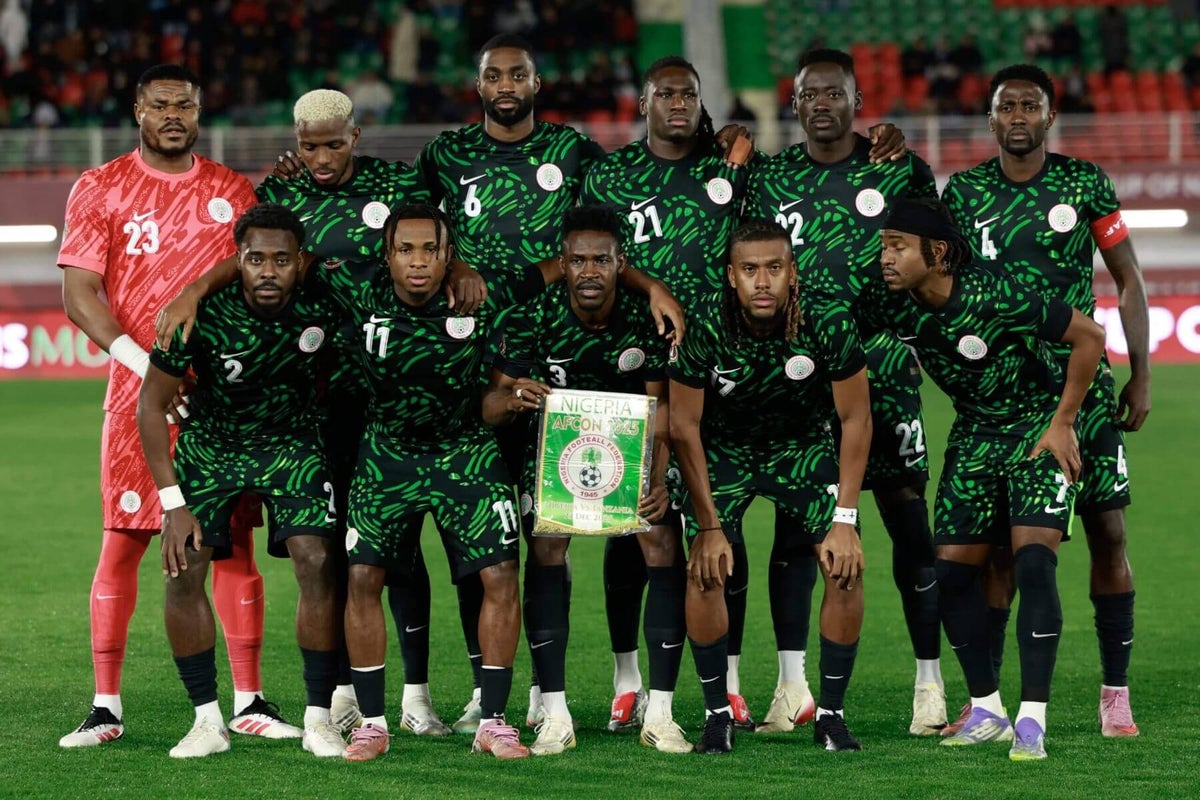
Every time Eberechi Eze represents England, a photo of him from nine years ago resurfaces on social media. The attacking midfielder’s dreadlocks are shorter than they are today, but his beaming smile is the same.
At first glance, there is nothing special about the image of Eze, who is standing next to Fulham’s then-Arsenal midfielder Alex Iwobi. But look closer and you will spot the badge of Nigeria’s Football Federation (NFF) on the polo shirts they are wearing.
sigh https://t.co/31Fv9ydTKX pic.twitter.com/rmOLkrcO88
— funsho (@nwoguuu) October 15, 2025
In March 2017, Eze was invited to a training camp at Barnet, a League Two (the fourth tier of English football) side in north-west London, organised by the NFF in an attempt to recruit players with dual English and Nigerian nationality. Ola Aina and Chuba Akpom were among the others who attended. At the time, Aina and Akpom were playing in the second-tier Championship on loan from parent clubs Chelsea and Arsenal. The pair had represented England across multiple youth age groups but never made a senior appearance.
Now at Nottingham Forest, full-back Aina has become a key figure for Nigeria — he started all seven of their games as they got to the final of the previous Africa Cup of Nations (AFCON) two years ago but missed out on this edition with a hamstring injury — while Akpom, at 30, is still waiting for an official senior call-up.
Iwobi, nephew of former Nigeria international Jay-Jay Okocha, played for England at under-16 and under-17 levels before switching allegiance. He made his Nigeria debut when still a teenager in 2015 and is now fourth on their all-time appearances list with 94 caps.
Eze was a slightly different case.
He was in Queens Park Rangers’ youth team when he attended that training camp but a successful loan spell with Wycombe Wanderers in the 2017-18 season kickstarted his career. In October 2018, he was called up by an England youth team for the first time, starting in a 2-1 victory for the under-20s over their Italy counterparts, and never looked back. He got his first senior cap in June 2023 and made three substitute appearances at the following year’s European Championship, helping England reach the final.
While Eze was flattered by Nigeria’s interest and considered playing for them, his preference was to represent England.
The NFF successfully pursued Aina, Iwobi and Ademola Lookman, a forward with Italy’s Atalanta who has arguably been the best player at the AFCON in Morocco, but Eze slipped out of their grasp.
He is not the only player with mixed heritage they have missed out on.
Eze’s Arsenal team-mates Bukayo Saka and Noni Madueke have Nigerian roots, too. Michael Olise of Bayern Munich, who plays for France but was also eligible for Algeria and England, was on the standby list for Nigeria’s AFCON qualifying-phase games in March 2021. Olise was only 19 and playing for Reading in the Championship at the time.
This is how Nigeria tap into their global diaspora — and the many challenges they face.
This issue is not unique to Nigeria.
Over a third of the players at AFCON 2023 were not born in Africa. For example, Algeria’s captain for that tournament, Riyad Mahrez, and Sebastien Haller, who scored Ivory Coast’s winning goal in the final, were raised in France.
Brahim Diaz, currently the top goalscorer at this AFCON, and Achraf Hakimi, the reigning men’s Confederation of Africa (CAF) Footballer of the Year, grew up in Spain but represent Morocco. The Royal Moroccan Football Federation (RMFF) has scouts in different countries monitoring players who are eligible for them from a young age, but Nigeria’s approach is more informal.
William Troost-Ekong was one of the first players with dual nationality to represent Nigeria. The defender was born in the Netherlands and grew up in London, spending time in Tottenham Hotspur’s academy. He played twice for the Netherlands’ under-20 team. Troost-Ekong was not on Nigeria’s radar until he spoke about potentially representing them in an interview with local media during a loan spell from Groningen to fellow Dutch side Dordrecht.
Troost-Ekong made 22 league appearances for Dordrecht in the 2014-15 season and, after his public comments, Nigeria’s then head coach Stephen Keshi watched them beat Ajax on the campaign’s final day. Keshi rang Troost-Ekong, who was 21, afterwards and invited him to be a part of their squad for fixtures against Chad and Tanzania. Troost-Ekong went on to succeed former Chelsea midfielder Mikel John Obi as captain in 2019 and earn 83 caps before retiring from international duty last month.
Though the now 32-year-old’s initial call-up was unconventional, as he points out, recruiting players from the Nigerian diaspora “was not an established pathway” in those days.
“When I was growing up, we didn’t have players like that,” Troost-Ekong, who was voted player of the tournament after Nigeria made the final of AFCON 2023, tells The Athletic. “People have seen what it means to represent Nigeria — you can look up to Alex Iwobi. Ademola Lookman is a boy from London who became the best player in Africa (the men’s CAF Footballer of the Year award in 2024). That is probably going to open a lot more doors, and if anything, is going to help Nigeria, because you want to have the best players, no matter where they are born, to come home and represent the nation.”
Troost-Ekong forged a strong bond with Aina, Iwobi, Lookman, Semi Ajayi and Calvin Bassey. The group all spent time in London during their childhood and are nicknamed the ‘Innit Boys’.
Gernot Rohr managed Nigeria for five years after being appointed in August 2016. Tunde Adelakun doubled up as Rohr’s assistant coach and chief scout. The pair, who now work together for Benin’s national team, played a key role in recruiting foreign-born players. It took them a long time to convince Lookman.
Nigeria first approached him shortly after he joined Everton from Charlton Athletic in January 2017. A few months later, he scored three goals for England at the Under-20 World Cup as they won the tournament. In September of the following year, England’s then senior manager Gareth Southgate insisted the forward was part of his plans.
Lookman’s career stuttered as he failed to settle in Germany after joining RB Leipzig in July 2019 and spent time back in England on loan with Fulham and Leicester City. He started the process of changing his nationality in 2021 but Rohr was sacked that December. FIFA, world football’s governing body, eventually approved Lookman’s request in February 2022 and he made his debut, along with the Italy-born Bassey — who had been called up previously by Rohr — as substitutes in the first leg of their World Cup play-off final against Ghana the following month.
“It changed my career and life,” Lookman said in an interview with Arise TV last June. “This is my home, this is my place, Nigeria. I am the son of the soil.”
Maduka Okoye, who was a surprise omission from the Nigeria squad for this AFCON, was approached by Rohr in 2019. Okoye grew up in Germany, where former Bayern Munich defender Rohr is from. He played for Fortuna Dusseldorf, and Rohr knew some of their senior figures. Rohr contacted the club directly to gauge Okoye’s interest in representing Nigeria. Okoye, now 26 and with Udinese in Italy, became their first-choice goalkeeper for AFCON 2022 but has only made two appearances since, due to the emergence of current first-choice Stanley Nwabali.
Amaju Pinnick was elected as the NFF’s president in September 2014 and served for eight years. He visited players with dual nationality, including Eze and Tammy Abraham, to hold talks about switching allegiance to Nigeria. In September 2017, then-England Under-21 international striker Abraham denied reports he had agreed to switch.
“I can confirm I met the president of the NFF after our last game against Tottenham at Wembley on Saturday, given he is a friend of my father,” Abraham said in quotes reported at the time by the Guardian newspaper in the UK. “However, any suggestion I have made a decision to change my international representation is incorrect and wide of the mark. I have informed the (English) FA that I remain available for selection for England.”
NFF closes up on @tammyabraham…https://t.co/2DnmSp3LNt #TammyAbraham #Nigeria #SuperEagles pic.twitter.com/YLMpW7FTSZ
— The NFF 🇳🇬 (@thenff) September 21, 2017
The relationship between Abraham’s father and Pinnick is important to highlight. The NFF will often approach a player’s parents first. This is due to cultural practices in Nigeria, and they hope the player’s family will then emphasise the importance of them honouring their heritage.
Abraham spent time in Chelsea’s academy, along with Aina and Fikayo Tomori. The trio remain close friends and if things had worked out differently, could have been playing together at this AFCON. Tomori was born in Canada but is also eligible for Nigeria. However, he never got approached by the NFF. “It’s not like I wouldn’t have played there, but they never called me,” the Milan defender told the Filthy Fellas podcast in November. “So I never had a choice to make.”
Abraham has been capped 11 times by England’s senior side but has not been in the squad since June 2022. Tomori was part of that victorious Under-20 World Cup side with Lookman and went on to make five appearances under Southgate, but he has not been called up since Thomas Tuchel started as head coach a year ago.
FIFA only allows players to switch nationalities if they have never represented another country at senior level, as was the case with Lookman, or if they earned fewer than three caps before they turned 21 and none of those appearances came at a major tournament. Real Madrid’s Diaz took advantage of this rule to represent Morocco after making one appearance for Spain, in a friendly against Lithuania in June 2021.
There are some signs of progress in the way Nigeria are now operating.
Ryan Alebiosu made his debut in their final AFCON group game against Uganda just over a week ago. The 24-year-old, a defender with Blackburn Rovers of the Championship who featured in The Radar on The Athletic, was born in London.
Nigeria were monitoring Alebiosu before he moved to Blackburn in July after he spent the second half of last season with St Mirren in Scotland, on loan from Belgian side Kortrijk. Head coach Eric Chelle contacted the full-back for the first time in August and offered words of encouragement. Injuries to fellow defenders Aina and Benjamin Fredrick opened the door for Alebiosu, who made a strong impression on the coaching staff in starting all of Blackburn’s league games this season before leaving for AFCON duty in mid-December.
One issue that threatens to hold Nigeria back.
Multiple sources The Athletic spoke to for this article, who asked to remain anonymous to protect relationships, have suggested that some players are reluctant to represent them because of repeated off-field issues and a lack of professionalism. In November, the squad boycotted training before a World Cup play-off semi-final against Gabon due to a financial dispute with the NFF. The Athletic reported that the players and backroom staff had not been paid for previous performances and were frustrated as they felt the federation and national government had broken promises.
Only on Wednesday, local media reported that Nigeria’s squad and staff were owed bonuses for their first four games at this AFCON. Twenty-four hours later, the country’s minister of state finance, Dr Doris Uzoka-Anite, said the issue was close to being resolved, with delays caused by “foreign-exchange processing”. Dr Uzoka-Anite added: “Going forward, the process will be fully streamlined to ensure faster, more predictable disbursements aligned with international best practice.” It was an unnecessary distraction before their quarter-final today (Saturday) against Algeria.
One source close to the dressing room — speaking before this week’s developments and doing so anonymously to protect relationships — said some senior players can return from international duty feeling emotionally and mentally drained by the drama.
There is another important factor to consider — nobody in the AFCON squad plays for a Nigerian top-flight club.
“Nigeria have to bring in foreign-born players because their league is not producing enough talent,” Calister Enejele, a Nigerian journalist covering the ongoing tournament in Morocco, tells The Athletic.
“Most of South Africa’s squad are playing in their domestic league. They have one of the best leagues in Africa, along with Morocco, Algeria and Tunisia. The Nigerian league is bad, and needs more investment. If the league is better, more players (from its clubs) will go into the national team. It’s a big issue for the federation.”
Prominent academies in the country are owned and run by individuals instead of clubs. Fredrick, who is on loan to Belgian club Dender from Brentford of the Premier League, started his career at the Simoiben academy, which is run by his international team-mate Moses Simon. Victor Osimhen, Nigeria’s second-highest all-time goalscorer behind Rashidi Yekini, was playing for the Ultimate Strikers academy when he starred as Nigeria won the Under-17 World Cup in 2015, leading to a move to German club Wolfsburg.
“Beyond Limits is another private academy, and the co-owner (Kunle Soname) runs Remo Stars (who won the Nigerian league title for the first time in 2024-25),” adds Enejele. “They sell their best players and the money is invested back into the infrastructure, coaching and scouting staff. They are a good example of what we should be doing.
“But selecting foreign-born players brings them closer to the culture, our traditions and helps us to connect with them more. It has been positive. The problem is when you depend on them to always come and help you.”