In a country where jewellery is not just an adornment or investment but also a sacred offering to deities, it is bewildering that there isn’t enough literature documenting its social and design history.
The few books available on Indian jewellery restrict themselves to the opulence of royal courts and the gem-studded jewels of their residents or focus on a specific region or design style such as meenakari (enamel work). That’s something Silver & Gold: Visions of Arcadia (Mapin Publishing), a new book by jewellery historian Usha R. Balakrishnan in association with Amrapali Museum, has tried to move away from.
The coffee-table book draws from the archives of Rajiv Arora and Rajesh Ajmera, two friends who founded Jaipur-based jewellery house Amrapali in 1978, to offer a view of the jewels belonging to tribal and pastoral communities across India. It begins with an anecdote: In May 1980, a barefoot couple walked into the Jaipur office of Amrapali and sold a bag containing traditional hair ornaments, earrings, necklaces and toe rings. There’s no mention of what the couple was paid but that incident encouraged the two founders to start a passion project: travelling across the world to collect ancient and traditional jewellery.
About 200 of the 1,000-plus pieces collected over 40 years, dating from the 1st century to the 20th century, find mention in Silver & Gold.
A photograph in the early pages offers one of the book’s key takeaways—that jewellery design in India has a near unbroken tradition. The photograph of an ivory plaque from the ancient city of Begram (Afghanistan) shows carved figures of bejewelled men and women “generally thought to originate either from north-central or southern India”. The beaded necklaces and disc-like earrings are familiar—they remain part of the contemporary jewellery vocabulary, visible everywhere from stores in malls to kiosks in Delhi’s Janpath and Mumbai’s Colaba. It’s a continuity of design that can be seen in the 19th century semi-circular enamelled silver earrings from Chamba, Himachal Pradesh, which hold an uncanny resemblance to the earrings on a 9th-century sandstone sculpture of Rahu in Mathura, Uttar Pradesh.
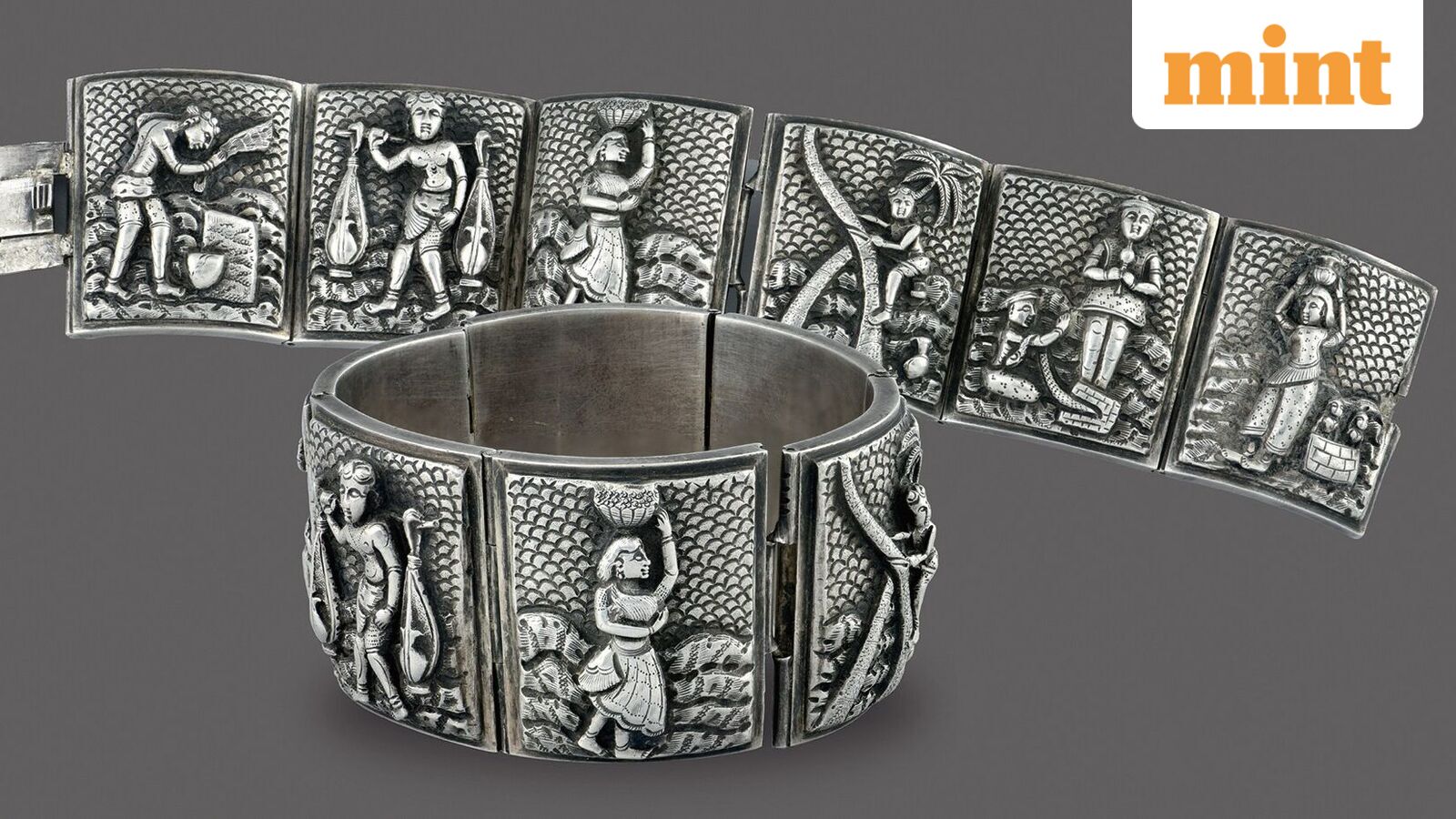
Whether it’s Assam’s nothengpi (ear plug) that looks like a curvaceous lampshade, or a silver bracelet showcasing different professions of 19th century Tamil Nadu, each piece in the book reiterates that jewellery was never just a display of wealth. It also functioned as a visual representation of traditional thoughts and beliefs, like cowrie shells being a symbol of fertility, and an amulet featuring the sun, moon and a cobra as a protection against the evil eye.
Many of the craft forms in the book are now endangered, some extinct. Little has been documented and much has been lost, “with oral transmission coming to a standstill” as the communities adjusted to modern life, states the book. Some traditions do to live. An example is the ayigalu or Shivadhara Lingam casket of Karnataka’s Lingayat community that worships Shiva. The ayigalu is pendant designed as an egg-shaped casket to hold a tiny lingam. “What lies hidden inside the hollow casket transforms the jewel to art. Inside the casket, there is a lingam, a solid ovoid stone, a representation of Shiva. The lingam is ceremonially given to a Lingayat child in an initiation ceremony,” the book explains.
“You don’t see this kind of variety in design in any other kind of jewellery,” Balakrishnan, who travelled across villages for five years to understand the significance of different kinds of folk jewellery, tells Lounge. “Beads, ivory, glass, betel wings, wood… they experimented with silver and other materials because they couldn’t afford gems,” she says. “They had to scale in terms of design, and that required exceptional talent. There was also a lot of exchange of ideas. For example, there is commonality in the form of amulets and bangles in India, Oman and Ethiopia from the 15th-16th centuries. One thing that was portable at the time was jewellery, which could be easily turned into liquid for cash. We were connected even before social media.”
Silver & Gold is a beautiful book in terms of visuals and text to interest even non-jewellery enthusiasts. What would have made the book better is more information about each piece, which could be missing since there’s a lack of documentation. It is self-appreciative book too, as it focuses solely on the Amrapali Museum collection. But the inward gaze works considering many jewellery collections in homes, museums and temples remain inaccessible. A nose ornament that tells your marital status, a chandelier-like chain for a horse, or a necklace that functions as a portable shrine is not just a vestige of the past. They are part of India’s material history, one that familiarises us with the vibrant tradition of jewellery that’s fast vanishing.