
South Africa’s matric pass rate has increased by more than 10 percentage points since the introduction of the National Senior Certificate system in 2014.
With the Minister of Basic Education set to release the 2025 matric results on 12 January 2026, experts are optimistic that the class will either equal or surpass 2024’s record high outcome.
The class of 2024 achieved a pass rate of 87.3%, the highest in South Africa’s democratic history. However, some opposition parties argue that the rate is much lower.
When South Africa introduced the Curriculum and Assessment Policy Statements (CAPS) system to replace the earlier Outcomes-Based Education (OBE) system, new minimum pass requirements were also implemented.
The OBE system had no set average required to be promoted beyond a grade, with learners often assessed on their progression in a subject rather than whether they had passed on paper.
While 40% was considered enough to pass, learners often also passed with less in a subject, making the exact requirements quite vague.
Although it also did not set out a strict minimum pass requirement, the CAPS system further clarified what learners needed to progress to the next grade.
CAPS was implemented over three years, with its introduction to Grades R, 1, 2, 3, and 10 in 2012, Grades 4, 5, 6, and 11 in 2013, and Grades 7, 8, 9, and 12 in 2014.
In the CAPS system, the minimum requirement to pass varies by subject, as students must achieve a minimum of 40% in their Home Language, 40% in two other subjects, and at least 30% in their remaining subjects.
Based on this, an overall average of 30% to 39% across all a learner’s subjects is still likely to result in their failing the grade.
While CAPS brought clarity to assessment standards and specified knowledge, its critics argue that is very administration, content, and assessment heavy.
According to the University of Cape Town’s Prof Joanne Hardman, South Africa has thrown the baby out with the bathwater with the implementation of CAPS.
“Viewing curriculum change in South Africa through a dialectical lens, we must appreciate that CAPS has produced a contradiction in the object of the activity of schooling: curriculum coverage versus understanding,” she says.
“We have children who are over-assessed, and, in some instances at least, this has led to teachers teaching to the test rather than developing students’ understanding of concepts.”
Up 10 percentage points
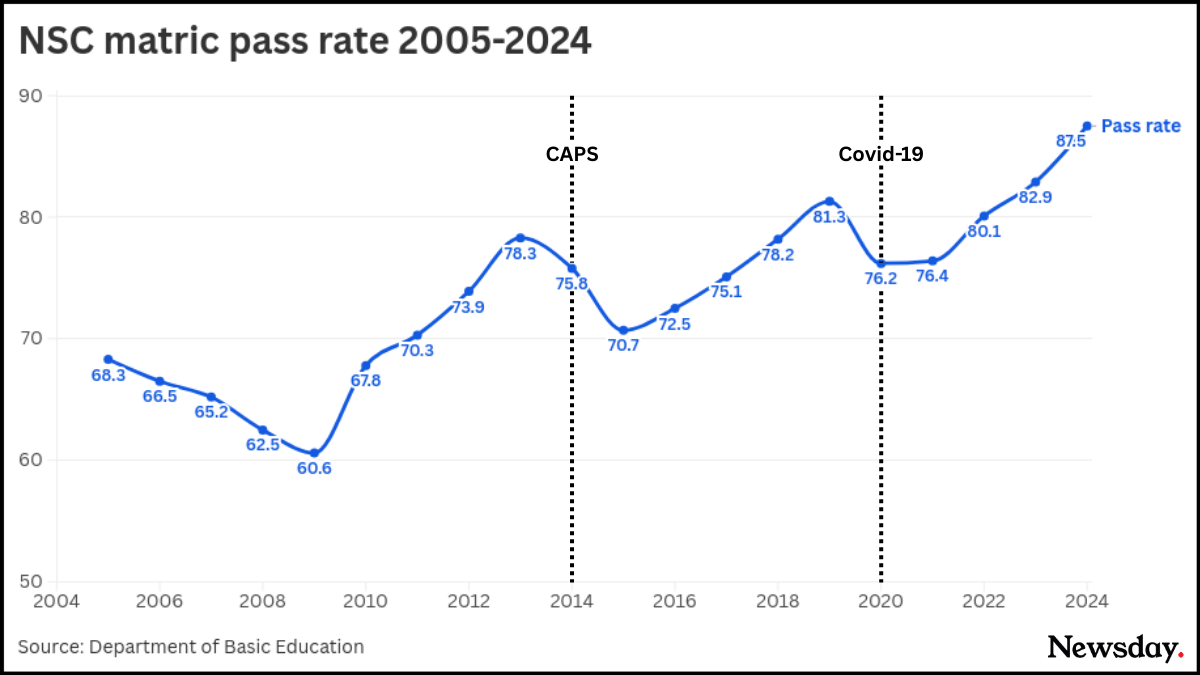
South Africa’s matric pass rate stood at 75.8% in the year that CAPS was implemented for Grade 12 students, which has steadily increased over the past decade.
In 2015, the pass rate dropped to its lowest level over the next decade, at 70.7%. However, it managed to consistently climb over the following years, surpassing the 80% mark (81.3%) for the first time since 1995.
This fell by over five percentage points in 2020 following the onset of the Covid-19 pandemic.
Similar to a few years prior, this plunge saw Grade 12 learners bounce back to achieve a record high in 2024, eventually reaching 87.5%.
The major pass mark debate
 Mmusi Maimane, BOSA leader and MP
Build One South Africa (BOSA) leader and Member of Parliament, Mmusi Maimane, tabled a motion in Parliament to raise the matric pass mark from 30% to 50% in December 2025.
Maimane argued that the low pass mark perpetuates inequality in South Africa. He said that quintile four and five schools, and private schools, deem it unacceptable that a child would pass with as low as 30%.
Meanwhile, children who cannot afford these schools and attend quintile one, two, and three schools, with fewer resources, pass at 30%.
“We are creating a divided society, with different standards of education for the wealthy and the poor,” he said.
“Once a child has passed with 30%, what work are you preparing them for? Other than for menial jobs, if they find a job at all.”
However the two largest parties in Parliament were among the numerous to have opposed Maimane’s motion, and it was ultimately rejected.
The main argument put forward by the ANC, the DA, and the Freedom Front Plus (FF+) was that the 30% overall pass mark is not factually correct.
Minister of Basic Education and DA member Siviwe Gwarube said that “there is no such thing as a 30% overall pass mark”.
Gwarube stated that learners must meet a three-tiered set of subject requirements, noting that out of the 724,000 learners who wrote the NSC exams in 2024, only 189 achieved the minimum standards, rather than attaining a bachelor’s pass.
You have read 1 out of 5 free articles. Log in or register for unlimited access.